

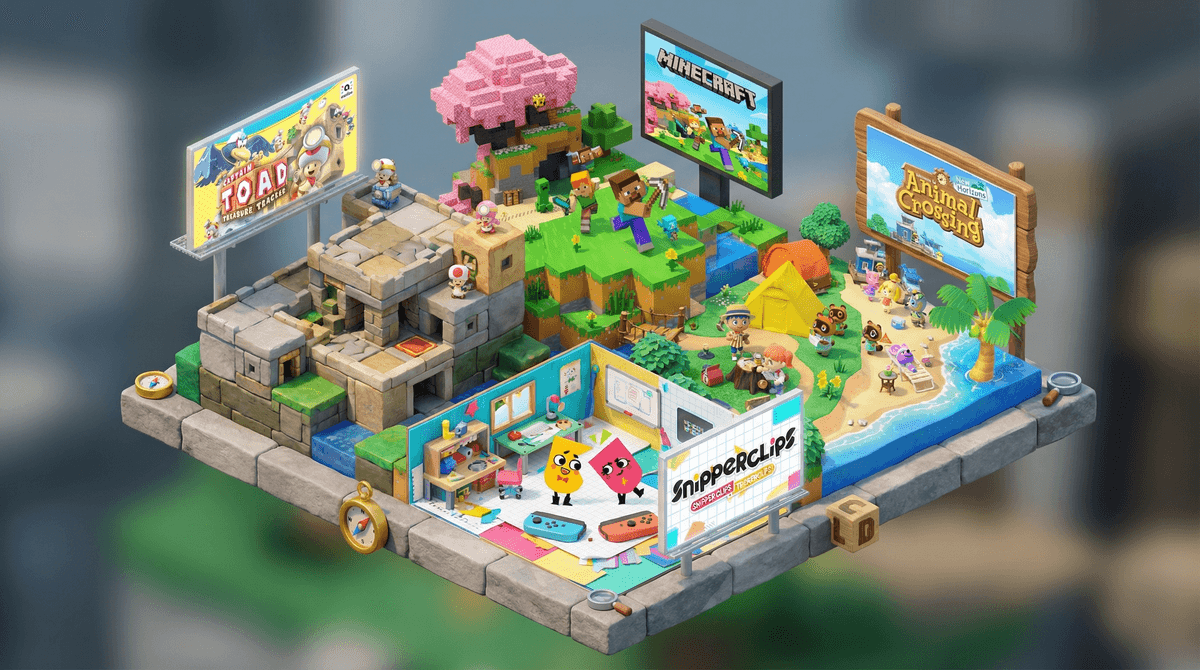
The Best First Video Games for Ages 5-8: Games That Build Planning, Spatial Reasoning, and Problem-Solving
So you're thinking about introducing video games to your young kid. Maybe they've been begging to play what their older sibling or cousin is into, or maybe you're just wondering if there's something more constructive than endless YouTube Kids videos. Either way, you're in good company—about 55% of families with elementary-aged kids report that their children play video games.
The good news? Not all games are created equal, and some genuinely do help develop important cognitive skills. The key is finding games that challenge without frustrating, teach without feeling like homework, and build genuine problem-solving abilities while still being fun enough that kids actually want to play them.
Screenwise Parents
See allWhen looking for first video games for the 5-8 age range, you want games that:
- Have clear goals and intuitive controls
- Allow for trial and error without harsh penalties
- Build progressively in difficulty
- Encourage planning ahead and thinking through consequences
- Don't require reading fluency (or have excellent voice acting)
Spatial reasoning (understanding how objects relate to each other in space) is foundational for everything from math to reading maps to packing a suitcase. Planning and problem-solving are executive function skills that help kids in school, friendships, and basically every aspect of life.
The beautiful thing about video games is they can provide a low-stakes environment to practice these skills. Failed to plan ahead? Your character falls in the pit. Didn't think through the spatial puzzle? Try again. There's immediate feedback, and unlike real life, you can always restart.
Minecraft (Ages 6+)
Yes, I'm starting with the obvious one, but hear me out. Minecraft in Creative Mode is genuinely brilliant for this age group. Kids can build without threat of monsters, experiment with spatial design, and plan increasingly complex structures. The game naturally teaches:
- Spatial reasoning: Understanding 3D space and how blocks fit together
- Planning: Designing structures before building them
- Problem-solving: Figuring out how to bring their vision to life
Parent tip: Start in Creative Mode, not Survival. Skip the multiplayer servers until they're older and you understand the safety settings.
LEGO Video Games (Ages 5+)
The LEGO game series—whether it's LEGO Star Wars, LEGO Harry Potter, or LEGO Marvel—are perfect first games. They're forgiving (you can't really "die"), have excellent co-op modes for playing together, and require kids to solve environmental puzzles. Plus, the humor is genuinely funny for both kids and adults.
These games build:
- Problem-solving: Figuring out which character's abilities solve which puzzle
- Planning: Strategizing how to collect all the studs and unlock secrets
- Spatial reasoning: Navigating 3D environments and understanding perspective
Captain Toad: Treasure Tracker (Ages 5+)
This Nintendo Switch gem is basically a spatial reasoning masterclass disguised as a cute puzzle game. Each level is a small diorama that players rotate to find hidden paths and treasures. It's non-violent, has no time pressure, and perfectly teaches kids to look at problems from multiple angles—literally.
Snipperclips (Ages 6+)
Another Switch exclusive, this cooperative puzzle game requires players to cut each other into different shapes to solve challenges. It's brilliant for:
- Spatial reasoning: Visualizing how shapes fit together
- Planning: Thinking through the sequence of cuts needed
- Communication: If playing co-op, kids learn to explain their thinking
Kirby and the Forgotten Land (Ages 5+)
The Kirby series is notoriously forgiving, making it perfect for first-time gamers. This 3D adventure has straightforward goals, clear visual cues, and gentle difficulty progression. Kids learn basic platforming skills while exploring colorful environments and solving simple puzzles.
Animal Crossing: New Horizons (Ages 6+)
While not a traditional puzzle game, Animal Crossing teaches planning and resource management in the gentlest way possible. Kids learn to:
- Plan their island layout (spatial reasoning)
- Manage resources and save for goals (planning)
- Organize their home and inventory (problem-solving)
Bonus: It runs on real-world time, which naturally limits play sessions.
Portal 2 (Ages 8+, with caveats)
Okay, this one's for the older end of this range and mature