

The Best Books 5th Graders Must Read in 2026
Fifth grade is that sweet spot where kids are ready for meatier stories but still need books that hook them fast. Here are the must-reads that actually work:
Classic Must-Haves:
For Kids Ready for More:
Contemporary Favorites:
Fifth grade reading is tricky territory. Your kid has moved past Dog Man and Diary of a Wimpy Kid, but they're not quite ready for full-on YA dystopian angst. They need books that treat them like the almost-middle-schoolers they are, without drowning them in content they're not ready for.
The good news? There's a solid canon of fifth-grade books that have earned their place for a reason. These aren't just teacher-approved classics gathering dust—they're books that kids actually finish, talk about, and sometimes even re-read.
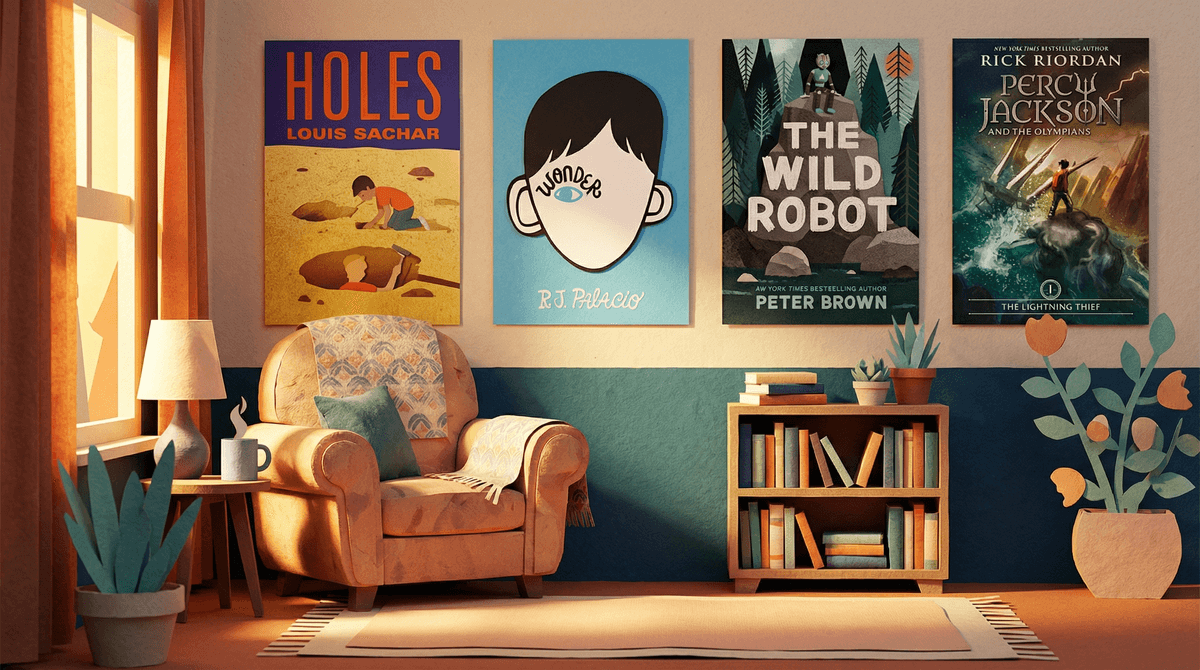
This is the book that proves school-assigned reading doesn't have to be torture. The plot weaves together a modern-day juvenile detention camp, a Wild West love story, and a family curse in a way that somehow makes perfect sense. Kids who claim they hate reading will get sucked into Stanley Yelnats' story (yes, his name is a palindrome, and yes, that matters).
Why it works: The chapters are short, the mystery builds perfectly, and there's actual payoff. Plus, digging holes in the desert as punishment is just the right amount of absurd to keep fifth graders engaged.
Content note: There's some mild violence and the setting is a detention camp, but nothing graphic. The themes of justice, friendship, and perseverance are solid without being preachy.
This book has become the empathy curriculum for upper elementary, and for good reason. Auggie Pullman has facial differences and is starting school for the first time in fifth grade. The story is told from multiple perspectives, which helps kids see how the same events look different depending on who's experiencing them.
Why it works: The multiple narrators keep it fresh, and kids this age are starting to really grapple with social dynamics and what it means to be kind versus just nice. Fair warning: this one makes kids (and parents) cry.
Content note: Bullying is a major theme, handled realistically but not gratuitously. Good conversation starter about how to handle social cruelty .
.
If your kid hasn't discovered Percy yet, fifth grade is prime time. A 12-year-old with ADHD and dyslexia discovers he's a demigod and heads to Camp Half-Blood. The series makes Greek mythology accessible and exciting, and there's enough action to keep even reluctant readers turning pages.
Why it works: Percy's voice is genuinely funny, the mythology is woven in naturally, and kids with learning differences see themselves as heroes. The entire series is solid, so if they like the first one, you've got four more books ready to go.
Content note: Fantasy violence (monster fighting), but nothing too intense. Some peril and scary moments, but handled at an appropriate level for this age.
This is often the first dystopian novel kids encounter, and it's a gentle entry point into "what if" societal criticism. Jonas lives in a seemingly perfect community where everything is controlled—no pain, no color, no real choice. When he's selected to be the Receiver of Memory, he learns what his society has sacrificed for "perfection."
Why it works: It's short (under 200 pages), the concept is mind-bending enough to spark great discussions, and it introduces big ideas without overwhelming kids. Many fifth graders read this as a class, which helps with comprehension.
Content note: Some mature themes (euthanasia, though not graphic), and the ending is deliberately ambiguous, which frustrates some kids but makes for great discussion. Best for more mature fifth graders or as a spring read.
Thirteen-year-old Brian survives a plane crash and has to figure out how to stay alive in the Canadian wilderness with nothing but a hatchet. This is a survival story that doesn't pull punches—Brian makes mistakes, gets injured, and has to solve real problems.
Why it works: The survival details are specific enough to feel educational, the pacing is tight, and there's something deeply satisfying about watching Brian figure things out. Great for kids who like Minecraft or survival games.
Content note: Some intense moments (the plane crash, animal attacks, injuries), but handled in a way that's appropriate for this age. Good for kids ready for more realistic fiction.
Roz is a robot who washes up on an island and has to learn to survive among the animals. This book is stunning—both in the story and the illustrations. It's about adaptation, belonging, and what it means to be alive.
Why it works: The illustrations break up the text nicely for kids who are still building stamina, the themes are rich without being heavy, and there's genuine humor alongside the deeper questions. The sequels (The Wild Robot Escapes and The Wild Robot Protects) are equally strong.
Content note: Some predator/prey dynamics (it's set in nature), but handled thoughtfully. Themes of environmental protection and what makes a family.
Three kids, three time periods, three refugee experiences: a Jewish boy fleeing Nazi Germany in 1939, a Cuban girl escaping to Miami in 1994, and a Syrian boy in 2015. The stories weave together in unexpected ways.
Why it works: The short chapters alternate between the three stories, keeping the pace quick. It makes history personal and connects past to present in ways that click for kids. Alan Gratz is a master at historical fiction that doesn't feel like homework.
Content note: War, violence, and refugee trauma are central themes. Nothing graphic, but these are real historical events with real stakes. Best for mature fifth graders or as a family read where you can discuss together.
Yes, everyone knows about Harry Potter, but fifth grade is often when kids are finally ready to tackle the full series. The first few books are appropriate for younger readers, but the series grows darker, making fifth grade a good entry point where they can read through the whole arc.
Why it works: The world-building is unmatched, the characters grow with the reader, and there's something magical (sorry) about being fully immersed in a series. Fair warning: once they start, they'll want to binge the whole thing.
Content note: The series gets progressively darker. Books 1-3 are fine for most fifth graders, but 4-7 deal with death, torture, and war. Consider reading ahead or checking out a guide to the series to time it right for your kid.
Sophie discovers she's an elf and is whisked away to a hidden world. This series has become the go-to for kids who loved Harry Potter and want something similar but fresh. The world-building is intricate, the friendships are central, and there are currently 9+ books in the series.
Why it works: The protagonist is a girl (representation matters), the magic system is detailed and interesting, and the books are chunky enough that kids feel accomplished finishing them. Great for strong readers who want to dive deep into a world.
Content note: Fantasy violence, some scary moments, and increasingly complex plots as the series progresses. Generally appropriate for fifth grade and up.
For kids who love graphic novels: New Kid by Jerry Craft bridges the gap between graphic novels and traditional chapter books. It's about a Black kid navigating a predominantly white private school, dealing with microaggressions and identity in ways that are both funny and real.
For kids into sports: Ghost by Jason Reynolds is the first in a series about a kid with a troubled past who discovers he's fast—really fast. The running is central, but it's really about processing trauma and finding your people.
For kids who love animals: Pax by Sara Pennypacker tells the story of a boy and his pet fox, separated by war. Alternating chapters show both perspectives. It's beautiful and heartbreaking in the best way.
For kids ready for historical fiction: Number the Stars by Lois Lowry is a classic about a Danish girl helping her Jewish friend escape the Nazis. It's less intense than some Holocaust literature but still powerful.
For kids who love mystery: From the Mixed-Up Files of Mrs. Basil E. Frankweiler by E.L. Konigsburg is about two kids who run away to live in the Metropolitan Museum of Art and solve an art mystery. It's clever, fun, and has stood the test of time since 1967.
Here's the thing about fifth grade: the reading level range in any given classroom is massive. Some kids are ready for The Hunger Games (though I'd argue most should wait until sixth), while others are still working through Wings of Fire.
Reading level matters less than engagement. A kid reading slightly "below level" books that they actually finish and enjoy is building more reading skills than a kid struggling through "appropriate level" books they hate.
That said, fifth grade is when reading stamina really develops. Most of these books are in the 200-300 page range, with some shorter (The Giver at 179 pages) and some longer (Harry Potter books grow from 309 to 870 pages across the series).
Let's address this: audiobooks count as reading. Full stop. If your kid is "reading" Percy Jackson on audio while building in Minecraft, they're still experiencing the story, building vocabulary, and developing comprehension skills.
Audiobooks are particularly great for:
- Kids with dyslexia or other reading challenges
- Long car rides or quiet time
- Experiencing books together as a family
- Getting through longer books that might feel daunting in print
Many kids do well with a combo approach: audiobook for the first few chapters to get hooked, then switching to print. Or following along in the physical book while listening. There's no one right way.
You don't need to own all these books. Libraries exist for a reason, and fifth graders can absolutely manage checking out and returning books (with reminders... lots of reminders).
That said, some books are worth owning:
- Books they want to re-read (yes, some kids do this)
- Books that generate discussion (having Wonder on the shelf means you can reference it later)
- Series they're actively reading through
- Books that feel special to them
Used bookstores, library sales, and hand-me-downs from older kids are your friends here. A well-loved, dog-eared copy of Holes is worth more than a pristine one that never gets opened.
The irony of writing about books on a digital wellness platform isn't lost on me. But here's the reality: kids who spend all their time on Roblox, YouTube, or TikTok often struggle to build the sustained attention needed for chapter books.
This doesn't mean screens are evil or books are superior—it means different media develop different skills. Fifth grade is a critical year for building reading stamina before middle school hits. Some strategies that work:
- Reading before screen time: 20-30 minutes of reading earns screen time
- Audiobooks during screen time: listening to a book while playing a chill game like Stardew Valley
- Family reading time: everyone (yes, including parents) reads for 20 minutes after dinner
- Bedtime reading: the classic for a reason—it's calming and builds a habit
The goal isn't to eliminate screens; it's to make sure reading has a protected place in the routine.
"I hate reading" usually means one of these things:
- "I haven't found the right book yet"
- "Reading feels like work because I'm not a strong reader"
- "I'd rather be doing something else and I'm being forced to read"
For #1: Keep trying different genres, formats, and topics. Graphic novels, choose-your-own-adventure books, books about video games—cast a wide net.
For #2: Audiobooks, books slightly below their reading level, and series with shorter chapters can help build confidence. Also, get their eyes checked. Seriously.
For #3: Lower the pressure. "Read for 10 minutes" is less daunting than "read a chapter." Let them read in bed, in a fort, outside—wherever they're comfortable.
Fifth grade reading is about building bridges—from early chapter books to middle grade novels, from reading because you have to to reading because you want to. These books have earned their place on must-read lists because they work: they engage kids, introduce big ideas at an appropriate level, and build reading skills without feeling like homework.
Start with the classics (Holes, Wonder, Percy Jackson), add in contemporary favorites (The Wild Robot, Refugee), and let your kid's interests guide you from there.
And remember: a kid reading anything is better than a kid reading nothing. If they're devouring Captain Underpants for the fifth time instead of tackling The Giver, that's okay. Reading should be a joy, not a chore.
Next Steps:
- Check what your kid's class is reading and get ahead of it
- Hit the library and let them choose 3-5 books to try
- Consider starting a family read-aloud with one of these titles
- Explore more book recommendations by age and interest