

TL;DR: The Quick Cheat Sheet AI is no longer a futuristic concept; it’s the engine behind your kid’s TikTok feed, their Snapchat My AI "friend," and the reason they’re asking if they still need to learn how to write an essay. To be a critical consumer, they need to move from "users" to "interrogators."
Top Resources to Start the Conversation:
- Watch: The Mitchells vs. the Machines — A frantic, hilarious, and surprisingly deep look at what happens when we let tech run the show.
- Play: Quick, Draw! — A simple Google experiment that shows how neural networks "learn" through patterns.
- Try: ChatGPT — Use it with them to see where it gets things hilariously (and dangerously) wrong.
- Read: The Wild Robot — A great entry point for younger kids to talk about the line between programming and "soul."
Get an AI safety plan for your family
We’ve all seen the video of the cat playing a piano while skydiving, or the "leaked" trailer for a live-action Harry Potter movie that looks suspiciously like a Wes Anderson film. Ten years ago, we taught kids not to believe everything they read on the internet. Today, we have to teach them not to believe everything they see or hear either.
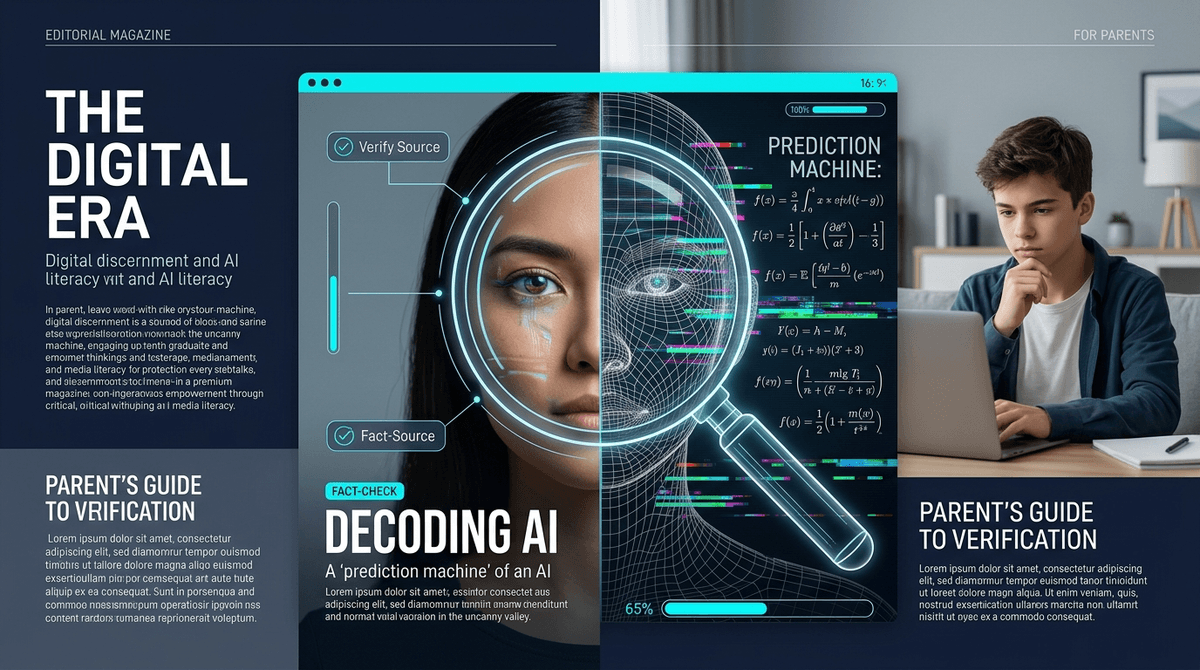
AI literacy isn't about teaching your kid how to prompt Midjourney to make "Skibidi Toilet but in the style of Van Gogh" (though that’s a fun Saturday afternoon). It’s about helping them understand that AI is a prediction machine, not a truth machine.
When a kid uses Google Search and sees an AI-generated summary, or asks Siri a question, they often assume the answer is coming from a digital god that knows everything. In reality, it’s coming from a complex math equation that is just guessing the next most likely word in a sentence.
In the AI world, a "hallucination" is when the system confidently tells you a total lie. If you ask ChatGPT to write a biography of a local person who doesn't exist, it will often invent a college degree, a career, and a list of awards for them without blinking an eye.
Kids need to know that AI is a confident liar.
One of the best ways to teach this is through a "Fact-Check Challenge." Have your kid ask an AI to write a summary of their favorite book—let’s say Wings of Fire—and then have them hunt for the errors. Did it get the dragon tribes right? Did it invent a plot point that never happened? This shifts the AI from a "shortcut for homework" to a "flawed tool that needs a human supervisor."
Check out our guide on how to talk to kids about AI and homework
We are officially in the era where "seeing is believing" is dead. Between voice cloning and photorealistic image generation, kids are being flooded with content that looks real but isn't.
If your middle schooler is on YouTube or Instagram, they’ve definitely seen AI-generated "covers" of songs or fake celebrity endorsements. The danger isn't just the big political stuff; it’s the "peer-level" deepfakes—using AI to make it look like a classmate said something they didn't.
How to teach a "Vibe Check":
- Look for the "Uncanny Valley": AI still struggles with hands, teeth, and reflections. If the fingers look like sausages or the earrings don't match, it’s a red flag.
- Verify the Source: Did this video come from the official MrBeast YouTube channel, or a random account with 12 followers?
- Cross-Reference: If something seems too weird to be true (like a "new" Minecraft update that lets you play as a sentient taco), check official sites or Common Sense Media.
If you want to bake these lessons in without it feeling like a lecture, use media that already deals with these themes.
This movie is a masterpiece of digital-age storytelling. It captures the chaos of a family trying to disconnect while the "smart home" AI (voiced by Olivia Colman, who is delightfully menacing) decides humans are obsolete. It’s the perfect jumping-off point to talk about how much power we give to algorithms.
For older kids (13+), this is a must-watch. It explains how AI isn't neutral—it’s trained by humans, which means it inherits human biases. If an AI is trained on data that is mostly white and male, it’s going to have a hard time "seeing" everyone else. It’s a great lesson in why we can’t just "trust the math."
The best way to understand an algorithm is to build one. Scratch isn't "AI" in the modern sense, but it teaches the "if this, then that" logic that powers everything. When kids see how hard it is to make a sprite move correctly, they start to understand that computers only do what they are told.
For the parents (or very precocious teens), this book by Hannah Fry is the best "No-BS" guide to how algorithms actually run our lives—from healthcare to the justice system. It’s readable, funny, and deeply eye-opening.
Elementary School (Ages 5-10)
- The Concept: Computers are like very fast, very literal puppies. They don't "know" things; they just follow patterns.
- The Action: Use Quick, Draw! together. Talk about how the computer "guessed" you were drawing a circle because it saw a million other circles.
- The Boundary: AI should be a toy, not a source of information. If they have a question about the world, use a book or a trusted website.
Middle School (Ages 11-13)
- The Concept: The "Algorithm" is trying to keep you watching. It doesn't care if the video is true; it only cares if you click.
- The Action: Look at their YouTube "Recommended" feed together. Ask, "Why do you think the computer showed you this? Is it because it's good, or because it's 'rage-bait'?"
- The Boundary: No using AI for school assignments without explicit permission. Talk about why the process of writing matters more than the result.
High School (Ages 14-18)
- The Concept: AI is a tool, like a calculator, but for language and images. You have to be the editor-in-chief.
- The Action: Experiment with Midjourney or DALL-E. Discuss the ethics of AI art—is it "stealing" from real artists?
- The Boundary: Absolute clarity on deepfakes and consent. Using AI to manipulate someone’s image is a massive red line.
Parents need to know that most AI models are "trained" on the data you give them. If your kid is having long, soul-searching conversations with Snapchat My AI, that data is being stored and used.
- Rule #1: Never give an AI your full name, address, school, or secrets.
- Rule #2: Assume everything you type into a prompt is public.
- Rule #3: Check the settings. Most apps, like ChatGPT, allow you to turn off "training" so your data isn't used to teach the model.
There’s a lot of talk about "brain rot" content—low-effort, AI-generated videos designed to hijack a kid’s dopamine system. You’ll see them on YouTube Shorts or TikTok: weirdly smooth animations, robotic voices, and nonsensical plots involving Roblox characters.
This stuff isn't "evil," but it is the digital equivalent of eating a bag of sugar for dinner. It requires zero critical thinking. The antidote? Active consumption.
When your kid is watching something, ask them: "How was this made? Do you think a person wrote this script, or a computer?" Turning them from a passive viewer into a "media critic" is the best defense we have.
AI isn't a monster under the bed, but it’s not a magic wand either. It’s a powerful, biased, occasionally brilliant, and often stupid tool.
Our job isn't to shield our kids from it—that’s impossible. Our job is to make sure that when they see something online, their first instinct isn't "Wow!" but rather "Wait, is that real?"
If you can teach them to pause, verify, and think about the intent behind the content, you’ve already won 90% of the battle.
- Do an AI Audit: Check which apps on your kid's phone have built-in AI (hint: it's almost all of them now).
- Have a "Prompt-Off": Sit down with ChatGPT and see who can get it to give the most ridiculous hallucination.
- Set the Standard: Be honest about when you use AI. If you used it to draft an email or find a recipe, tell them. Show them how you checked the results for mistakes.