

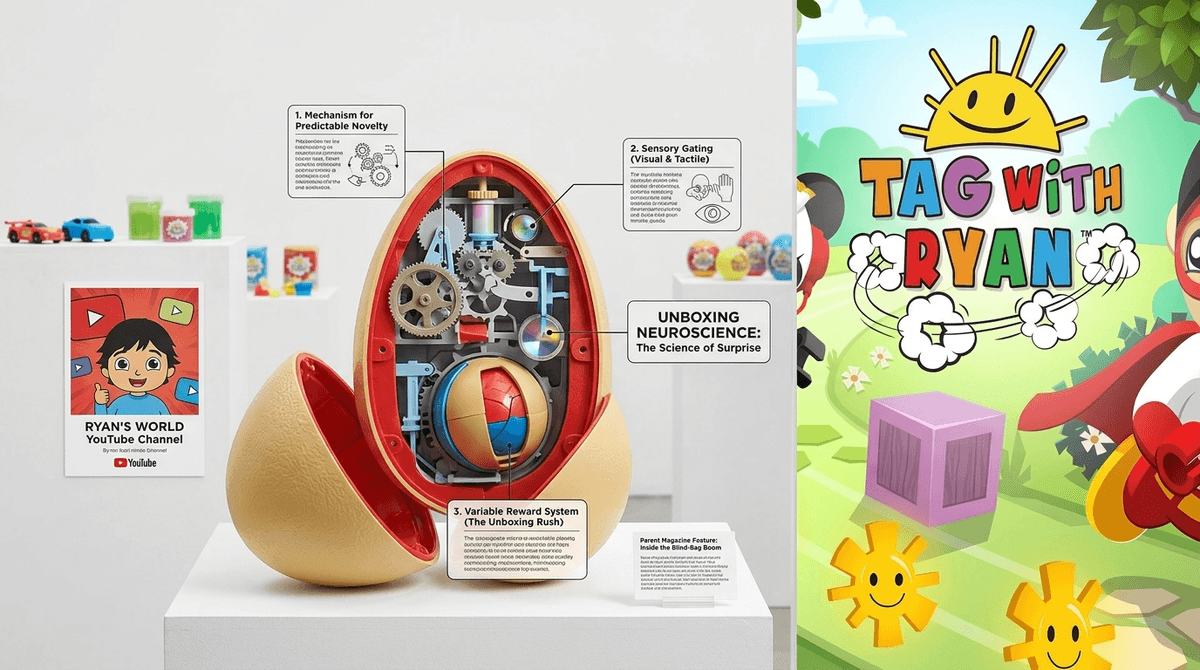
TL;DR: Ryan Kaji is the $30-million-a-year king of "unboxing," a genre that turns consumerism into entertainment for the preschool set. While Ryan’s World isn't "evil," it is essentially a 24/7 infomercial that triggers the same dopamine loops as gambling. If you’re tired of the "I want that" loop, consider pivoting to content that prioritizes doing over buying, like Emily's Wonder Lab or StoryBots.
If you’ve spent five minutes with a four-year-old lately, you know the Drill. The giant yellow egg. The frantic ripping of plastic. The high-pitched "Wait, what’s inside?!"
What started in 2015 as Ryan ToysReview—a simple channel of a kid opening Legos—has morphed into a multi-billion dollar retail empire. We aren't just talking about a YouTube channel anymore; we’re talking about a "Ryan’s World" ecosystem that includes a Tag with Ryan game, a show on Hulu, and physical aisles at Walmart and Target overflowing with "Mystery Eggs."
The "Ryan’s World Economy" is the gold standard of the unboxing trend. It’s a business model where the content is the product, and the product is the content. For parents, it creates a unique challenge: How do you handle a "show" that is literally a series of toy commercials?
It’s easy to dismiss unboxing videos as "brain rot," but there is actual neurobiology at play here. Kids aren't just watching a kid play; they are experiencing vicarious reinforcement.
- The Dopamine Hit: The human brain loves a mystery. The "surprise" element of an unboxing video triggers a dopamine release. It’s the same mechanism that makes adults enjoy "haul" videos or "mystery boxes." For a child, the anticipation of what’s inside the egg is often more satisfying than the toy itself.
- The Parasocial Connection: To your kid, Ryan isn't a corporate brand; he’s a friend. This is a parasocial relationship. When Ryan gets excited about a new plastic truck, your child feels that excitement as if they were in the room.
- Low Cognitive Load: Unlike Bluey, which requires following a narrative and understanding emotional nuances, Ryan’s World is visually loud, repetitive, and simple. It’s "easy" watching for a tired toddler brain.
The biggest headache for Screenwise parents isn't usually the content itself—Ryan is a polite, happy kid—it’s the consumerist fallout.
Watching unboxing videos creates a "want" loop. Because the toys are "mystery" items, the collection is never complete. This is the physical version of the "loot box" mechanic found in games like Roblox or Brawl Stars.
When your kid sees Ryan open a "rare" golden titan, they don't just want a toy; they want that specific feeling of "winning" the surprise. This leads to the inevitable meltdown in the toy aisle when you refuse to drop $40 on a plastic egg filled with $2 worth of figurines and stickers.
If you feel like Ryan’s World is turning your living room into a landfill of discarded plastic, it might be time to diversify the digital diet. The goal isn't necessarily to ban Ryan, but to introduce "Active" content that encourages kids to do something rather than just want something.
Ages 4-10 If your kid likes the "experiment" side of Ryan’s newer videos, Emily Calandrelli is the antidote. It’s high-energy, involves "surprises" (chemical reactions!), but it encourages kids to go into the kitchen and actually make something.
Ages 4-8 This is the gold standard for "cool factor" without the retail heavy-handedness. It satisfies the "collecting" itch through "Creature Power Suits" rather than mystery eggs.
Ages 3-7 Instead of focusing on stuff, StoryBots focuses on how stuff works. It’s fast-paced and colorful enough to keep a Ryan-addicted kid engaged, but it actually leaves them smarter.
Ages 5-7 If your kid is obsessed with the "business" of Ryan, pivot them toward creation. ScratchJr lets them build their own animations and games. It’s the first step toward understanding how the digital world is built, rather than just being a consumer of it.
- Ages 2-4: This is the "danger zone" for unboxing. Kids this age can't distinguish between entertainment and advertising. If they watch Ryan’s World, they will think they are supposed to have those toys. Limit exposure or watch with them to narrate ("Ryan is playing with a toy he was given for his job").
- Ages 5-7: Use Ryan as a jumping-off point for "Media Literacy 101." Ask questions like, "Why do you think Ryan is so excited?" or "Do you think that toy is as big in real life as it looks on the screen?"
- Ages 8+: Most kids age out of Ryan by this point, but they might move on to MrBeast. The "economy of scale" is different, but the "science of surprise" remains.
Check out our guide on teaching media literacy to preschoolers
It’s worth noting that the Kaji family has faced scrutiny from the FTC regarding "deceptive advertising." For a long time, it wasn't clear to kids (or parents) which toys Ryan actually liked and which ones he was being paid to promote.
While they’ve cleaned up their act with clearer disclosures, the entire channel remains a "sponsored" experience. Even the "organic" videos are designed to drive sales for the Ryan’s World brand.
When your kid plays the Tag with Ryan game, they are being funneled back to the YouTube channel. When they watch the YouTube channel, they are being funneled to the Amazon store. It is a closed loop of consumption.
You don't have to be the "No Fun Parent," but you can be the "Real Talk Parent."
Try saying: "I noticed that every time we watch Ryan, you end up feeling sad because you want a new toy. That’s because Ryan’s job is to make toys look like the most exciting thing in the world. Let’s take a break from Ryan today and watch something that makes us want to build with the Legos we already have."
Or, if they are begging for a Mystery Egg: "Those eggs are designed to make you feel like you're winning a prize, but usually, the toys inside aren't very sturdy. Why don't we save that money for a boardgame we can all play together?"
Ryan’s World isn't inherently "bad" content, but it is high-calorie, low-nutrition digital candy. It’s fine in moderation, but when it becomes the primary source of entertainment, it warps a child’s perception of play, turning it into a series of acquisitions rather than an imaginative process.
The "unboxing economy" thrives on the "Science of Surprise." By understanding that your kid isn't just being "greedy"—they're being "hacked"—you can approach the situation with more empathy and better boundaries.
- Audit the Feed: Check your YouTube history. If it’s 90% unboxing, it’s time to introduce some "how-to" or narrative-driven content.
- Set "Store Boundaries": Make it a rule that we don't buy things we saw on YouTube today. It breaks the immediate "see-want-buy" neural pathway.
- Ask Screenwise: Not sure if a specific toy-based show is just a long commercial?
Get a review of a specific YouTube channel Check out our guide on the best educational YouTube channels for 2026