

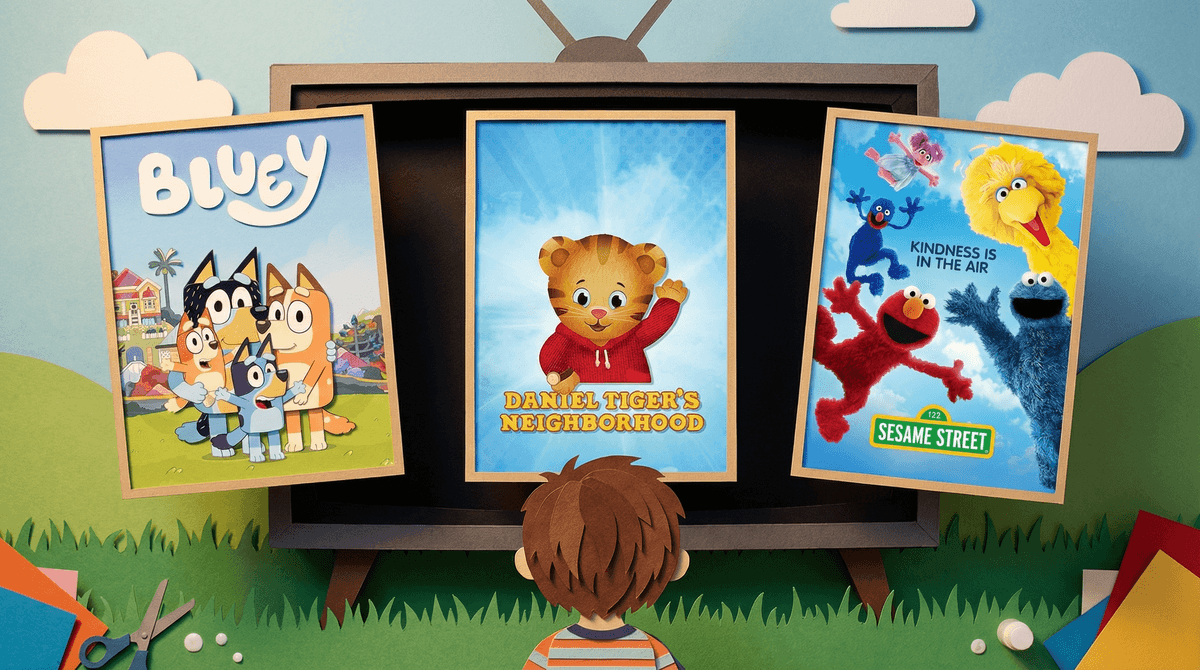
Media literacy isn't just for middle schoolers learning to fact-check TikToks. It starts way earlier—like, before your kid can even read. At its core, media literacy for preschoolers means teaching your 3-5 year old to think critically about what they see on screens: Who made this? Why did they make it? Is this real or pretend?
And honestly? It's one of the most important things you can teach them, right up there with sharing and not eating sand.
Here's the thing: your preschooler is already consuming media. Whether it's Bluey on Disney+, YouTube Kids, or that one Elmo video they've watched 47 times, they're taking in messages about the world. And unlike us, who grew up with three TV channels and Saturday morning cartoons, today's preschoolers are navigating an endless buffet of content—some great, some questionable, and some straight-up designed to keep their eyeballs glued to the screen so advertisers can sell them stuff.
Media literacy gives them the tools to start questioning that buffet. Not in a cynical way, but in a curious, empowered way.
Preschoolers are incredibly impressionable. Their brains are like little sponges, soaking up everything—the good (sharing is caring!), the bad (hitting gets you what you want!), and the weird (unboxing videos as entertainment?).
But here's what's wild: research shows that kids as young as 3 can start understanding the difference between reality and fantasy, between a TV show and real life, between an ad trying to sell them something and content made just for fun. They won't get it perfectly—they're still learning that the moon follows the car—but they can start building those critical thinking muscles.
Why start now?
- Advertising is everywhere. Even in "ad-free" content, there's product placement, influencer marketing, and characters conveniently loving the same toys you can buy at Target.
- Algorithms don't care about development. YouTube Kids might be "for kids," but the autoplay feature will happily serve up increasingly chaotic content if you're not paying attention.
- Early habits stick. Teaching your preschooler to pause and think about what they're watching now sets them up to be more critical consumers of media later—when the stakes are higher (hello, middle school social media).
The good news? You don't need a PhD in media studies to do this. You're already doing some of it without realizing it. Every time you say "that's just pretend" during a scary part of a movie, or "that commercial wants you to buy that toy," you're teaching media literacy.
But let's get more intentional about it.
Start with the Basics: Real vs. Pretend
This is the foundation. Preschoolers are still figuring out what's real and what's not, and screens make it harder. A cartoon dog talks and solves mysteries—is that real? A YouTube family goes to Disneyland—is that real?
Try this: During or after screen time, ask simple questions:
- "Is Bluey a real dog or a pretend dog?"
- "Could that really happen, or is it make-believe?"
- "Do you think that family is acting for the camera, or is that how they always are?"
You're not trying to ruin the magic—just helping them understand the difference between a story and reality.
Teach Them About "Who Made This?"
Even preschoolers can start to grasp that someone created what they're watching. A person (or team of people) decided what happens, what the characters say, what colors to use. This is huge for developing critical thinking.
Try this:
- "Who do you think made this show? What do you think they were trying to teach us?"
- "Why do you think they made the character do that?"
- Point out credits at the end of a show: "See all those names? Those are the people who made this for you!"
This plants the seed that media isn't just there—it's made by people with intentions.
Introduce the Concept of Ads (Yes, Really)
Your preschooler might not understand capitalism, but they can absolutely understand "this wants you to buy something." And they need to, because ads are targeting them constantly—even in apps and games marketed as educational.
Try this:
- When an ad pops up: "That's an advertisement. It's trying to get us to want that toy. Do you think we need it, or do they just want us to think we need it?"
- Talk about how ads make things look extra fun or exciting to convince you to buy them.
- If they're playing a game with in-app purchases, explain: "See how they're showing you that cool thing? They want you to ask me to spend money. That's how they make money."
Learn more about how in-app purchases work and why they're designed to be irresistible .
.
Model Healthy Media Habits
Your preschooler is watching you too. If you're scrolling through Instagram while they're trying to show you their tower of blocks, they're learning that screens are more important than people. If you watch TV to zone out after a hard day, they're learning that screens are for numbing out.
This isn't about being perfect—it's about being intentional. Talk about why you're using a screen. "I'm texting Grandma to see how she's feeling." "I'm looking up a recipe for dinner." "I'm watching this show because it makes me laugh after a long day."
Choose Content Intentionally
Not all screen time is created equal. Bluey? Amazing. Random YouTube autoplay rabbit holes? Not so much. Daniel Tiger's Neighborhood? Solid social-emotional learning. Unboxing videos of toys? Literally just ads.
Look for:
- Content with clear educational or emotional value
- Shows that encourage interaction (asking questions, pausing for responses)
- Age-appropriate pacing (not overstimulating)
- Diverse characters and stories
Avoid:
- Autoplay features (turn them OFF)
- Content that's just selling, selling, selling
- Overstimulating, fast-paced videos designed to hijack attention
Check out this guide to choosing quality content for preschoolers for specific recommendations.
Ages 2-3:
- Keep it simple: real vs. pretend
- Co-view everything (yes, everything)
- Limit screen time to 1 hour/day of high-quality content
- Talk during shows: "Oh, look! He's feeling sad. Can you make a sad face?"
Ages 4-5:
- Introduce "who made this?" and "why did they make it?"
- Start talking about ads and persuasion
- Encourage them to ask questions about what they see
- Let them help choose what to watch (from pre-approved options)
- Gradually increase independence, but still co-view most content
The key is to make this conversational, not like a pop quiz. You're not trying to ruin Sesame Street—you're helping them think.
Good questions to ask:
- "What do you think will happen next? Why?"
- "How do you think that character is feeling?"
- "Is this real or pretend? How do you know?"
- "Why do you think they showed us that toy/snack/game?"
- "What do you think the people who made this want us to learn?"
When they ask YOU questions (and they will), answer honestly:
- "Is that real?" → "No, that's animation—people drew it on computers."
- "Can I have that toy?" → "That's an ad trying to make you want it. Let's think about whether you'd really play with it or if it just looks cool on TV."
- "Why did they do that?" → "Good question! What do you think?"
Teaching media literacy to preschoolers isn't about making them cynical or robbing them of joy. It's about giving them tools to navigate a world that's increasingly mediated by screens. It's about helping them ask questions, think critically, and understand that what they see isn't always the whole story.
And honestly? It makes screen time more meaningful. Instead of just passively consuming, you're engaging together, talking, thinking. That's the difference between media as babysitter and media as learning tool.
This week:
- Turn off autoplay on every platform your kid uses (YouTube Kids, Netflix, Disney+, etc.)
- Co-view one show and practice asking questions: "Is this real or pretend?" "Who made this?"
- Point out one ad and talk about what it's trying to sell
This month:
- Audit your kid's content diet. Is it mostly high-quality stuff, or are you in a YouTube rabbit hole? Here's how to evaluate content quality.
- Model good habits. Talk about your own screen use. Put your phone away during meals.
- Introduce media-free zones. Bedrooms, dinner table, car rides—pick one and stick to it.
Long-term: Keep the conversation going. As your kid grows, these questions evolve. "Is this real or pretend?" becomes "Is this news source credible?" "Who made this?" becomes "What's this influencer's agenda?" You're building a foundation that will serve them for life.
And if you need help figuring out what's age-appropriate, what's worth watching, or how to navigate a specific app or game, Get help teaching media literacy to your preschooler—we've got your back.