

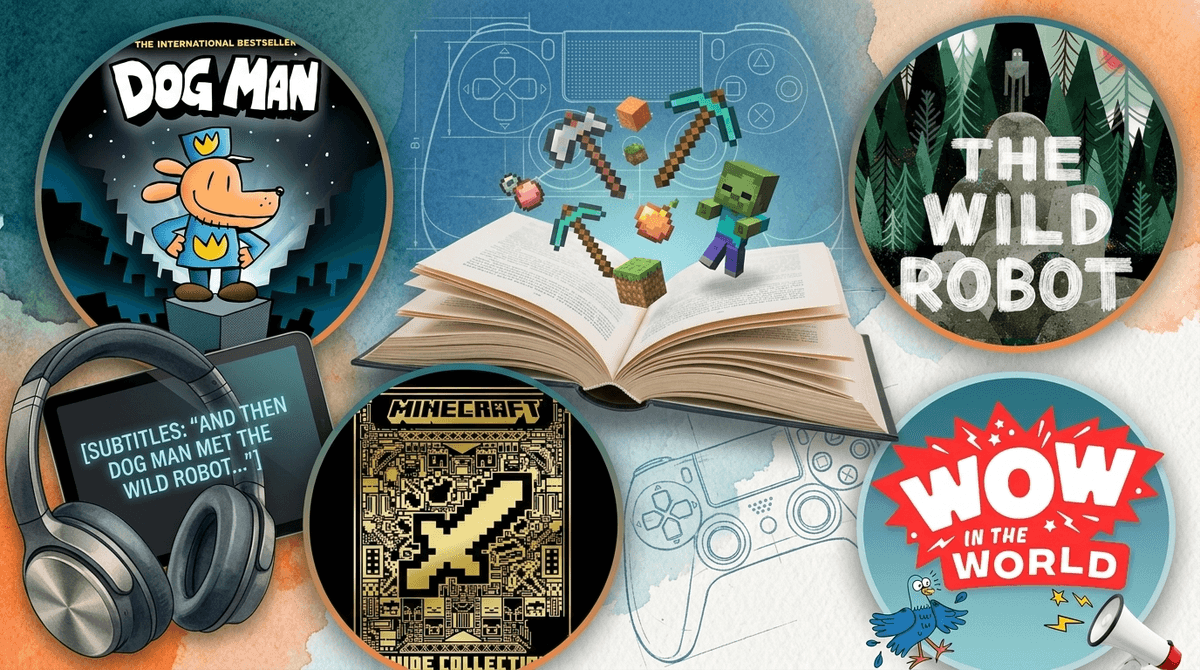
TL;DR: If your kid treats a paper book like a plate of cold broccoli but will spend three hours reading the Minecraft Wiki or decoding Roblox trade chats, they aren't "hating reading"—they’re just reading in a different format. You can bridge the gap by leaning into graphic novels like Dog Man, utilizing screen-to-page pipelines like The Wild Robot, and validating "ear-reading" through podcasts like Wow in the World.
Let’s be real for a second: the "put the tablet down and pick up a book" battle is exhausting. It feels like a personal failure when you see other kids devouring 500-page fantasy novels while your kid thinks a "long read" is the patch notes for the latest Fortnite update.
But here’s the No-BS truth: literacy in 2026 isn't just about ink on dead trees. We live in a world of "transmedia literacy." If your kid is navigating complex game menus, following a storyline in The Legend of Zelda: Tears of the Kingdom, or researching how to build a Redstone farm on a fan-run website, their brain is doing the work.
The goal isn't to kill the screen time; it's to use the screen as a gateway drug to deeper literacy.
Most "reluctant readers" aren't actually struggling with the mechanics of reading; they're struggling with the pacing. Compared to the high-octane dopamine hits of a YouTube short or a Brawl Stars match, a wall of text feels like "Ohio"—weird, boring, and kind of mid.
Screens offer immediate feedback, visual cues, and social connection. Books, by comparison, are a solo, quiet, and slow experience. To win them over, we have to stop treating books and screens like enemies and start treating them like teammates.
If your kid is obsessed with a specific game, that is your "in." Every major franchise now has a massive ecosystem of supplementary reading material. This isn't "cheating"—it's contextual learning.
For the kid who lives in Creative Mode, the official Minecraft handbooks are gold. They are technical, instructional, and—most importantly—they give the kid "status" in their peer group because they know facts others don't.
- Ages: 7-12
- The Hack: Ask them to "teach" you a build using the book as a guide.
Roblox is basically a social network disguised as a game. Reading about "scams to avoid" or "how to code in Lua" is high-stakes reading because it involves their digital "money" (Robux) and their reputation.
- Ages: 8-13
- The Hack: Focus on books or articles about entrepreneurship in Roblox.
I’m going to be honest: the FNAF lore is a convoluted mess of haunted animatronics and "purple guy" theories. It’s objectively a bit much. But kids are obsessed. The graphic novels and "Survival Logbooks" are often the first things a reluctant middle-schooler will read cover-to-cover.
- Ages: 11+ (It’s creepy, be warned)
- The Hack: If they’re watching FNAF theories on YouTube, hand them the Fazbear Frights series.
If you still think graphic novels are "just comic books" and don't count as reading, I need you to let that go. Graphic novels are the ultimate bridge for reluctant readers because they provide visual scaffolding. They help kids understand tone, pacing, and dialogue without getting bogged down in descriptive paragraphs.
This series is the GOAT for a reason. It’s silly, it’s irreverent, and it’s accessible. Is it high art? No. Is it "brain rot"? Also no. It’s fun, and fun is what creates a reading habit.
- Ages: 6-9
If your kid wants something more "epic" but is intimidated by the size of the original novels, the graphic novel adaptations are incredible. It’s Game of Thrones for kids (with fewer casualties).
- Ages: 8-12
Perfect for the kid who likes the humor of SpongeBob SquarePants. It’s fast-paced, full of puns, and visually engaging.
- Ages: 7-10
Check out our full list of graphic novels for reluctant readers
We often think that if a kid watches the movie, they won't read the book. Usually, the opposite is true. Use the "Screen First" method to build interest in the world and characters.
- The Wild Robot: Watch the movie, then buy the The Wild Robot by Peter Brown. The book has short chapters and beautiful illustrations, making it very "digestible."
- Percy Jackson & The Olympians: The Disney+ series is a perfect entry point. Once they’re hooked on the mystery of who Percy’s dad is, the Percy Jackson books are waiting.
- The Bad Guys: The Dreamworks movie is great, but the The Bad Guys book series is even funnier and written in a hybrid comic/novel style.
Let’s settle this: Audiobooks are reading. The brain processes the narrative, vocabulary, and syntax similarly whether it's coming through the eyes or the ears. For kids with ADHD or those who find the physical act of tracking text exhausting, audiobooks and podcasts are a lifesaver.
This is the gold standard of kids' podcasts. It’s high-energy, funny, and teaches actual science. It proves that "educational" doesn't have to mean "boring."
- Ages: 5-12
If your kid is into mythology (or just likes a good story about monsters), this National Geographic Kids podcast is phenomenal.
- Ages: 7-13
If you make reading a chore, they will treat it like taking out the trash. Here is how to handle the "reluctant" phase without losing your mind:
- Model the behavior (but on your phone?): If they never see you read a physical book, they won't think it's a "real life" skill. But even if you’re reading an article on your Kindle or phone, tell them: "Hang on, let me finish this chapter/article." Let them know the screen is being used for reading, not just scrolling.
- Keep the Subtitles ON: This is the easiest hack in the book. Turn on subtitles for everything—Bluey, YouTube, MrBeast. It creates an "automatic" reading environment.
- The "10-Minute Trade": Instead of "no screens until you read," try "if you read for 10 minutes, you get 10 minutes of 'bonus' screen time." It frames reading as a value-add rather than a barrier.
- Stop judging the content: If they want to read a Guinness World Records book or a magazine about LEGO Ninjago, let them. Literacy is a muscle; it doesn't care if the "weights" are Shakespeare or a catalog.
- Early Elementary (Ages 5-7): Focus on "decoding." Use apps like Khan Academy Kids or Duolingo ABC. Keep it gamified.
- Middle Elementary (Ages 8-10): This is the "Graphic Novel Sweet Spot." Series like The Baby-Sitters Club (Graphic Novels) or I Survived (Graphic Novels) are huge here.
- Middle School (Ages 11-13): They might move toward Webtoon or fan-fiction. This is where you need to watch for "brain rot"—some Webtoons are definitely not for kids. Stick to curated platforms like Epic!.
A kid who spends all day on a screen isn't a lost cause for literacy—they are just a reader in search of a format. By validating their digital interests and providing "low-friction" reading options like graphic novels and audiobooks, you take the shame out of the struggle.
Stop fighting the screen and start using it as the ultimate "Previously On..." for their next favorite book.
- Turn on subtitles on every TV in your house right now.
- Download a podcast like Brains On! for the next time you’re in the car.
- Check out our guide on how to use video games to encourage reading.
- Use Screenwise's list maker for a specific recommendation based on your kid's favorite YouTube channel:
What books should my kid read if they love MrBeast?
