

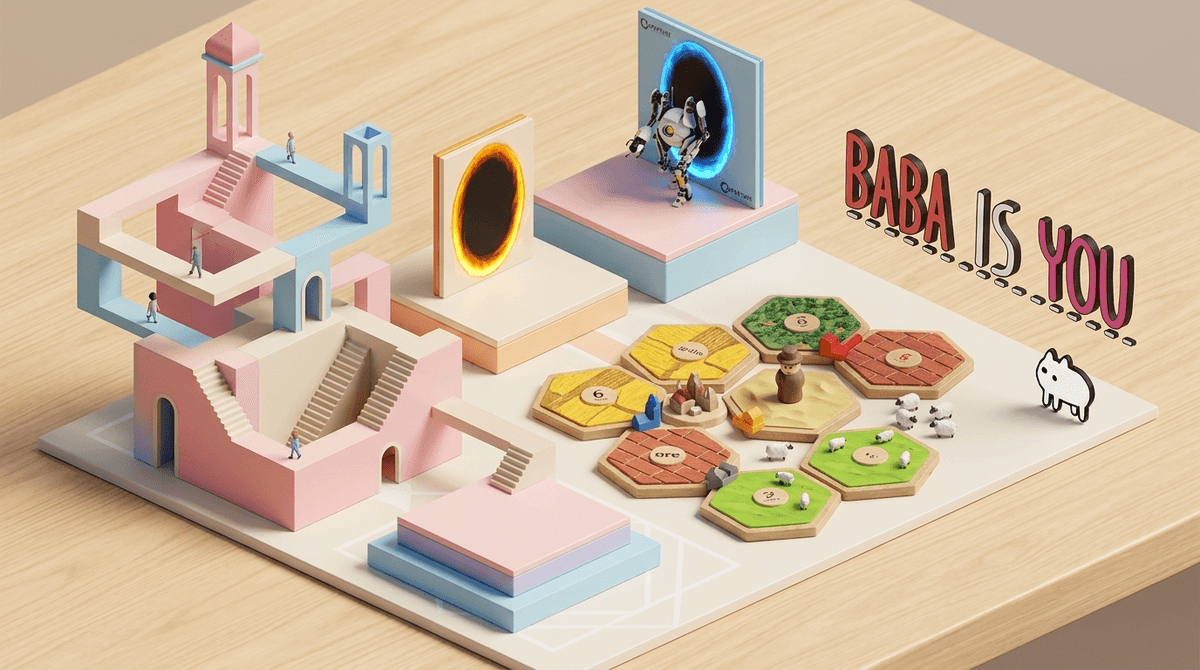
TL;DR: The Quick List
If you’re looking to swap "brain rot" scrolling for something that actually fires up those neural pathways, here are the top picks for different ages and formats:
- Best for Spatial Reasoning (App): Monument Valley
- Best for Physics & Co-op (Console/PC): Portal 2
- Best for Coding Logic (Console/PC): Baba Is You
- Best for Solo Logic (Tabletop): Rush Hour
- Best for Browser-Based Thinking (Website): Scratch
- Best for Family Strategy (Tabletop): Catan
Get puzzle game recommendations based on your child's age
We’ve all been there. You look over your kid’s shoulder and they are watching a video of a giant head in a toilet, or they’re doing a "skibidi" dance that makes zero sense, and you wonder if their brain is slowly turning into lukewarm oatmeal.
But here is the reality: screens aren't the enemy; the content usually is. If we can pivot them from passive consumption to active problem-solving, we aren't just "managing screen time"—we’re building cognitive muscles.
Critical thinking isn’t just a buzzword for school board meetings. It’s the ability to look at a mess, see the patterns, and persevere when the first five solutions fail. Whether it’s a physics-based digital world or a wooden logic puzzle on the coffee table, these games teach kids how to think, not just what to think.
Most "educational" games are terrible. They’re usually just math worksheets with a thin coat of glitter and a cartoon mascot. Kids smell the "learning" a mile away and run toward Roblox.
The best puzzle games work because they tap into the "Aha!" moment. That hit of dopamine when a difficult problem finally clicks is more addictive than any mindless clicker game. This builds perseverance—the willingness to fail, iterate, and try again. In a world of instant gratification, that’s a superpower.
Ages 7+ This is quite possibly the most beautiful game ever made. It’s an M.C. Escher-inspired puzzle where you manipulate architecture to move a character through impossible geometry. It teaches spatial reasoning in a way that feels like art. There’s no timer and no "losing," which makes it a great entry point for kids who get frustrated easily. Check out our full guide on why Monument Valley is a digital wellness win
Ages 10+ If your kid has a console (Switch, PlayStation, Xbox) or a PC, this is the gold standard. You use a "portal gun" to create holes in space to navigate rooms. It’s heavy on physics, momentum, and deductive logic. Plus, the co-op mode is a fantastic way for you to play with them. Just be prepared: the AI character, GLaDOS, is incredibly sarcastic (and hilarious), which kids love but might lead to some "Ohio" level sass at the dinner table.
Ages 8+ Don't let the simple graphics fool you. This game is a masterpiece of logic and rule-breaking. In each level, the rules of the game are physical blocks you can push around. If you push blocks to say "Wall Is Push," you can suddenly move walls. If you make "Lava Is Float," you can walk over it. It’s essentially teaching the logic of computer programming without a single line of code. It gets hard, though, so be ready to help them out.
Ages 9+ Wait, isn't this an action game? Yes, but the core mechanic involves building complex machines—cars, planes, bridges—using a physics engine that is better than most engineering software. If your kid is constantly draining your bank account for Robux, try pointing them toward Zelda. It’s a masterclass in creative problem solving.
Learn more about the difference between "brain rot" games and "high-agency" games
Sometimes the best way to build critical thinking is to put the phone in the "tech basket" and clear the kitchen table.
Ages 5+ This is a classic for a reason. It’s a sliding block puzzle where you have to get the red car out of a traffic jam. It’s tactile, it’s portable, and it scales from "my kindergartner can do this" to "I’ve been staring at this for twenty minutes and I’m annoyed." It builds sequential thinking—the ability to see five steps ahead.
Ages 12+ For the older kids (and parents who like a challenge), this is a fascinating game about deductive reasoning. You’re trying to find a secret three-digit code by "questioning" a mechanical computer (made of punch cards—no batteries!). It’s like Sudoku on steroids and feels like actual detective work.
Ages 10+ Critical thinking isn't just about blocks and physics; it's about resource management and negotiation. Catan teaches kids how to trade, when to pivot their strategy, and how to handle the "robber" (which is also a great lesson in emotional regulation when your sibling ruins your plans).
We know kids are going to find ways to play games at school or on their Chromebooks. Instead of just fighting it, point them toward the sites that actually offer something of value.
Ages 8+ Created by MIT, Scratch is a "game" in the sense that you can build your own. It’s a drag-and-drop coding language. The "puzzle" here is: How do I make this cat jump when I press the spacebar? It’s the ultimate critical thinking tool because the problems are the ones they create for themselves.
Ages 6+ Think of this as the "anti-textbook." It’s full of interactive puzzles and "Polyads" that let kids explore mathematical concepts visually. It’s less about memorizing 7x8 and more about understanding the logic of shapes and numbers.
Ages 7+ Okay, let’s be real: not everything on Coolmath Games is "math." But they have some stellar logic puzzles. Run 3 is a great spatial awareness game, and 2048 is a classic for a reason. It’s a much better use of a 15-minute break than TikTok.
Check out our guide on the best educational websites that don't suck
- Ages 5-7: Focus on spatial awareness and cause-and-effect. Games like Khan Academy Kids have great logic mini-games. Physical puzzles and blocks are still king here.
- Ages 8-12: This is the sweet spot for complex logic and "if-then" thinking. Baba Is You and Minecraft (especially Redstone circuits) are perfect.
- Ages 13+: Move into abstract reasoning and strategy. Games like The Witness or complex board games like Wingspan challenge them to see systems as a whole.
Here is the "No-BS" part: Puzzle games are frustrating. That is literally the point.
If your child is a "rage-quitter," they might struggle with these at first. In our house, we talk about the "Optimal Challenge." If a game is too easy, it’s boring. If it’s too hard, it’s frustrating. The "fun" is in the middle.
When your kid gets stuck on a level in Portal 2, don’t give them the answer. Ask them:
- "What have you tried so far?"
- "What is the one thing that has to happen for you to win?"
- "What happens if you try the exact opposite of what you think will work?"
This is how we move from "Mom, help me!" to "Mom, look what I figured out!"
We don't need to ban screens to protect our kids' brains; we just need to raise the bar for what they do on them. A kid who spends an hour solving a level in Monument Valley is developing more grit and logic than a kid who spends an hour being "entertained" by a YouTube prankster.
Start small. Maybe replace one "mindless" app with one "logic" app this week. Or better yet, grab a copy of Rush Hour and leave it on the kitchen table without saying a word. I bet you $10 they’ll be playing it by the end of the day.
- Audit the Tablet: Look at the "Games" folder. If it's 100% "endless runners" (like Subway Surfers), add one of the logic games mentioned above.
- Play Together: Sit down and do a "Co-op" puzzle. It’s a great way to model how you handle getting stuck.
- Check the Screenwise Community: See what other parents in your school district are recommending for logic and thinking.