

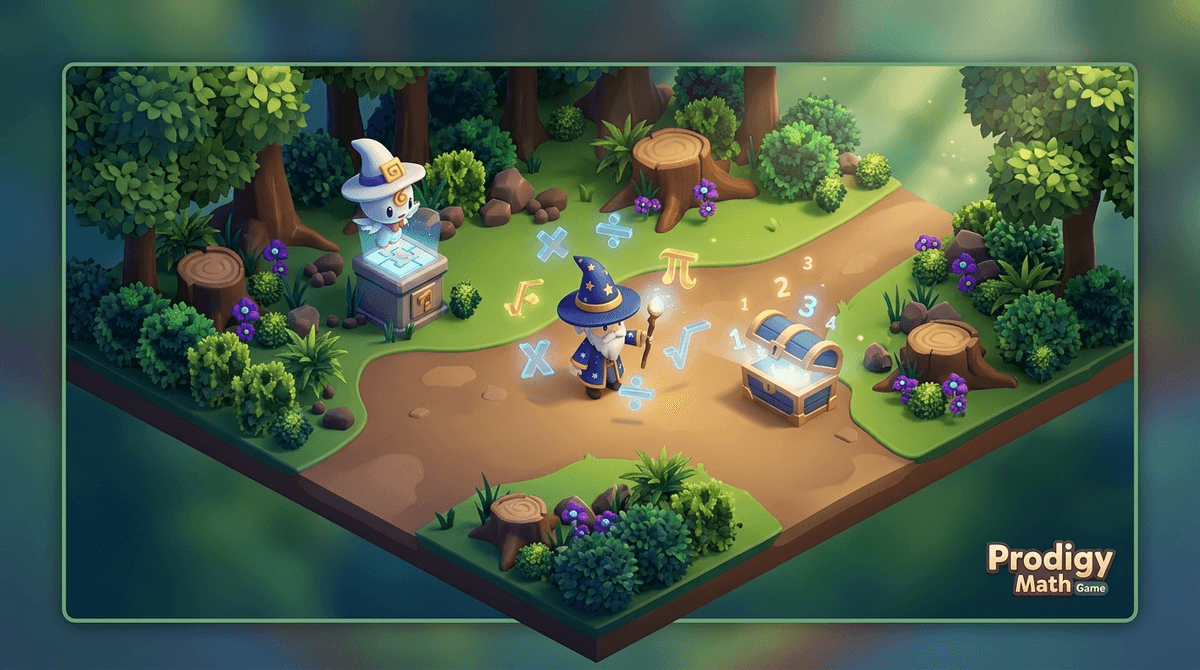
TL;DR: Prodigy Math is a fantasy RPG that makes kids solve math problems to win battles. It’s incredibly effective at getting kids to practice, but the "freemium" model is aggressive with membership ads. If your kid loves Pokémon or Roblox, they will likely be obsessed with this.
Quick Links:
- The Game: Prodigy Math
- The App Version: Prodigy Math App
- A Solid Alternative: Zearn
- For Pure Math Mastery: DragonBox Algebra 5+
If you’ve walked past your child’s screen lately and seen a wizard-hat-wearing avatar casting fireballs at a giant mechanical owl, you’ve seen Prodigy Math.
At its core, it’s a fantasy role-playing game (RPG) designed for kids in Grades 1-8. Think of it like a simplified version of World of Warcraft or Pokémon. Players explore a 2D world, collect pets, and engage in turn-based battles. The "twist" is that every time a player wants to cast a spell or perform an attack, they have to solve a math problem aligned with their specific grade level and curriculum (Common Core, TEKS, etc.).
It is currently one of the most popular educational platforms in the world. In many school districts, it’s a Friday afternoon staple. About 25-30% of elementary students are logging in at least once a week, often because their teachers have assigned it or because their friends are "battling" each other during indoor recess.
Kids aren't playing Prodigy Math because they’re dying to do long division. They’re playing it for the dopamine loop.
- The Collection Aspect: Just like [Pokémon](https://screenwiseapp.com/media/pokemon-go-game, kids can "tame" monsters they encounter in the wild. Having a rare pet is a status symbol in the 3rd-grade world.
- The Social Presence: While there is no "open chat" (thank god), kids can see each other’s wizards running around the world map. They can challenge friends to battles, which feels much more like a "real game" than a math worksheet.
- The Gear: You earn gold to buy hats, wands, and boots. If your kid is into the "drip" culture of Roblox or Fortnite, they’ll find the same motivation here.
- Low Friction: The math starts easy. It builds confidence. For a kid who feels "bad at math," being a powerful wizard who happens to be doing subtraction is a huge psychological win.
Learn more about why gamified learning works for some kids and not others
Here is the "no-BS" part: Prodigy Math is a masterclass in the "freemium" business model.
The math content is, and always has been, free. The company makes its money by upselling parents on a Premium Membership. And they aren't subtle about it. While playing the free version, your child will constantly run into "Member Only" chests they can't open, "Member Only" pets they can't catch, and "Member Only" areas they can't enter.
It creates a massive amount of FOMO (Fear Of Missing Out). Your kid will likely come to you saying their wizard is "weak" or "boring" because they don't have the paid membership. In a school setting, this can actually create a bit of a "haves vs. have-nots" dynamic where the kids with memberships have the coolest gear.
Is the membership worth it? From a purely educational standpoint, no. The math is the same whether you pay or not. From a "peace in the household" standpoint? That’s a personal call. It’s essentially paying for your kid to stop complaining about the locked chests.
Yes and no.
The Pros: It’s great for fluency and volume. A kid might solve 50-100 math problems in a single session without realizing it. For rote practice—addition, multiplication tables, basic geometry—it’s excellent. The teacher dashboard (which parents can also access) is actually quite high-quality, showing you exactly where your kid is struggling.
The Cons: It doesn't necessarily teach conceptual math. If a kid gets a problem wrong, the game might show them the right answer or a hint, but it’s not the same as a teacher or a site like Khan Academy explaining why the math works. Also, as kids get older, the "game" part can start to outweigh the "math" part. A savvy 6th grader might spend 20 minutes customizing their wizard and only 5 minutes actually doing math.
Compared to the wild west of YouTube or TikTok, Prodigy Math is very safe.
- Communication: There is no open-text chat. Players can only interact through pre-written phrases (e.g., "Good game!" or "Follow me!"). This eliminates the risk of predatory behavior or cyberbullying found in Roblox.
- Data: They are COPPA and FERPA compliant, which is why so many schools allow it. They aren't selling your kid's data to third parties in the way a standard social media app might.
- Screen Time: It’s still "screen time." Because it’s "educational," parents often give it a pass, but the game mechanics are designed to be addictive. Keep an eye on the "just one more battle" loop.
If you find the Prodigy Math membership prompts too "Ohio" (that’s kid-speak for cringey/weird) or if your kid is spending too much time on the RPG side, consider these:
This is the gold standard for many teachers. It’s less "gamey" and more instructional. It follows the "Eureka Math" curriculum and focuses on deep understanding rather than just "battling." If Prodigy Math is dessert, Zearn is the main course.
If you want to see a masterpiece of educational design, this is it. It teaches the logic of algebra to kids as young as five without using numbers at first. It’s a paid app, but there are zero ads or subscriptions.
A huge collection of browser-based games. It’s less of a "world" and more of a "menu" of games. Great for targeted practice on specific skills like fractions or decimals.
A great alternative for younger kids (K-3) that has a similar "battle monsters with math" vibe but feels a bit more contained and less focused on the "membership" upsell.
If your kid is obsessed, don't fight it—use it as a bridge.
- Ask to see their pets: "Which pet was the hardest to catch?" This shows you value their effort in the game world.
- Check the Parent Dashboard: Instead of asking "Did you do your math?", say "I saw you crushed the division problems today, but the fractions look tricky. Want to look at one together?"
- Discuss the "Marketing": Use the membership prompts as a teaching moment about how "free" apps make money. "They really want me to buy that membership, don't they? Why do you think they make the member gear look so much cooler?"
Prodigy Math is not "brain rot." It’s a legitimate educational tool wrapped in a very shiny, very corporate RPG wrapper.
If your kid is struggling with math motivation, it can be a lifesaver. If your kid is already a math whiz and is just using it to "flex" on friends with their legendary gear, you might want to nudge them toward something more challenging like Scratch or Khan Academy.
It’s safe, it’s curriculum-aligned, and it’s better than 90% of what they’d otherwise be doing on an iPad. Just be prepared for the inevitable "Can I have a membership?" conversation. (Pro-tip: They usually have a "Group Buy" or "Back to School" sale if you decide to cave).
Check out our guide to the best math apps for every grade level
Next Steps:
- Log in to your child's account and look at the "World Map" together.
- Set up a Parent Account to track their progress (it’s free).
- Set a clear boundary: "30 minutes of Prodigy, then 15 minutes of Zearn or a book."