

Look, I know this seems obvious. Picture books are books with pictures. But hear me out — because in 2026, when we say "picture book," we're actually talking about something pretty specific that's competing with a lot of other things for your kid's attention.
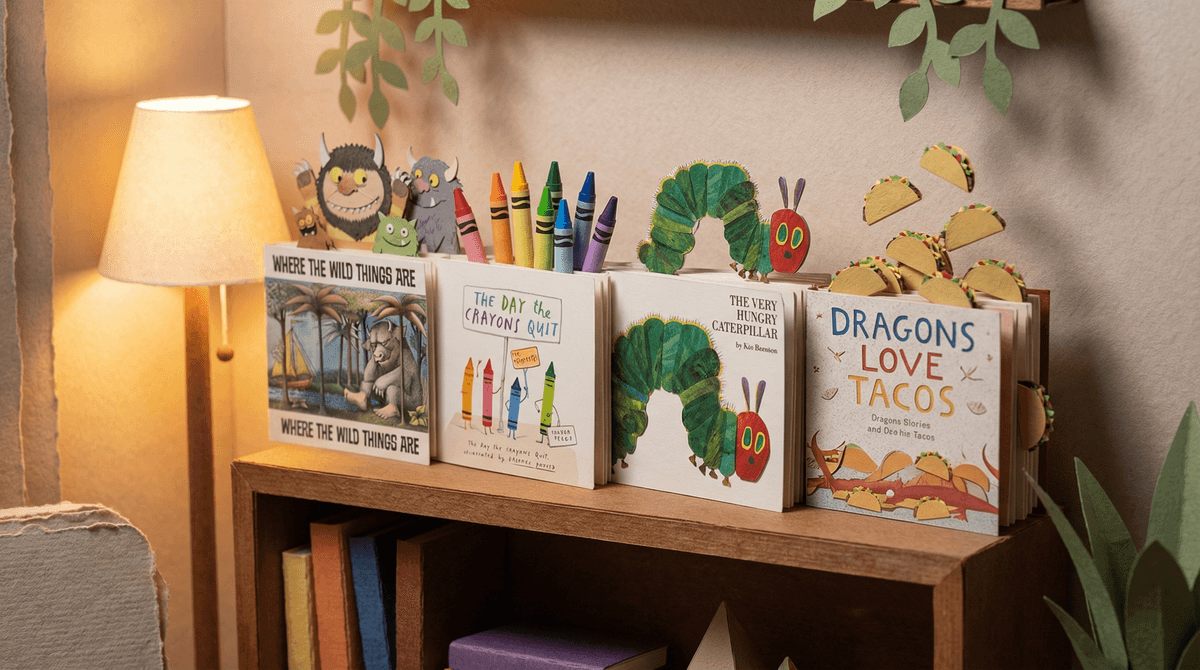
Traditional picture books are those 32-page hardcovers with illustrations on every page, designed for kids roughly ages 0-8. We're talking The Very Hungry Caterpillar, Where the Wild Things Are, Dragons Love Tacos. They're meant to be read aloud, held in actual hands, with pages that turn and sometimes get ripped by enthusiastic toddlers.
And here's the thing: they're not just "books but simpler." They're doing something completely different than what screens do to developing brains.
Every parent knows reading is "good." But the research on physical picture books specifically is kind of wild when you look at what's happening in kids' brains compared to screen-based stories.
The attention span thing is real. When a kid is looking at a physical book with you, they're practicing sustained attention on a single thing. No notifications. No autoplay next episode. No algorithm serving up something more stimulating every 8 seconds. Just one story, beginning to end. This is increasingly rare for kids under 8, and it matters.
The language development gap is significant. Studies show that kids whose parents read physical books aloud to them hear, on average, 1.4 million more words by age 5 than kids who don't get read to. Even the fanciest educational app doesn't replicate the back-and-forth conversation that happens naturally when you're reading together. "Look at that dog! What sound does a dog make? Is that dog bigger or smaller than our dog?" That's not happening with YouTube Kids.
The bonding is different. When you're reading a physical book together, you're physically close, making eye contact, responding to each other. Your kid is looking at your face, hearing your voice, feeling your presence. When they're watching Bluey (which is great, by the way), they're looking at a screen. The neural pathways being built are just fundamentally different.
Let's address the elephant in the room: "But what about reading apps? What about ebooks? What about those interactive story apps?"
Here's the honest answer: they're not bad, but they're not the same thing.
Apps like Epic! or even just ebooks on a tablet have their place. They're portable, they're convenient, they can be great for road trips or waiting rooms. But the research is pretty clear that kids comprehend less and retain less from screen-based reading compared to physical books, especially at younger ages.
Why? Partially it's the distractions (even in "book" apps, there are often games, sounds, animations). Partially it's that the physicality of turning pages, seeing how much book is left, feeling the weight of it — all of that helps with comprehension and memory. And partially it's just that when a screen is involved, the parent-child interaction changes. You're both looking at the device instead of at each other.
Interactive story apps with games and sound effects? Those are even further from traditional reading. They're fine as entertainment, but they're training a different kind of attention — one that expects constant stimulation and rewards. That's basically the opposite of what reading is supposed to teach.
Ages 0-2: Board books are your friend. Indestructible, chewable, throwable. The goal here isn't reading comprehension — it's associating books with comfort, routine, and your attention. Goodnight Moon, Brown Bear, Brown Bear, anything by Sandra Boynton.
Ages 2-4: This is prime picture book age. Kids can sit for longer stories, understand simple plots, ask questions. They'll want the same book 47 nights in a row. This is good. Repetition is how they learn. The Pigeon books, Pete the Cat, anything by Julia Donaldson.
Ages 4-6: Picture books get more sophisticated. Longer stories, more complex emotions, early lessons about friendship, fear, change. The Day the Crayons Quit, Last Stop on Market Street, Jabari Jumps.
Ages 6-8: Many kids are starting to read independently, but don't stop reading aloud to them. Seriously. Read-aloud time can continue well into elementary school. Picture books for this age often tackle bigger topics — divorce, death, racism, anxiety. The Name Jar, Hair Love, The Invisible Boy.
You don't need a huge collection. The library exists. Use it. Kids genuinely benefit from rereading the same books over and over anyway. Five beloved books that get read 100 times each are better than 100 books read once.
Bedtime reading is the easiest win. If you only do one thing, make it bedtime stories. It's a natural wind-down from screens, it's a consistent routine, and it's a guaranteed few minutes of connection. Even 10 minutes counts.
It's okay if your kid would rather watch TV. Of course they would. TV is designed by teams of people to be maximally engaging. Books require more effort. That's actually the point. You're the parent — you get to decide that some things are worth doing even when they're not the most immediately gratifying option.
You can't really start too early or stop too late. Read to your newborn even though they have no idea what's happening. Keep reading to your 10-year-old even though they can read themselves. The bonding and the language exposure matter at every age.
Diverse books matter. Kids need to see themselves in books and see people who are different from them. This isn't performative — it's how kids learn that different kinds of people and families and experiences all exist and are normal. If your bookshelf is all white characters, you're teaching something whether you mean to or not.
Picture books aren't just "content delivery for pre-readers." They're teaching attention, language, empathy, and bonding in ways that screens simply cannot replicate, no matter how educational the app claims to be.
Does this mean no screens ever? No. Does it mean your kid is doomed if they watch Sesame Street instead of reading every single day? Also no.
But if you're trying to figure out where to draw lines in your family's digital life, here's an easy one: protect picture book time. Make it non-negotiable. Make it screen-free. Make it a few minutes where the most advanced technology in the room is a bound stack of illustrated paper.
Your kid's brain will thank you, even if they're currently asking to watch Cocomelon instead.
- Set a bedtime reading routine if you don't have one. Even 10 minutes. Every night.
- Get a library card if you don't have one. Most libraries have apps now where you can reserve books online and just pick them up.
- Create a book nook somewhere in your house that's cozy and screen-free. Doesn't have to be fancy — a corner with a pillow and a basket of books works.
- Read what your kid loves, even if it's the same book every night for three months. Repetition is learning.
- Keep reading aloud even after they can read independently. Chapter books, picture books, whatever. The bonding and vocabulary building continue.
Want book recommendations for your specific kid? Tell me their age and interests and I'll give you a real list, not just the same five books everyone recommends.