

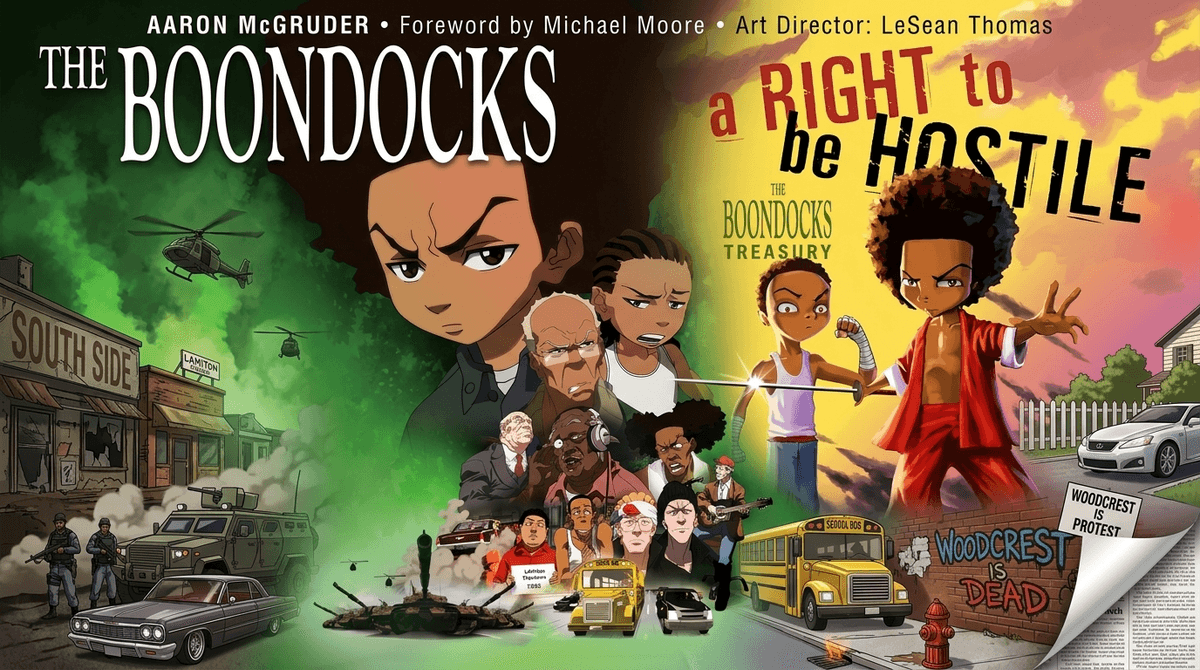
The Boondocks is a masterclass in satire, but let’s be clear: the animation and the 10-year-old protagonist are a total head-fake. This isn't a "family" cartoon. It’s a sharp-edged, profanity-laced, deeply intellectual critique of American culture, Black politics, and the absurdity of the early 2000s. If you’re looking for a show to watch with your elementary-schooler, this isn't it—but if you have a teenager who’s starting to ask real questions about race, media, and systemic irony, it’s one of the most important shows they could watch.
TL;DR: The Boondocks is a brilliant Adult Swim satire that uses a fish-out-of-water premise to skewer everything from celebrity worship to domestic policy. Because of its heavy use of the N-word and mature themes, it’s best for the high school crowd. If they’re ready for the language, it’s a perfect springboard for conversations about media literacy and social critique.
Based on the comic strip by Aaron McGruder, the show follows Huey Freeman (a 10-year-old revolutionary and domestic terrorist-in-waiting) and his 8-year-old brother Riley (a wannabe gangsta who worships every rap trope imaginable). They’ve been moved from South Side Chicago to the fictional, affluent white suburb of Woodcrest by their "Granddad," Robert Freeman.
The show ran on Adult Swim for four seasons, and while the quality dipped in the final season (after McGruder left), the first three seasons are untouchable pieces of cultural commentary. It’s stylized like an anime—think Cowboy Bebop or Samurai Champloo—with high-octane fight scenes, but the dialogue is pure social philosophy.
You can’t talk about The Boondocks without talking about the language. The show uses the N-word more frequently than almost any other piece of media in existence.
Here’s the thing: it’s not used for shock value. It’s used as a surgical tool to examine how the word functions within Black culture, how it’s been commodified by corporate interests, and how different generations (like Granddad vs. Huey) perceive it.
If your kid is watching this, they are going to hear it—a lot. If they aren't old enough to understand the difference between using a slur and interrogating a slur through satire, they aren't old enough for this show. This is why we generally point parents toward our digital guide for high school when this show comes up.
The show doesn’t have "sacred cows." It attacks everyone.
The Political Revolutionary: Huey Freeman
Huey is the heart of the show. He’s the smartest person in any room, a cynical intellectual who sees the world for exactly what it is. He spends most of his time trying to wake people up to government conspiracies or the "poison" of mainstream media. For a teenager, Huey is a fascinating entry point into media literacy. He’s the one asking: Who owns this channel? Why are they showing us this? Who benefits when we stay angry at each other?
The Cultural Consumer: Riley Freeman
Riley is Huey’s foil. He’s the kid who believes everything he sees on TV. He wants the rims, the chain, and the "thug life," despite living in a safe, wealthy suburb. Riley is a caricature of how corporate marketing targets Black youth by selling them a specific, often destructive, image of "authenticity."
The Social Skewering
Some of the most famous episodes are the most uncomfortable. "Return of the King" imagines what would happen if Martin Luther King Jr. woke up from a coma in 2005 and saw the state of popular culture (spoiler: he’s not happy). Another episode, "The Trial of R. Kelly," was years ahead of its time in calling out the way fans defend celebrities despite horrific allegations.
One reason kids are drawn to The Boondocks is that it looks incredible. It’s heavily influenced by Japanese anime, particularly the work of Shinichirō Watanabe. The fight scenes are fluid, well-choreographed, and genuinely exciting.
If your kid is a fan of Spider-Man: Into the Spider-Verse or Avatar: The Last Airbender, they’ll recognize the visual language here. But while Avatar uses that style for an epic hero's journey, The Boondocks uses it to punch up at American institutions.
If your teen is already watching The Boondocks, don't just ignore the noise coming from the TV. This is one of those rare shows where "watching it together" actually pays off because there is so much to unpack.
- Ask about the satire: When an episode ends, ask: "Who was the show actually making fun of there?" Often, the show makes Riley look like a fool to critique the people who made Riley think that way.
- Look up the references: The show is packed with nods to 90s hip-hop, 70s Black cinema, and specific political figures of the Bush era. It’s a history lesson hidden in a cartoon.
- Compare it to the comic: The original comic strip is a bit more grounded and even more focused on Huey’s internal monologue. It’s a great way to see how a creator’s voice evolves when they move to a bigger platform like Adult Swim.
If the satire and cultural critique are what's hitting, there are other ways to keep that energy going without just re-watching the same episodes:
- Atlanta: For older teens, Donald Glover’s series is the spiritual successor to The Boondocks. It’s surreal, funny, and deeply invested in exploring the Black experience in America.
- Black-ish: A much "safer," network-TV take on similar themes of moving into the suburbs and maintaining cultural identity. It’s a good bridge for middle schoolers.
- Sorry to Bother You: A wild, satirical movie that captures the same "everything is a conspiracy and everything is absurd" vibe that Huey Freeman loves.
- South Park: If they just like the "nobody is safe" style of satire, this is the obvious comparison, though it lacks the specific cultural focus of McGruder’s work.
Q: Is The Boondocks okay for a 12-year-old? It’s a stretch. While a 12-year-old will get the jokes about "Granddad being cheap," they’ll likely miss 90% of the political satire and just absorb the surface-level profanity and violence. It’s better suited for 15+.
Q: Why is there so much violence in a show about kids? The violence is a mix of anime homage and a metaphor for the "war" Huey feels he’s fighting. It’s stylized and "cool," but it rarely has real-world consequences, which is part of the show’s critique of how we consume violence in media.
Q: Is the show "anti-Black"? No, but it is incredibly critical of certain aspects of Black popular culture. Aaron McGruder uses the show to "read" the culture from the inside. It’s a classic example of "loving something enough to criticize it."
The Boondocks is brilliant, but it’s "Old Energy" Adult Swim—it’s designed to provoke, offend, and educate all at once. If your kid is in high school and has the maturity to handle the language, it’s a top-tier recommendation for building a critical eye toward the media they consume every day. For everyone else, check out our best shows for kids list for something that won't require a three-hour debrief after every episode.
- Check out the digital guide for high school for more mature-rated picks.
- Explore our best shows for kids list for age-appropriate alternatives.
- Get an episode maturity breakdown
 for a specific breakdown of any episode.