


In case you haven’t seen it, there’s a new viral article by Dorota Talalay circling MommyStack with the hot take that “Screen Time” is bad for kids, actually.
Dorota’s article has some good points (you should read it!) — in particular, I strongly agree with her that the main issue is parents and grandparents who are addicted to their screens. I’ve even made this argument myself! Several times! But I will throw it out there that from personal experience, trying to coax the phone away from a screen-addicted adult is far more difficult and unpleasant than just confiscating it from a little kid.
At the other extreme, there are posts like this one claiming that you’re a “you’re a great parent no matter what your kids are watching” (as long as it’s not porn or Andrew Tate), which, while clearly well-intentioned, is also just kind of untrue (sorry).
I’ve scanned the media landscape for children and have banned 95%+ of it because I’m worried it will rot my kids’ brains and/or corrupt their souls. But this isn’t just a screens thing! I have also banned quite a lot of books (e.g. everything PAW Patrol) as well as the vast majority of foods marketed towards kids.
Generally speaking, I am very obsessed with protecting my children’s developing brains from junk. (And yet I know some wonderful parents with healthy, well-adjusted kids who let them watch Peppa Pig and eat goldfish crackers so I should probably chill out, it is a bit concerning how family members fearfully side-eye me every time my kid gets a hold of cookie made with food colouring and white sugar at a party.)
Anyway, I got into it a bit with Dorota this morning before I drank any coffee and I agree with her that her piece deserves a more thoughtful response than I usually provide in the “notes” section. My kids and husband slept in with the flu so I had no excuse not to churn this one out.
Not All Screen Time is Equal
Dorota writes in her headline that the “ results are in” regarding screen time and the negative impact on children’s development.
But the problem with many (if not most) of the studies, articles, and social media posts on the effects of “screen time” on children is that they tend not to distinguish between the type of screens used, how the screens are used, and what’s on the screens.
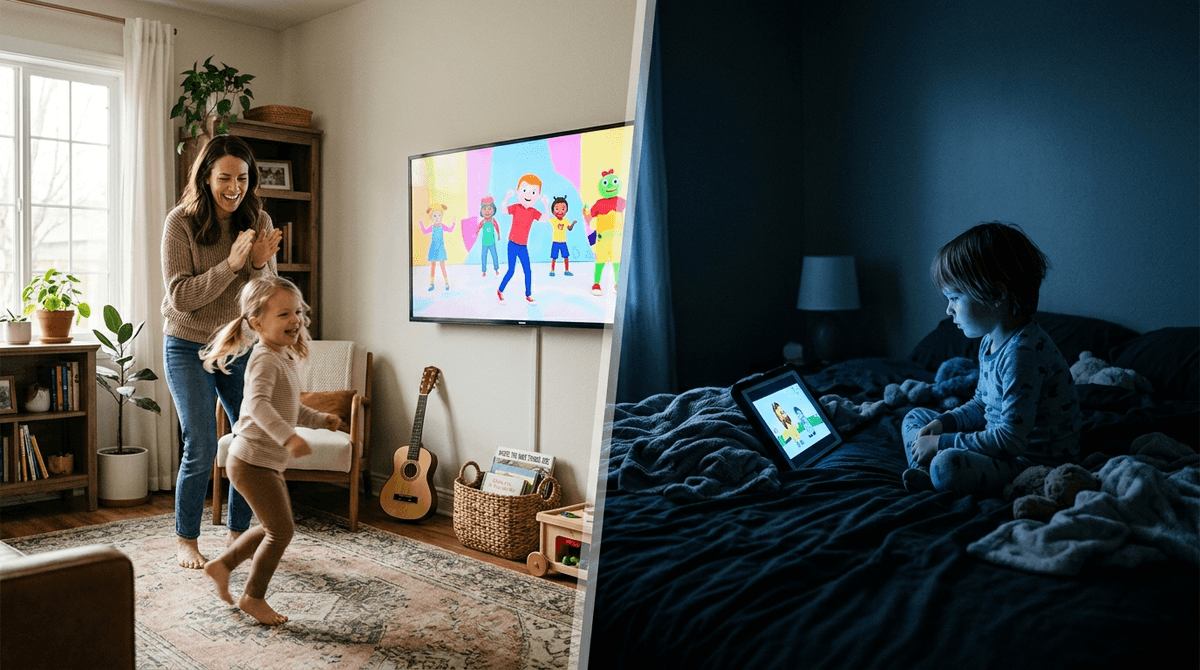
I have noticed that my kid will get way more zombie-like and obsessed while watching a show on a phone than she does watching the exact same show on the television. Loosely, this is because phones and tablets provoke more focussed, intense attention than television screens. My kid will also complain that a show is “boring” and demand we turn off the TV and do something more fun, but has literally never put down a phone once she’s got a hold of it for the same reason.
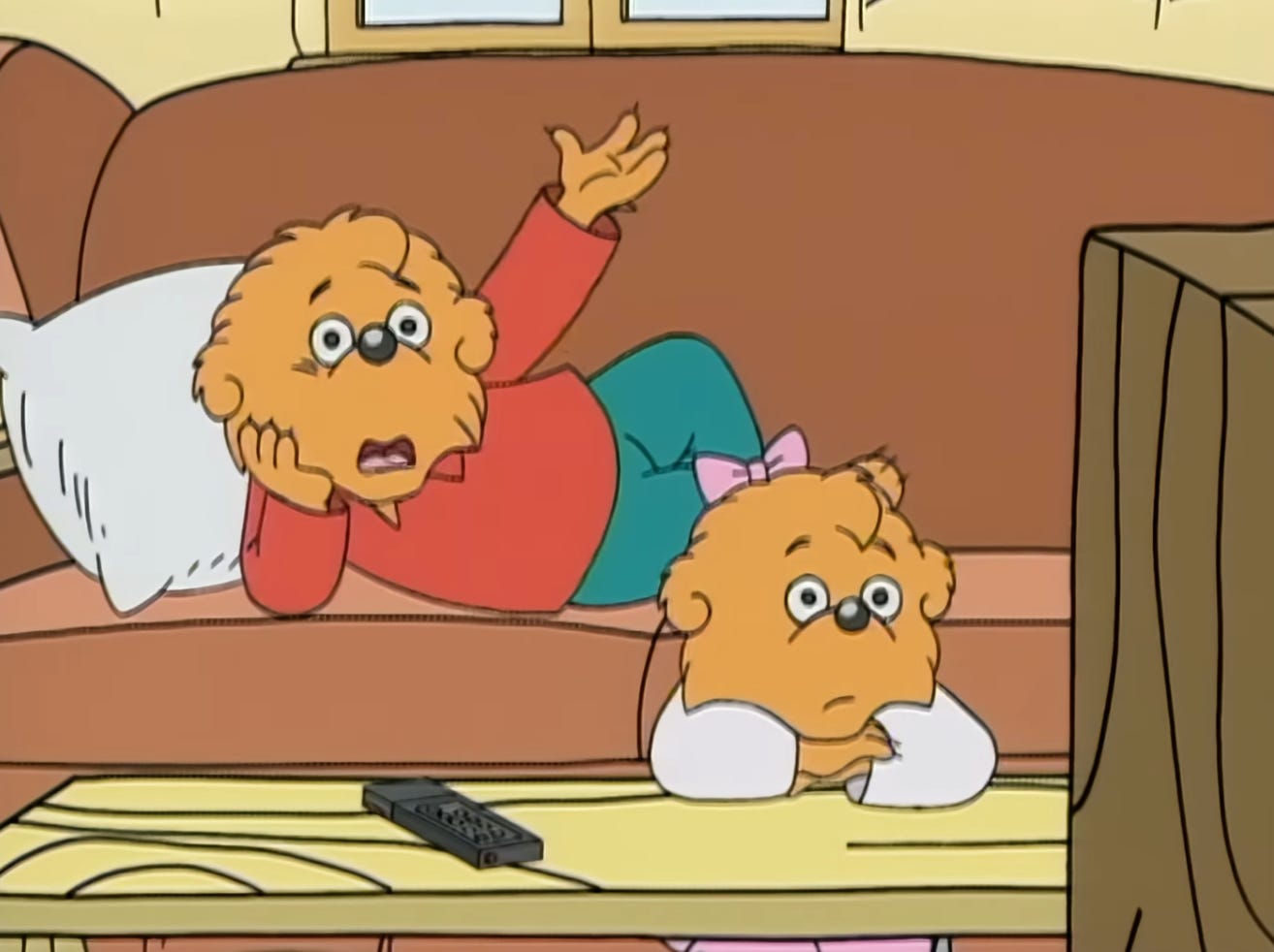
Still from the Berenstain Bear’s TV adaptation of Too Much TV, ironically one of my daughter’s favourite episodes. While she loves the show, she will pick having one of the books read to her over watching it pretty much every time.
Using a phone or tablet is also unlikely to be an in-person social activity, whereas a television screen easily can be. There is a huge difference between a kid playing a game alone on an iPhone versus with a bunch of friends on the television in the living room. Similarly, sitting down as a family to watch a kid-friendly movie with a good story and artistic merit is not the same thing as letting your kid mainline YouTube videosalone in their bedroom on an iPad.
Similarly, what’s on the screens is important! As I’ve mentioned, about 95% of content is banned in my house. So what kind of screen time do I allow?
- Music videos, specifically performance-based videos (e.g. Tiny Desk concerts), videos with fun dancing we can mimic (e.g. Taylor Swift’s “Shake It Off”), and Jewish a cappella.
- Family-friendly musicals with clever lyrics and good stories and messages we can talk about and learn from (e.g. Robin Hood, Joseph and the Amazing Technicolour Dreamcoat, The Princess and the Frog, Tangled— I also allowed the Frozen franchise but I regret that one because Elsa is a bad influence).
- Slow-paced television shows with clever writing, educational content, and good messages, typically stories that are also available in book form and we just embrace the franchise in all of its forms as a family (e.g. Little Bear, Berenstain Bears, Bluey, Magic School Bus, Sesame Street). I hope to eventually add good documentaries to this list, but right now my four-year-old says they are “too boring” and will just turn off the TV if I try to put one on.
As well, while I tried to ban phones and tablets, I ended up caving for long airplane trips and the drawing app on my husband’s phone and educational games on our tablet. I’m a bit concerned that my kids spend way longer doodling on my husband’s phone than they do with markers and paper, but also it’s cheaper and more environmentally-friendly and still improves their fine-motor skills.
I also can’t really think of a good argument against educational video games because I spent hundreds of hours playing math games on the computer as a little kid and that’s probably one of the reasons why I later tested off the charts as “gifted” in math. But we’re talking like maximum two hours per week playing art or educational games on a device and I’m still not thrilled about it.
Overall, the effects of all this “screen time” on my kids appears to be:
- Slightly improving their vocabularies (those bears are very articulate).
- Inspiring them to try new high-imagination games — from talking to other parents, this is basically the Bluey effect. Our kids will watch an episode of Bluey, and then spend hours destroying our homes by building forts everywhere, enlist us as characters in some pretend-play drama, or demand we play a game of “Keepy-Uppy” for forty-five minutes with a balloon.
- The Jewish a cappella videos are teaching them about their Jewish heritage and how to sing some songs in Hebrew.
- Some minor improvements to fine motor skills, math, and reading skills via the drawing app and educational content.
- Inspiring them to sing, dance, and try to learn how to play the various musical instruments scattered around the house (my husband and his mom, who lives with us, are both professional musicians). I noticed that one of Dorota’s links she claims is about the adverse effects of screen time was actually about the adverse effects of physical inactivity (a bit deceptive there, Dorota, that was one of the first links I clicked and you misrepresented what it actually said), which suggests to me that dancing to (family-friendly!) music videos with your kids is just fine.

On the other hand, reading books to your kids is a stationary activity that often involves unhealthy hunching. (Obviously, it’s still good to read books in moderation). Stock image by pvproductions at freepik.com.
I should clarify — I’m not talking about a few hours of week of screen time here. We’re more in the territory of a couple hours per day, especially on rainy, miserable days (common where I live — other days, my kids get zero screen time. It’s all circumstantial.). But my kids rarely stare at the TV like zombies. Most of the time, it’s basically just background noise while they play (or dance and sing along).
If all this “screen time” has had an adverse effect on my kids’ attention spans or development, it is not (yet) apparent — they’ve hit every milestone on time or early, and the only feedback I’ve heard from other adults is that both my kids have unusually good attention spans. I also constantly hear how well-behaved they are, especially in public. They also play well with other kids — my four-year-old in particular has some pretty big Popular Kid energy.

Don’t worry, she will inevitably be humbled when other kids start making fun of her for singing the Jew lyrics to popular songs instead of the real ones. (Still from Six13’s “Elton Johnukah”).
I know it’s annoying and other moms don’t really want to read about kids who are Doing Just Fine, but my point is my kids have probably watched every episode of Bluey at least five times by now and so far absolutely none of the supposed negative effects of screen time have manifested. (My older daughter will sometimes throw a small tantrum when told she can’t watch something, but she has thrown similar tantrums over not being allowed to eat a bunch of fruit right before dinner, not being allowed to go to the playground because it’s pouring rain, or my husband telling her he can’t immediately take to her library — and yet I have not banned blueberries, going outside, or library visits just because my daughter occasionally throws a fit over being denied them).
The Bluey-inspired forts are a bit of safety hazard, to be fair, but so far no serious injuries (knocks on wood).
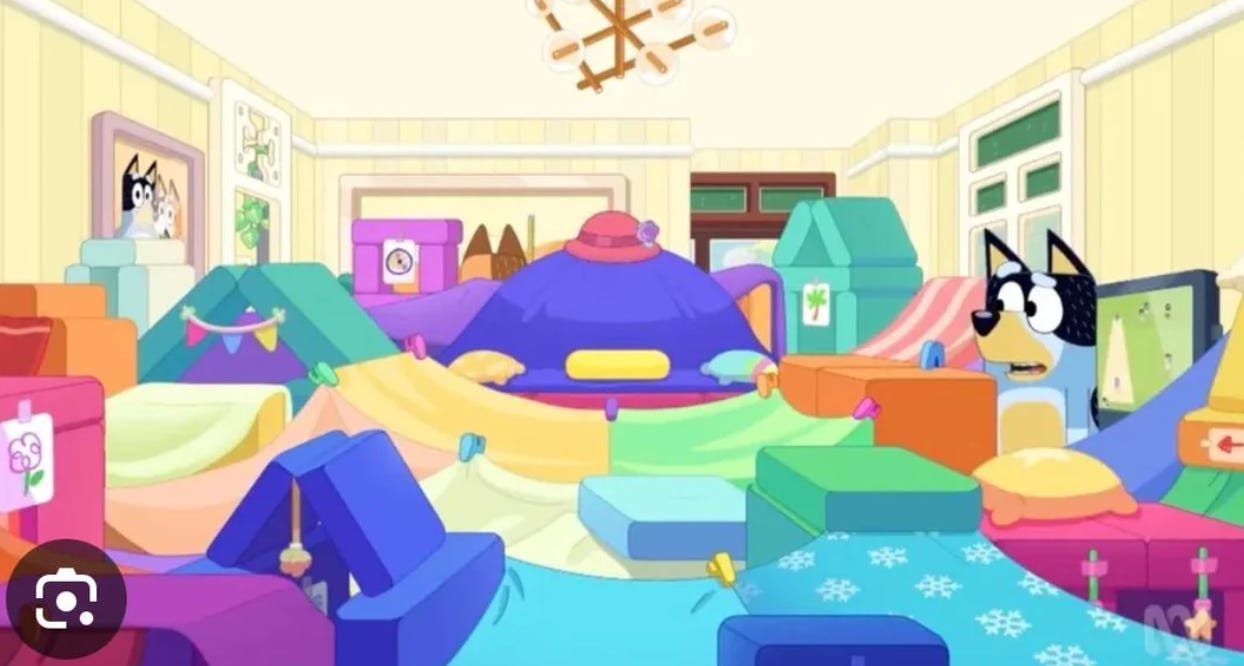
Thanks, Bluey.
This is my main quibble with Dorota’s post and similar arguments, but the stars have aligned to give me lots of kid-free time today so let’s dig in a little more —
It’s Not Just the Screens, Stupid!
Dorota repeats Jon Haidt’s argument that the youth mental health crisis is mostly caused by screens.
Absolutely, yes, screens have had an overall adverse effect on mental health. But this is obviously not the only factor at play .
I think Lila Krishna is a bit more on point with her take that screen addiction is typically a symptom of other problems, not The Problem in and of itself.
Other relevant factors in declining youth mental health include:
- Higher processed food consumption, leading to brain-gut disruption, junk food addiction and disordered eating, and nutrient deficiencies which negatively affect mood, resilience to trauma and other stressors, energy levels, emotional processing, attention etc.
- More social isolation, the breakdown of the extended family (i.e. the “village”), and over-reliance on paid childcare workers. More kids raised by single parents, more kids raised by divorced parents, more kids raised away from grandparents and other extended family members and/or without siblings and/or cousins to play with. More kids raised by highly-mobile parents who will uproot them and move to a new city or new country. (Lack of a “village” is also why so many parents use screens. Yes, we’d all love it if we had other family members and other kids around to entertain ours while we cook, clean, and juggle other responsibilities but a lot of us don’t, and if Bluey stops my older daughter from running into the bedroom while I’m trying to put her baby sister down for a nap, then I think it’s worth it — sorry, Dorota, I’d rather not risk her stuffing my oven with toilet paper while I’m breastfeeding the baby into a slumber, to borrow an example).
- More exposure to various environmental and pharmaceutical toxins and other poisons which may disrupt hormones and brain development.
- The sun was vilified and sunscreen use became more widespread, leading to Vitamin D deficiency. Vitamin D deficiency is associated with nearly all common mental health conditions. Sunlight is important.
- Exposure to EMFs (electromagnetic fields), microplastics, mould, and more has dramatically increased (this is why I demanded my husband hook our TV directly up to the Internet instead of using WiFi).
- It is possible that more children are being born who are genetically very sensitive, which increases the likelihood of adverse outcomes in an unhealthy environment.
- Rates of narcissism have been steadily rising since at least the 1970s, according to social psychologists. This means there are more narcissistic parents — and grandparents — today than in previous generations. And one of the biggest predictive factors of poor mental health according to the therapy literature is having one or more narcissistic parents and/or otherwise disrupted attachment.
I was a pretty lonely child — but I never had a problem with screens, despite being allowed to watch some shows and movies and play a few games. I did, however, develop an extremely unhealthy addiction to reading books. Does this mean reading is inherently unhealthy? Of course not. My unhealthy relationship to reading was a symptom of my loneliness and attachment difficulties — similarly, as Lila correctly points out, screen addiction is usually a symptom, not the underlying cause.
It is not, in fact, significantly healthier to spend hours alone in your room dissociating into novels than it is to spend hours in your room binge-watching a favourite TV show — and a well-written TV show might actually be better for the brain and personality than poorly-written, ideologically-driven reading material.
For some related ramblings on why books / reading are not inherently Good For You (in brief: it’s what inside the books that counts, reading is not an inherently superior way of consuming stories, and there are better ways to develop your toddler’s language skills than reading books to them).
Moral Narcissism and the Literary Crowd
Why Reading to Babies and Toddlers is Overrated
That Being Said, I Mostly Agree with Dorota
Dorota has some pretty good advice for cutting down on screen time at the bottom of her essay and makes some very solid points about the prevalence and dangers of screens being almost everywhere (it’s scary that people apparently average 4.5 hours of scrolling per day). My one quibble is her recommendation to rediscover your own reading practice — not because I’m against reading, but because my kids are just as annoyed when I ignore them to read a book as they are when I ignore them to do something on my laptop or phone. As well, she talks about getting a landline instead of using a smart phone, but my kids actually hate it MORE when I talk on my phone than when I text message or scroll, because talking in real time to another person makes it significantly more difficult to put the phone down to pay attention to them.
My point is that it is possible to have a healthy relationship to screens, and they can be incorporated into a child’s life in a way that benefits their development.
I’m a huge musical theatre nerd. I would LOVE IT if I could take my kids to musicals on Broadway every week. Obviously this is not realistic, but the good news is that now we can watch a lot those musicals together on TV. I would also love it if my husband could just play guitar all day or if we could go to concerts all the time, but that’s not going to happen, so it’s pretty cool we can watch and listen to some of our favourite musicians on YouTube. Bluey has done more to inspire my older daughter to use her imagination than I ever could. It would be great if we could read her Berenstain Bears books to her heart’s content, but I’m not convinced it’s considerably worse to let the TV read her favourite stories to her while I’m prepping a healthy snack or whatever. I think good storytelling has a lot of value, and screens can be a useful medium for that.
Jury’s out on the educational games and the drawing app. I’m not convinced, but I do like that I don’t have to worry about the baby putting a felt marker tip in her mouth when she doodles with an electronic pen on my husband’s phone.
While I’m going to hold out on letting my kids have their own iPhones for as long as possible, screens are sort of like junk food in that you really can’t protect your kids forever from them and you don’t want it to become a forbidden fruit. My alternative plan is to try to model and teach my kids to have a healthy relationship to screens (and to junk food!).
And maybe I’m sensitive to all of this stuff because I actually wish everyone in my household — young and old — would spend less time on their screens. I wish for a lot of things, but as it is, I have reality to deal with.
If all the screens in the world disappeared tomorrow, most of my family’s problems would remain (I would probably get more attentive grandparent support though, which would be cool) and the Western world would still have a significant mental health crisis.
In many ways, the loss of screens would actually make it more difficult to raise healthy children today. I’ve learned A LOT about nutrition and attachment parenting and how to reparent yourself after a difficult childhood (etc) from reading articles on the Internet, and most of the good books I’ve read on these topics I first learned about online. Screens have also made it possible for many parents to work from home, and thus have more time with their kids. And while obviously it is healthier for kids to hang out with friends in-person instead of online, there have always been very lonely kids (and adults!) out there — and now many of them are able to find community online. Those online communities may be toxic as hell, but the loneliness is the underlying issue, not the screens lonely kids turn to for support.
Yes, screens have created or exacerbated quite a lot of problems. New technologies tend to do that before we collectively figure out how to live with them in a reasonably healthy way. Historically, there were also enormous surges of violence following spikes in literacy (Europe was basically a bloodbath following the invention of the printing press) and plenty of people, myself included, have spiralled into mental health crises following periods of excess book-reading. And yet I don’t see people advocating for limiting access to books during childhood.
I have a salad to make for a family party so I’m going to wrap this up. Funnily enough, the only person who spent any time on a screen today in my family was me, typing out this essay. The flu seems to have passed and the sun was out and my husband spent most of the day outside with our kids. And I’m grateful to my laptop for making it much easier and faster for me dump out my writer’s brain than a typewriter or pen and paper would have.
C’est la vie. I’m a far cry from a perfect mother. But when I weigh it all out, I think overall the existence of screens has helped more than hindered my journey toward trying to become a “good enough” one.
All the best and have a wonderful holiday (with or without the TV!)
Note for subscribers — while I still intend on publishing posts without a paywall, I have decided to retroactively paywall some older posts which are a bit more personal and less academic in nature. If you’re a free subscriber and really want access to an old post I added a paywall to, just shoot me a message.
Also, if any parents out there are looking for a Christmas present that will help you cut down on screen time, my kids love their Toniebox (alas, I am not sponsored by them, but it is a great toy).