

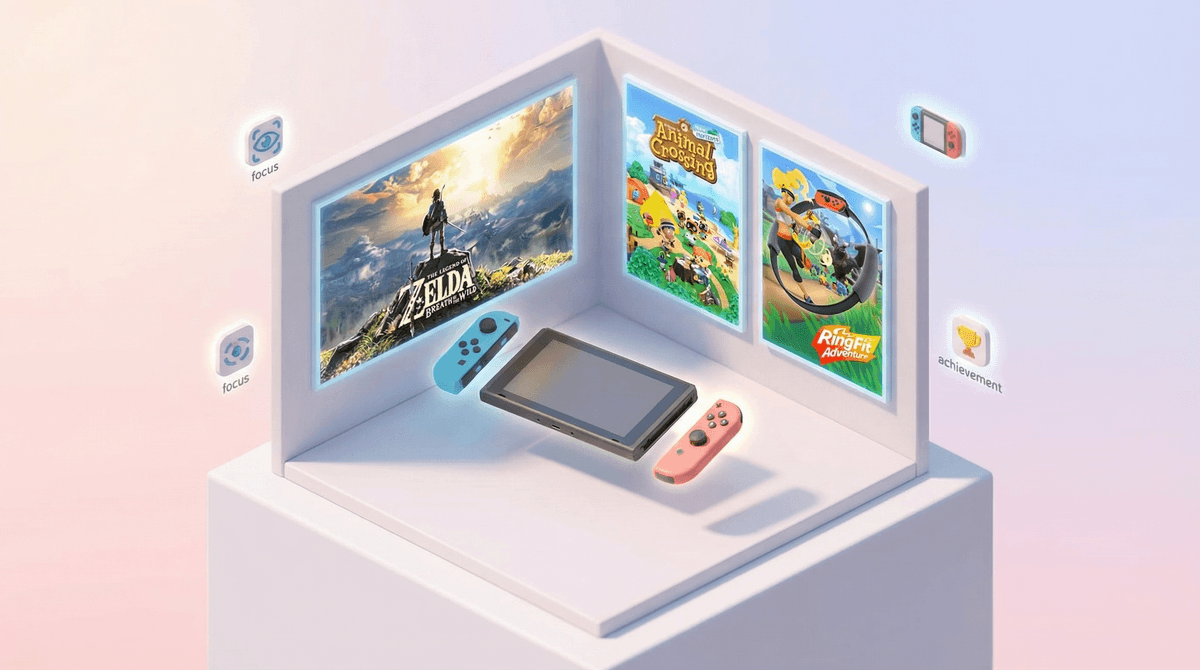
The Nintendo Switch is Nintendo's hybrid gaming console that works both as a handheld device and plugged into your TV. It's been around since 2017, and it's become the go-to gaming system for families because it's portable, has a massive library of games ranging from adorable to action-packed, and honestly? It's just really well-designed.
But here's what makes it interesting for kids with ADHD specifically: the Switch offers an unusual amount of flexibility in how kids play. Handheld mode lets them move around. TV mode can be more social. The Joy-Con controllers can be held separately (great for fidgeting). And the game library includes everything from high-intensity action games to slower-paced creative sandboxes.
Let's be real: gaming and ADHD is complicated territory. On one hand, video games are literally designed to hijack attention systems—they're engineered to be compelling, rewarding, and hard to stop. On the other hand, many kids with ADHD struggle to find activities that hold their focus at all, and games can provide structure, clear goals, and immediate feedback in ways that homework... does not.
The Switch sits in an interesting middle ground. Unlike mobile games that are often designed around microtransactions and infinite scroll mechanics, most Switch games have actual endpoints. There are levels to complete, stories that finish, goals you can reach. This makes them easier to set boundaries around than, say, Roblox or YouTube.
But the ADHD-specific considerations go deeper:
Motor skills and hand-eye coordination: Many kids with ADHD also have developmental coordination challenges. The Switch's motion controls (in games like Ring Fit Adventure or Just Dance) can actually support gross motor development. The Joy-Cons are also smaller and easier to grip than traditional controllers.
Executive function practice: Games like Animal Crossing: New Horizons or Stardew Valley require planning, organization, and delayed gratification—all executive function skills that kids with ADHD are actively developing. These games provide a low-stakes environment to practice those skills.
Emotional regulation: This is where it gets tricky. Games can be genuinely soothing and regulating for some ADHD kids—the predictability, the control, the dopamine hits. But they can also trigger massive dysregulation when it's time to stop playing, especially with games that don't have natural stopping points.
Let's not sugarcoat this: the Switch can become a major battleground in your house if you're not intentional about it.
Transitions are brutal. The "one more level" plea is real, and for kids with ADHD who struggle with task-switching, stopping a game can trigger full meltdowns. This isn't manipulation—their brains genuinely have a harder time shifting gears.
Time blindness is a thing. Kids with ADHD often have poor time perception, and games make it worse. What feels like 20 minutes might be 90 minutes. You'll need external timers and warnings, not just "five more minutes" called from the kitchen.
Sleep disruption. The Switch's portability means kids can (and will) play under the covers at 11 PM if you let them. The blue light, the stimulation, the "just one more thing" nature of games—it's all terrible for sleep, which ADHD kids desperately need for regulation.
Not all games are created equal. Fast-paced games like Fortnite or Splatoon 3 can be incredibly dysregulating. They're exciting! But they also spike cortisol and make transitions even harder. Meanwhile, slower games like Minecraft in creative mode or Pokémon can be genuinely calming.
Ages 6-8: At this age, you want games with clear stopping points and lower frustration levels. Kirby and the Forgotten Land is forgiving and cheerful. Mario Kart 8 Deluxe has races that naturally end. Keep sessions short (20-30 minutes) and always give a 5-minute and 2-minute warning.
Ages 9-11: This is when kids can handle more complex games and longer play sessions, but they still need structure. The Legend of Zelda: Breath of the Wild is phenomenal for exploration and problem-solving, but it's also easy to lose hours in. Set clear time limits and help them identify good stopping points (after a shrine, after saving, etc.).
Ages 12+: Older kids with ADHD might benefit from games that actually teach skills or provide creative outlets. Nintendo Switch Sports gets them moving. Splatoon 3 teaches teamwork (but watch for online toxicity). The key at this age is helping them develop their own awareness of how different games affect their mood and focus.
Use the parental controls. The Switch has genuinely good parental control features through a smartphone app. You can set daily time limits, restrict online communication, and even pause gameplay remotely. For ADHD kids who struggle with self-regulation, these external controls aren't punitive—they're supportive scaffolding.
Not before homework or hard tasks. Gaming before a challenging task is like eating dessert before dinner for an ADHD brain. The dopamine hit from gaming makes everything else feel impossibly boring by comparison. Save gaming for after responsibilities are done, or use it as a genuine reward for completing hard things.
Physical activity matters. If your kid is going to game, try to balance it with movement. Games like Ring Fit Adventure or Just Dance actually count as exercise. Or set a rule: 30 minutes of outdoor play earns 30 minutes of Switch time.
Watch for hyperfocus. ADHD kids can hyperfocus on things they find interesting, and gaming is prime hyperfocus territory. This isn't the same as healthy engagement—it's when they literally can't hear you calling them, skip meals, or hold their bladder too long. If you're seeing this pattern, you need stricter limits and more frequent check-ins.
Co-play when you can. Playing together gives you insight into what they're experiencing, makes transitions easier (you're both stopping), and can be genuinely fun. Mario Party Superstars or Overcooked 2 are great for family play.
The Switch isn't inherently good or bad for kids with ADHD—it's a tool that can support or undermine their development depending on how it's used. The portability and game variety are genuine advantages, but they require more intentional boundaries than a console that lives in the family room.
If your kid has ADHD, you'll need to be more hands-on than with a neurotypical kid. That means: clear time limits enforced by technology (not just your voice), careful game selection based on how your specific kid responds, strategic timing (not before bed or homework), and lots of transition warnings.
But here's the thing: gaming isn't going away, and the Switch offers some genuinely positive experiences. Problem-solving, creativity, hand-eye coordination, even social connection through multiplayer games—these are real benefits. The goal isn't to avoid gaming entirely; it's to help your ADHD kid develop a healthy relationship with it, which is a skill they'll need for life.
Start by setting up Nintendo Switch parental controls before your kid even starts playing. Choose 2-3 games that match their interests and frustration tolerance. Set clear expectations about when and how long they can play. And most importantly: notice how your specific kid responds to gaming. Some ADHD kids genuinely regulate through gaming; others spiral. You'll need to adjust based on what you observe, not what the internet says should happen.
And if you're wondering whether your kid's gaming habits are typical for their age, Screenwise can help you understand that in context.