

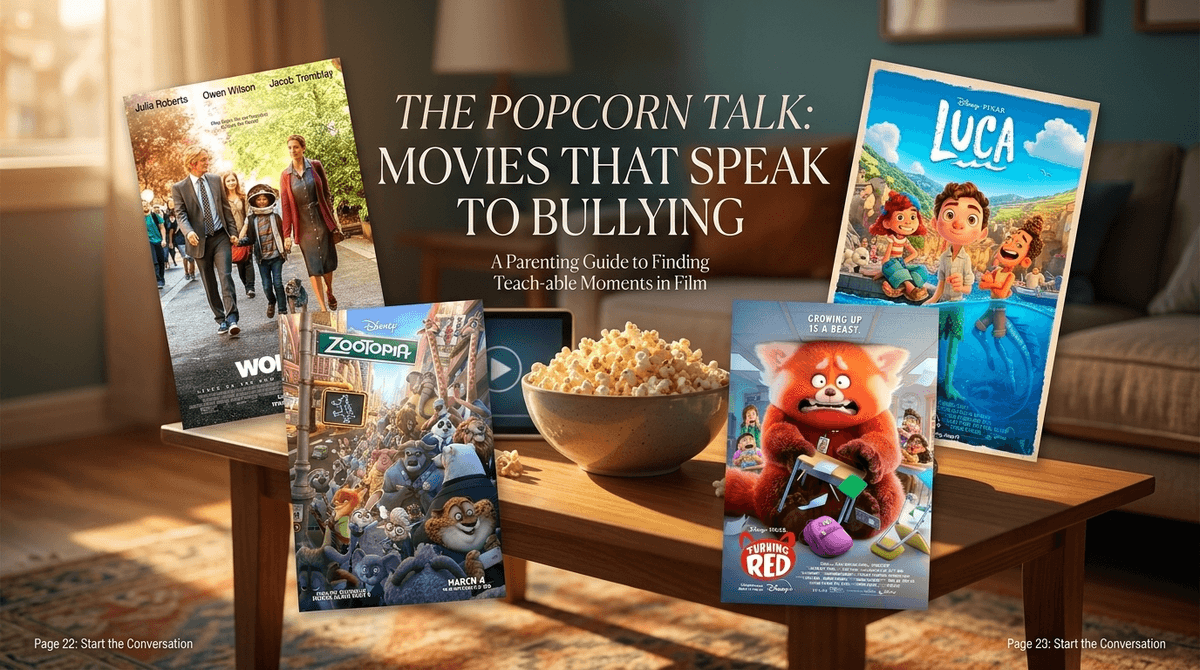
TL;DR: If you’re looking for the absolute best movies to kickstart a conversation about bullying without your kid rolling their eyes and saying "bruh," start with Wonder (Ages 8+), Luca (Ages 6+), or Zootopia (Ages 8+). For the older elementary crowd (4th-5th grade), A Silent Voice is a masterclass in redemption, though it’s heavy.
Avoid the "after-school special" vibe—kids can smell a lecture from a mile away. Use these films as a "displacement" tool: it’s much easier for a 9-year-old to talk about why a character was a jerk than to admit they got called "Ohio" in the Roblox chat today.
We’ve all been there at school pickup. You hear a snippet of conversation about someone being "excluded" or a "fake friend," and your internal alarm goes off. By the time kids hit 3rd or 4th grade, the social dynamics get weirdly complex. It’s not just about who pushed whom on the playground anymore; it’s about "prestige," digital status, and the subtle art of making someone feel like an outsider.
In 2026, bullying often looks like being left out of a group thread or getting "cooked" in a YouTube comment section. But the core emotions? Those haven't changed since we were kids.
At Screenwise, we’re big fans of using media as a bridge. Instead of the dreaded "So, is anyone mean to you at school?" interrogation, we recommend the "Popcorn Talk." You watch a movie, eat some snacks, and talk about the characters. It lowers the stakes and opens the door.
Here is our no-BS guide to the best (and a few of the worst) movies for discussing bullying with your elementary-aged kids.
Ages 8+ This is the gold standard for a reason. It follows Auggie Pullman, a boy with facial differences entering a mainstream school for the first time. What makes Wonder so effective for a "Popcorn Talk" isn't just Auggie’s perspective—it’s the fact that the movie shifts perspectives to show the "bully" (Julian) and the "friend" (Jack Will). The Talk: Ask your kid, "Why do you think Julian felt the need to be mean?" It helps them see that bullying usually comes from the bully’s own insecurities, not the victim’s "weirdness."
Ages 10+ If you have a 5th grader who thinks they’re "too cool" for Disney, this anime is incredible. It’s a brutal, honest look at a boy who bullies a deaf classmate, only to become a social outcast himself later. It’s a story about redemption and the long-term impact of our actions. Fair warning: It deals with heavy themes like depression. It’s not "brain rot" entertainment; it’s a serious film that demands a post-movie chat.
Sometimes, the best way to talk about bullying is to not talk about "bullying" at all, but about "belonging."
Ages 6+ On the surface, it’s about sea monsters in Italy. In reality, it’s about the fear of being "found out" and the way people treat those they don't understand. Ercole, the town bully, is a classic example of "peaked too early" energy. The Talk: Focus on the phrase "Silenzio Bruno!"—which the characters use to shut down their inner critic. It’s a great tool for kids who struggle with the "internal bully" that tells them they aren't good enough.
Ages 8+ Zootopia is brilliant because it tackles systemic bullying and prejudice. When Nick Wilde (the fox) shares his flashback of being muzzled by the "prey" animals as a kid, it hits hard. The Talk: This is the perfect movie to discuss how groups of people (or animals) can be mean to others just because of what they are, not what they’ve done.
Elementary school is the birthplace of the "frenemy"—that kid who is your friend one day and your harshest critic the next.
Ages 8+ Let’s be real: Greg Heffley is often a terrible friend to Rowley. This movie (and the book series) is a fantastic "what NOT to do" guide. The Talk: Ask, "Is Greg actually a good friend to Rowley?" It’s a great way to talk about social climbing and how some kids will throw their friends under the bus to feel "cool."
Ages 9+ While mostly about puberty and family, it has a great subplot involving Tyler, the school "antagonist" who eventually just wants to be included. It shows that sometimes the kids who act out the most are the ones who just want to belong to the group.
Ages 6+ It’s an older flick, but the premise is perfect for 1st graders. A kid who gets bullied by a bigger kid takes his frustration out on an ant hill, only to be shrunk down and forced to live as an ant. The Talk: It’s a literal "walk a mile in their shoes" (or six legs) story. It’s simple, effective, and helps younger kids understand empathy.
Ages 6+ Lilo is "weird." She likes Elvis and photography and has a doll with "scary" features. The way the other girls in her hula class treat her is a very realistic depiction of "girl world" bullying—whispering, excluding, and name-calling. The Talk: Focus on "Ohana" and finding your "found family" when the "popular" kids aren't being kind.
Not every movie about bullying is helpful. Some are just mean-spirited or, frankly, unwatchable.
- Tall Girl (Netflix): Guys, this is just not it. The "bullying" the main character faces is... being 6'1"? In a world where kids are dealing with actual cyberbullying and systemic issues, this feels incredibly out of touch and "cringe." Skip it.
- Old-School 80s Comedies: While we love a bit of nostalgia, movies like The Karate Kid (the original) or Back to the Future often feature physical violence as the only solution to bullying. In 2026, telling your kid to "sweep the leg" is a one-way ticket to a school suspension. We want to teach de-escalation and boundaries, not "might makes right."
When the credits roll, don't jump into a 20-minute lecture. Try these specific prompts based on what you just watched:
- The Bystander Effect: "If you were Jack Will in Wonder, would you have laughed at the joke Julian made, even if you didn't think it was funny?"
- The Digital Angle: "Do you ever see kids being mean like Ercole in the Roblox or Minecraft chats?"
- The Redemption Question: "Do you think the bully in this movie deserved to be forgiven? Why or why not?"
Check out our guide on preventing cyberbullying in elementary school
By age 10, roughly 20-30% of kids report being bullied, and a huge chunk of that has moved into digital spaces. If we don't give them the vocabulary to talk about it in the living room, they won't bring it to us when it happens on their tablets.
Movies provide a "safe container." They allow kids to process the fear, the anger, and the social anxiety of elementary school from the safety of the couch.
Bullying is a "canon event" for almost every kid, but it doesn't have to be a trauma. Using films like Wonder or Zootopia helps build the empathy muscles they need to be "upstanders" rather than bystanders.
If you're worried about a specific app or game where your kid is spending time, take the Screenwise survey to see how your family's digital habits compare to your community.
Get more movies for 8-year-olds about kindness
Next Steps:
- Pick a "Movie Night" this Friday.
- Let your kid choose between two of the "Heavy Hitters" listed above.
- Keep the conversation light, but be ready to listen if they start connecting the movie to their own school day.