

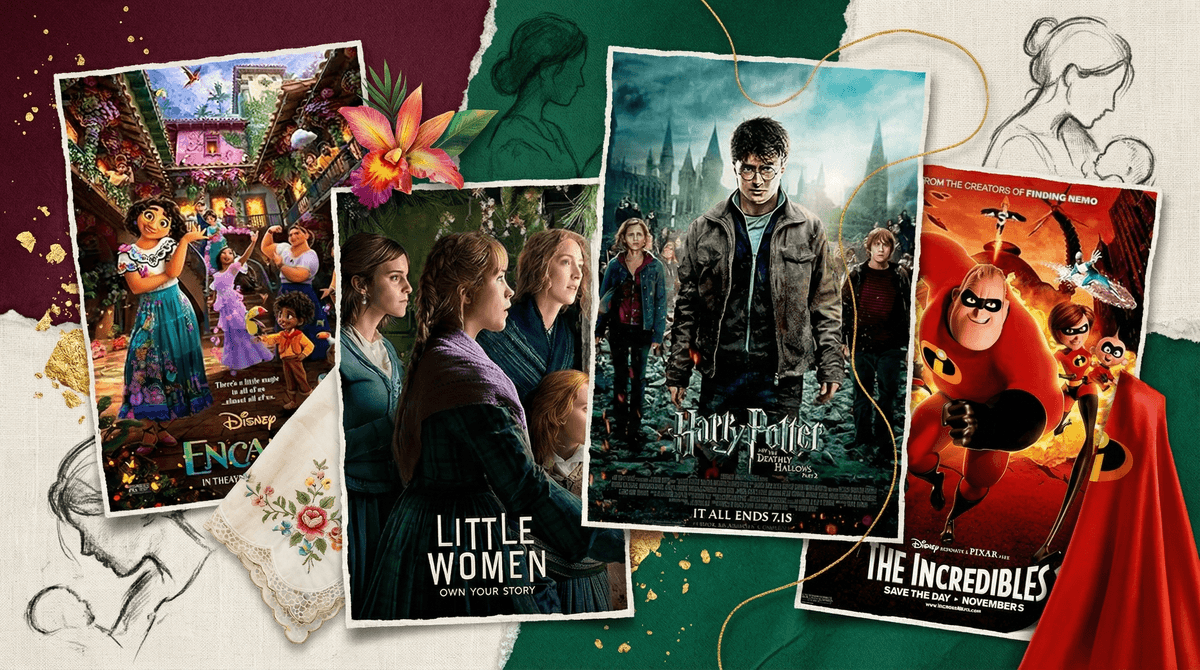
Look, Mother's Day is coming up, and every streaming service is about to serve you a "Movies to Watch with Mom" playlist that's basically just Steel Magnolias and whatever rom-com came out last year. But here's what's more interesting: what are our kids actually learning about motherhood from the movies they're watching?
Because let's be real—kids absorb everything. They're watching Encanto and forming opinions about intergenerational trauma before they can spell "intergenerational." They're seeing Mrs. Weasley in Harry Potter literally duel Bellatrix and thinking "yeah, that tracks."
Screenwise Parents
See allSo let's rank some iconic movie moms—not by who's "best" (there's no such thing), but by what they're actually teaching our kids about motherhood, sacrifice, family dynamics, and what it means to show up for your people.
Tier 1: The Gold Standard
Marmee March (Little Women) What she teaches: Motherhood as moral anchor, quiet strength, and letting your daughters become themselves.
Marmee is doing the impossible—raising four wildly different daughters during the Civil War while her husband is away, and somehow each girl feels seen. When Jo explodes with anger, Marmee doesn't shame her. She says "I'm angry nearly every day of my life." That moment? Chef's kiss. She's showing kids that good parents have feelings too, and that managing them is part of the work.
Mrs. Weasley (Harry Potter series) What she teaches: Chosen family, fierce protection, and that love is an action verb.
Molly Weasley takes in Harry without hesitation, knits him sweaters, and eventually screams "NOT MY DAUGHTER, YOU BITCH" before taking down one of the most dangerous witches alive. She's teaching kids that family isn't just biology, that mothers can be warriors, and that protective love is a superpower. Also that hand-knit sweaters are non-negotiable.
Helen Parr/Elastigirl (The Incredibles) What she teaches: Mothers are whole people with their own identities, dreams, and capabilities.
Helen is literally stretching herself thin (sorry) trying to be a perfect suburban mom while suppressing her superhero identity. But when crisis hits, she doesn't just save her kids—she flies the plane, fights the bad guys, and tells her children in no uncertain terms that "if they're killed, I'll be very upset." She's competent, she's struggling with identity loss, and she's not apologizing for either. Kids watching this see a mom who's allowed to be complex.
Tier 2: Complicated But Real
Lorelai Gilmore (Gilmore Girls) What she teaches: Parenting through friendship, breaking generational patterns, and that it's okay to be imperfect.
Lorelai had Rory at 16 and built an entire life around being the opposite of her own mother. She's more best friend than traditional mom, which is both her superpower and her limitation. Kids watching see a parent-child relationship that's genuinely close, but also one where boundaries get blurry. It's a useful conversation starter about different parenting styles and what kids actually need versus what feels good in the moment.
Alma Madrigal (Encanto) What she teaches: How trauma shapes parenting, and how control masquerading as protection damages everyone.
Abuela isn't technically a mom to Mirabel, but she's the matriarch, and wow is she a teaching moment. She's so traumatized by losing her husband that she's built an entire family system around being "useful" and "magical enough." Kids watching this are getting a masterclass in generational trauma, impossible expectations, and what happens when love gets twisted up with performance. The fact that she gets a redemption arc? That's teaching kids that people can change and repair harm.
Mrs. George (Mean Girls) What she teaches: What NOT to do—trying to be the "cool mom" instead of an actual parent.
Amy Poehler's "I'm not a regular mom, I'm a cool mom" is iconic for a reason—it's cringe-inducing and everyone knows it. She's giving kids alcohol, trying to be their friend, and completely abdicating parental responsibility. This is a useful example for kids to see what happens when adults refuse to be adults. It's also a good reminder that your kids don't actually want you to be their friend—they want you to be their parent.
Tier 3: The "Let's Talk About This" Category
Lady Tremaine (Cinderella) What she teaches: Favoritism, emotional abuse, and how family structures can be weaponized.
Look, she's literally the wicked stepmother, but she's teaching kids something important: not all parents are safe, and sometimes family members are the perpetrators of harm. For kids in blended families or dealing with favoritism, seeing this dynamic named on screen can be validating. It's also a chance to talk about what makes someone's behavior abusive versus just strict or unfair.
Mother Gothel (Tangled) What she teaches: Narcissistic parenting, gaslighting, and how love can be manipulated.
"Mother knows best" is literally a gaslighting anthem. Gothel isolates Rapunzel, makes her doubt herself, and uses "love" as a control mechanism. Kids watching this—especially tweens and teens—are getting a crash course in emotional manipulation. This is actually one of the better examples in kids' media of what coercive control looks like, and it's worth talking through with older kids.
Here's the thing: kids are building their internal models of what parents "should" be from every input they get—including movies. They're watching how movie moms handle stress, conflict, sacrifice, and love, and they're filing it away as data points.
When they see Helen Parr struggling with identity loss, they're learning that mothers are allowed to have complex feelings about caregiving. When they see Marmee March letting Jo be angry, they're learning that good parents don't demand emotional perfection. When they see Mother Gothel, they're learning what abuse looks like even when it's wrapped in "I love you."
This doesn't mean every movie needs to be a parenting manual. But it does mean that co-viewing and conversation are your friends here. When you watch these movies together, you get to add context, ask questions, and help your kids process what they're seeing.
Ages 5-8: Stick with clearer examples like Mrs. Weasley, Helen Parr, and Marmee March. At this age, kids benefit from seeing different types of good mothering—nurturing, protective, adventurous. They're not ready for the nuance of Lorelai Gilmore or the darkness of Mother Gothel.
Ages 9-12: This is when you can introduce more complexity. Encanto is perfect for this age—they can understand family pressure and generational patterns. Mean Girls (PG-13, so use your judgment) can spark conversations about boundaries and what "cool parent" actually means.
Ages 13+: Teens can handle the full spectrum. They can analyze why Lorelai's approach works and doesn't work, understand the psychological manipulation in Tangled, and have real conversations about what they want their future parenting to look like.
Don't overthink it. You don't need to pause the movie every five minutes for a teaching moment. Just watch together, and then casually bring it up later:
- "What did you think about how Mrs. Weasley handled that situation?"
- "Do you think Alma was a good grandmother? Why or why not?"
- "Would you want a mom like Lorelai?"
Normalize complexity. Help your kids understand that most parents—including movie parents—are doing their best with varying degrees of success. Marmee March isn't perfect either; she's just trying really hard.
Use it as a mirror. Ask your kids what kind of parent they see you as, and what they appreciate or wish was different. This is vulnerable, but it's also incredibly connecting.
Movie moms aren't real, but the lessons kids take from them are. Whether it's Mrs. Weasley teaching them that love is fierce and protective, or Mother Gothel teaching them what manipulation looks like, these characters are shaping your kids' understanding of motherhood.
The good news? You get to be part of that conversation. You get to add nuance, context, and your own family's values to what they're seeing on screen.
And honestly? Most of us are doing a Marmee March/Helen Parr hybrid—trying our best, stretching ourselves thin, occasionally wanting to duel someone who threatens our kids, and hoping the hand-knit sweaters (metaphorical or literal) land well.
That's not just okay—it's actually pretty great.
Want to dig deeper into how media shapes kids' understanding of family dynamics? Check out our guides on how to talk to kids about complex family structures or movies that tackle divorce and separation well.
And if you want personalized recommendations based on your family's values and your kids' ages, take our family survey—we'll help you find the movies that actually align with what you're trying to teach.