

Screen Time for Babies and Toddlers: What Actually Matters
Let's be honest: you're here because someone—maybe your pediatrician, maybe your mother-in-law, maybe the internet—made you feel weird about handing your 18-month-old your phone at the grocery store checkout.
Here's the thing: screen time for babies and toddlers (birth to age 3) is genuinely different from screen time for older kids. Their brains are doing wild developmental gymnastics, and how they interact with media actually matters more than we initially thought. But also? You're not ruining your child by letting them watch Bluey while you make dinner.
The research is pretty clear on some things and frustratingly vague on others. Let's talk about what we actually know.
Babies and toddlers learn primarily through serve-and-return interactions—that back-and-forth dance of communication with real humans. When your baby babbles and you respond, their brain is literally building neural pathways. This is how they learn language, emotional regulation, cause-and-effect, and basically everything.
Screens don't do serve-and-return. Even "interactive" apps can't read your toddler's cues, adjust their response, or follow their interest the way a human can.
The other big thing: displacement. Every minute spent watching a screen is a minute not spent doing the things that build toddler brains—moving their bodies, manipulating objects, pretending, making a mess, demanding your attention for the 47th time today.
Does this mean screens are poison? No. It means they're not neutral, especially for the youngest kids.
The American Academy of Pediatrics guidelines:
- Under 18 months: Avoid screen media other than video chatting
- 18-24 months: If you want to introduce media, choose high-quality programming and watch together
- Ages 2-5: Limit to one hour per day of high-quality programming, co-viewed when possible
Now, let's translate this from pediatrician-speak:
Under 18 months is when screens provide basically zero developmental benefit and maximum displacement risk. That said, if you FaceTime with grandma or play a lullaby video during a meltdown, you're not breaking your baby. The guideline is about regular, daily use, not occasional survival mode.
18 months to 2 years is the gray zone. Some kids are ready for very limited, high-quality content (think Bluey or Daniel Tiger's Neighborhood), especially if you're watching together and talking about it. Others will just zombie out or get overstimulated.
Ages 2-5 is when quality content can actually support learning—but only if it's genuinely high-quality and ideally co-viewed. One hour is a reasonable daily limit, though plenty of families go over on weekends or sick days and their kids are fine.
Not all screen time is created equal. Here's what makes content appropriate for toddlers:
The good stuff:
- Slow-paced with clear storylines
- Educational without being preachy
- Characters that model emotional regulation and problem-solving
- Content that invites participation ("Can you find the blue ball?")
- Shows that reflect your values and family life
Examples: Bluey, Daniel Tiger's Neighborhood, Sesame Street, Elinor Wonders Why
The brain rot:
- Rapid scene changes and overstimulation
- Content designed to hold attention through sensory overload rather than story
- Unboxing videos, toy reviews, and algorithm-optimized YouTube content
- Anything with ads targeting kids
- Most YouTube Kids content, honestly (read more about YouTube Kids concerns)
Here's a good rule: if you watch 10 minutes and feel like your brain is melting, it's probably not great for your toddler either.
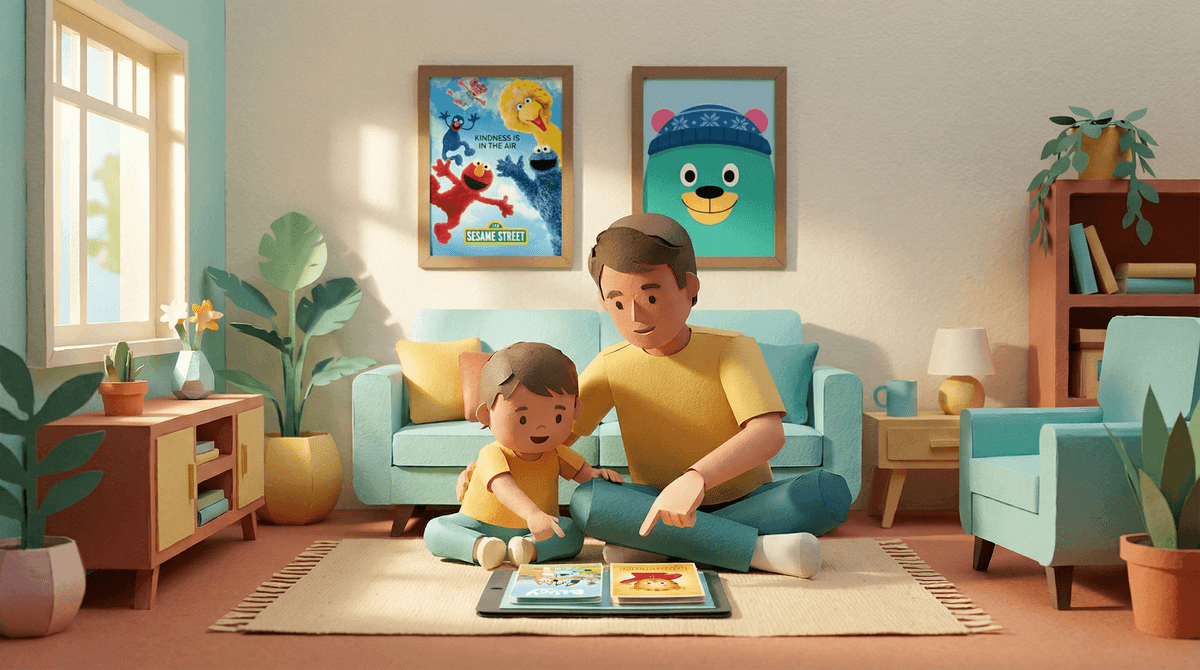
The research on this is really consistent: when parents watch with their toddlers and talk about what's happening, kids learn more and the negative effects of screen time decrease.
Co-viewing means:
- Sitting with them (not just being in the room)
- Pointing things out: "Look, Daniel is feeling frustrated!"
- Asking questions: "What do you think will happen next?"
- Connecting to real life: "Remember when you felt sad like that?"
Does this mean you can never put on a show to get 20 minutes of peace? No. It means that when possible, co-viewing turns passive consumption into active learning.
For babies and young toddlers: skip them. The "educational" apps for 6-month-olds are marketing, not learning tools.
For older toddlers (2-3): there are some genuinely well-designed apps that teach letters, numbers, and problem-solving. But even the best apps should be:
- Time-limited (15-20 minutes max)
- Actually educational, not just branded with PBS characters
- Free of ads and in-app purchases
- Used alongside, not instead of, hands-on learning
Better than most apps: Khan Academy Kids is free, ad-free, and actually educational. Sago Mini apps are gentle and open-ended for younger toddlers.
But honestly? A cardboard box, some crayons, and your attention will always be better for development than any app.
Background TV is a problem. Even if your toddler isn't watching, having the TV on in the background reduces the quality and quantity of parent-child interactions. It's distracting for both of you. If you need background noise, music or podcasts are better choices.
Phones are different than TV. Toddlers with their own access to phones or tablets tend to have more behavior issues around screens—more tantrums when devices are taken away, more difficulty self-regulating. Keep devices parent-controlled.
Car screens are a thing now. Look, if you're doing a 6-hour drive, nobody's judging the iPad. But making screens the default for every car ride trains kids to need entertainment constantly. Sometimes boredom is okay.
You will break your own screen time rules. You'll have a newborn and a toddler and you'll put on Bluey for two hours so you can survive. You'll be sick. You'll be solo parenting. You'll have a work emergency.
This is fine. Screen time guidelines are about patterns, not perfection. What matters is your typical week, not your worst day.
The guilt around toddler screen time is real, but it's also often misplaced. Your toddler is not going to have developmental delays because you let them watch TV while you made dinner three times this week.
For babies and toddlers, less is genuinely better when it comes to screens. Not because screens are evil, but because there are so many better ways for young kids to learn and grow.
When you do use screens:
- Choose high-quality, age-appropriate content
- Watch together when possible
- Keep it time-limited
- Don't feel guilty about occasional survival mode
The goal isn't zero screen time (unless that works for your family). The goal is being intentional about when, how, and why screens are part of your toddler's day.
- Audit your current setup: How much screen time is your toddler actually getting? Is it mostly high-quality content or YouTube rabbit holes?
- Try co-viewing: Pick one show this week and actually watch it with your toddler. Talk about what's happening. See if it changes the experience.
- Create screen-free zones: No devices during meals or in bedrooms is a good place to start.
- Find alternatives: Have a list of 5-10 non-screen activities ready for those "I'm desperate" moments—play dough, water play, music, going outside, helping you with chores.
Explore more about age-appropriate shows for toddlers or learn about setting up healthy screen habits early.
You've got this. And your toddler is going to be fine.