

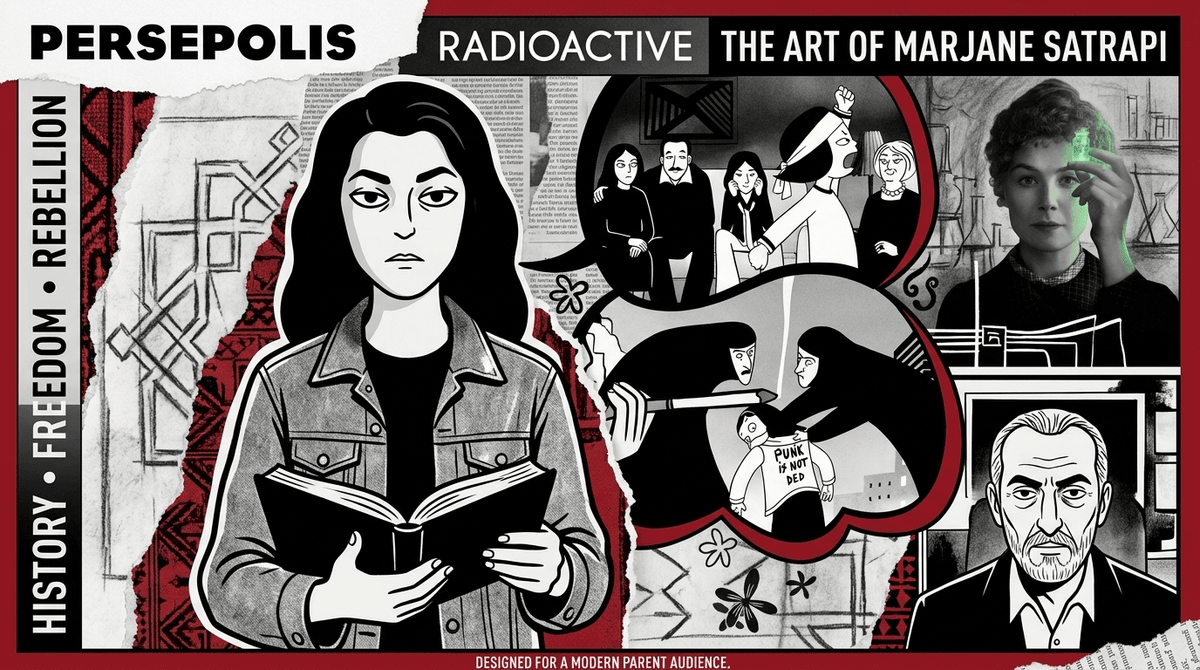
Marjane Satrapi didn’t write for kids, but she wrote the exact books that turn kids into thinking adults. With the news of her passing this week, there’s no better time to hand your teen a copy of Persepolis and let them see what it actually looks like to grow up in the middle of a revolution. She was a punk-rock force who proved that history isn't just a list of dates in a textbook—it’s a messy, funny, terrifying story about trying to stay yourself when the world is demanding you be someone else.
TL;DR
Marjane Satrapi was the legendary creator of Persepolis, a graphic memoir that is essential reading for any teen interested in history, freedom, or rebellion. Following her death in June 2026, parents should look to her work—including the Persepolis movie and her collaborative book Woman, Life, Freedom—as the ultimate bridge for talking about global politics and personal identity.
If your kid thinks history is boring, they haven't met "Marji." Satrapi’s Persepolis follows her childhood in Iran during the Islamic Revolution. It’s got everything a teenager actually cares about: wanting to wear Nikes and listen to Iron Maiden, arguing with parents, and realizing the people in charge might be full of it. It’s gritty, it’s honest, and it doesn't sugarcoat the violence of war or the suffocating nature of fundamentalism.
The reason it sticks is the art. Satrapi used a high-contrast, black-and-white style that makes the heavy stuff digestible without losing its impact. It’s one of the best books for kids hitting that middle-to-high-school transition because it treats the reader like an adult. It assumes they can handle the nuance of a girl who loves her country but hates its government.
While Persepolis is the heavyweight champ, Satrapi’s later work shows a creator who never stopped pushing.
- Woman, Life, Freedom: This is a collaborative graphic novel she spearheaded to document the 2022 Iranian protests. It’s a vital piece of modern history that shows the fight Satrapi started in the 70s is still happening.
- Chicken with Plums: A more poetic, melancholic story about a musician who loses the will to live. It’s a great pick for the artistic, "emo" teen who wants something deeper than a standard superhero arc.
- Radioactive: Satrapi also directed this biopic about Marie Curie. It’s stylized and weird in the best way, focusing on the human cost of scientific genius. It’s a solid Friday night watch for a kid into STEM who also likes a bit of visual flair.
Satrapi was a vocal defender of the graphic novel as a "real" medium. For kids who struggle with dense blocks of text—or those who just think visually—her work is a godsend. It builds the "language comprehension" strands of literacy by forcing them to interpret facial expressions, pacing, and symbolism alongside the dialogue. If you’re trying to move a kid from Diary of a Wimpy Kid to something with more meat on its bones, Satrapi is the bridge.
You don’t need to be a Middle East expert to talk about Satrapi’s work with your kid. The core of her stories is universal.
- Ask about the "small rebellions": In Persepolis, Marji gets in trouble for a Kim Wilde poster and denim jackets. Ask your kid: "What are the things you’d refuse to give up if the rules suddenly changed?"
- Discuss the "Hero" vs. the "Human": Satrapi doesn’t draw herself as a perfect martyr. She’s often selfish, stubborn, and wrong. Ask: "Why does it matter that she shows her mistakes and not just her brave moments?"
- The Power of Witnessing: Satrapi died "from sadness" according to some reports, deeply affected by the state of the world. Talk about why she felt it was her job to draw these stories instead of just moving on with her life in France.
The Persepolis movie and book contain depictions of torture (done in a stylized, non-graphic way), execution, and some swearing. It’s heavy, but it’s the "real world" kind of heavy that teens actually respect. If your 12-year-old is ready for The Hunger Games, they’re ready for this.
Q: Is Persepolis appropriate for a 12-year-old? Yes, generally. While it deals with war and revolution, the graphic novel format makes the intensity manageable. It’s a staple in many 7th and 8th-grade classrooms for a reason—it’s the perfect age to start talking about these themes.
Q: Which is better, the Persepolis book or the movie? The Persepolis book is more detailed and covers her time in Austria more deeply, but the Persepolis movie is a visual masterpiece that Satrapi co-directed. Do the book first, then the movie.
Q: What are the content warnings for Marjane Satrapi's work? Expect themes of war, political imprisonment, and death. There is some smoking, social drinking, and "salty" language (mostly Marji being a defiant teen). It’s honest about the harshness of life under an oppressive regime.
Marjane Satrapi was a giant. She took the "comic book" and turned it into a weapon for truth and a mirror for every kid who feels like an outsider. Losing her in 2026 is a massive hit to the art world, but her work is the best possible inheritance for a generation of kids who need to know that their voice—and their rebellion—matters.
- Check out our best books for kids list for more graphic memoirs.
- See our best movies for kids list to find more high-quality animation for teens.
- Get more graphic novel recommendations
