

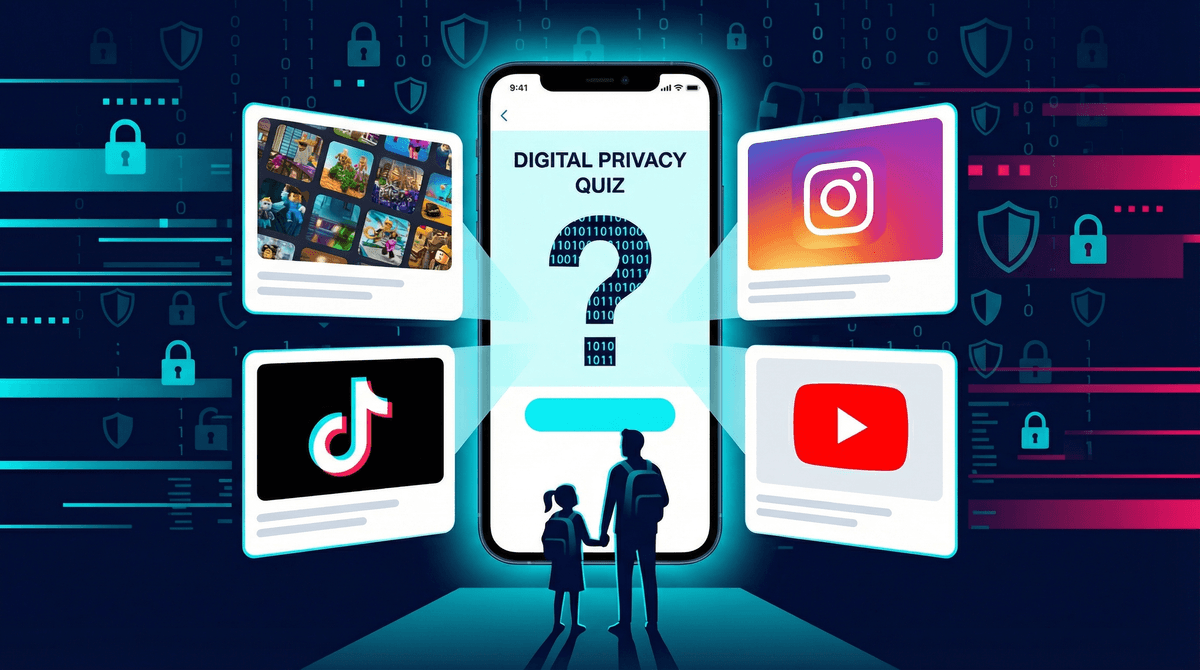
Look, I'll be honest: most adults can't make it through a privacy policy without their eyes glazing over. We all just scroll to the bottom and click "I Agree" because who has 45 minutes to read about data collection protocols?
But here's the thing — our kids are out there using apps, games, and platforms that are collecting a lot of information about them. And most of us have no idea what we've actually agreed to on their behalf.
So let's make this fun (and slightly terrifying). Take this quiz with your kid and see who actually knows what's happening with their digital footprint.
Question 1: When you use a "free" app, how does the company make money?
A) They're just really nice people
B) By selling your data to advertisers
C) Through optional in-app purchases
D) Both B and C (spoiler: it's usually this one)
Question 2: True or False: If you delete a photo from Instagram, it's completely gone from their servers.
False! Instagram's data policy states they can keep your content even after deletion for "backup" purposes. Fun!
Question 3: What information can Roblox collect about players?
A) Just their username
B) Their location, device info, and who they interact with
C) Everything they type in chat
D) All of the above
The answer is D. Roblox collects a lot of data, including geolocation, IP addresses, chat logs, and behavioral patterns. This isn't necessarily evil — it's how they moderate the platform and target ads — but most kids (and parents) have no idea.
Question 4: When a website says it doesn't share your "personal information," that means they're not sharing anything about you, right?
Nope! "Personal information" has a very specific legal definition. Many companies can still share "anonymized" data, behavioral data, device information, and more. They're technically telling the truth while sharing... almost everything.
Question 5: If your kid watches YouTube videos, what does YouTube know about them?
A) What videos they watch
B) How long they watch each video
C) What they search for
D) All of the above, plus recommendations based on their viewing patterns
It's D. YouTube's algorithm is incredibly sophisticated at building a profile of your kid's interests, attention span, and viewing habits. This is why the rabbit hole effect is so real — the algorithm knows exactly what will keep them watching .
.
Question 6: True or False: Once your child turns 13, they can sign up for any social media platform without parental permission.
Technically true in the U.S., thanks to COPPA (Children's Online Privacy Protection Act). But here's the catch: most platforms still require users to be older (Instagram and TikTok say 13, but their own terms of service recommend parental involvement). And just because they can doesn't mean they should.
Question 7: What happens to your kid's voice data when they use Alexa or Siri?
A) It disappears immediately
B) It's stored temporarily for processing
C) It's stored indefinitely unless you manually delete it
D) Depends on your settings
The answer is mostly C/D. By default, both Amazon and Apple store voice recordings to "improve their services." You can delete them, but you have to know where to look and actually do it.
Question 8: If your kid plays Fortnite, what does Epic Games know about their gaming habits?
A) How long they play
B) Who they play with
C) What they buy in the game
D) All of the above, plus their skill progression, favorite modes, and behavioral patterns
All of the above! Epic Games collects extensive data on gameplay patterns, social connections, purchase history, and more. This data helps them design addictive features and target in-game purchases.
If you got more than half of these wrong, you're in good company. Privacy policies are deliberately confusing, and companies count on us not reading them.
But here's why it matters: our kids are growing up with digital profiles that follow them everywhere. The data collected today could affect them for years — from targeted advertising that exploits their vulnerabilities to potential college admissions or job applications that dig up their digital past.
And beyond the creepy factor, there's a real safety concern. When apps collect location data, chat logs, and behavioral patterns, that information can potentially be accessed by hackers, sold to data brokers, or used in ways we never intended.
1. "Free" apps aren't actually free. If you're not paying for the product, you (or your kid) are the product. Their attention and data are what's being sold.
2. Age gates are easily bypassed. That "Are you 13?" checkbox? Kids lie. All the time. And platforms know this but have little incentive to verify.
3. Privacy settings exist, but they're buried. Most apps default to maximum data collection. You have to actively opt out, and even then, you're still sharing more than you think.
4. Kids don't understand the permanence of digital data. That embarrassing video? That mean comment? That photo they wish they hadn't posted? It might be out there forever, even if they delete it from their account.
5. Data breaches happen constantly. Even if you trust the company with your kid's data, hackers might not be so trustworthy. In 2023 alone, millions of children's accounts were compromised across various platforms.
This isn't a one-and-done conversation. Digital privacy needs to be an ongoing dialogue, just like stranger danger or internet safety.
For younger kids (ages 6-10): Keep it simple. "When you use this app, the company can see what you're doing. It's like if someone was watching over your shoulder. That's why we need to be careful about what we share."
For tweens (ages 10-13): Get more specific. Show them how to check privacy settings together. Talk about why companies want their data (spoiler: money). Discuss what information is okay to share and what should stay private.
For teens (ages 13+): Have real conversations about digital footprints and future consequences. Show them news stories about data breaches or people losing opportunities because of old social media posts. Help them understand that "private" accounts aren't really private.
1. Review privacy settings together. Pick one app or platform your kid uses most and go through the privacy settings together. Make it a monthly habit.
2. Set up parental controls where appropriate. Roblox has parental controls, so does YouTube, so does pretty much every major platform. Use them.
3. Consider a family media agreement. Create rules together about what information is okay to share online and what isn't. When kids help create the rules, they're more likely to follow them.
4. Use privacy-focused alternatives when possible. DuckDuckGo instead of Google, Signal instead of regular texting, browsers with built-in tracking protection.
5. Model good behavior. If you're oversharing on social media or clicking "I Agree" without reading anything, your kids will do the same.
Nobody expects you to become a privacy expert overnight. But understanding the basics of what data is being collected from your kids — and having conversations about it — is part of modern parenting.
The goal isn't to scare kids away from technology or make them paranoid. It's to help them become informed digital citizens who understand that their data has value and they get to decide (within reason) how it's used.
So how'd you do on the quiz? If you got a few wrong, don't stress. Now you know more than you did ten minutes ago, and that's what matters.
Want to dig deeper into your family's specific digital habits and get personalized guidance? That's exactly what Screenwise is here for. We'll help you understand not just the what, but the "now what?" for your unique family situation.
Because at the end of the day, the best privacy policy is the one you actually understand.