

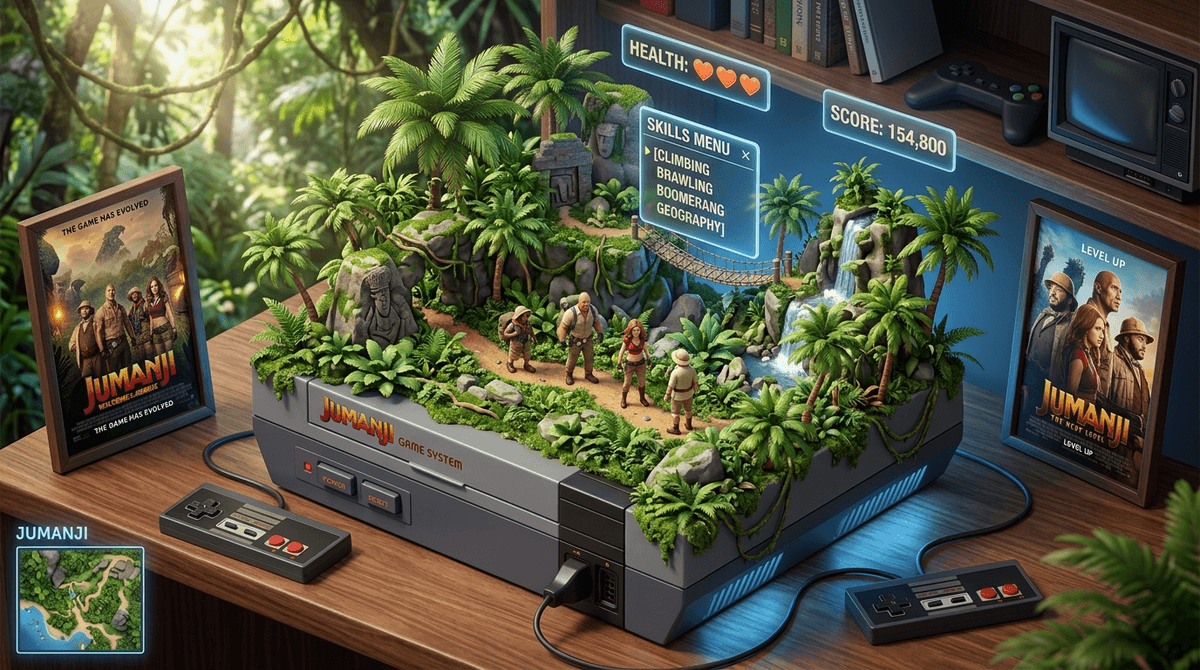
TL;DR: Jumanji: Welcome to the Jungle is more than just a funny Rock-and-Kevin-Hart movie; it’s a brilliant metaphor for how our kids navigate digital identity. It’s the perfect "gateway" film to discuss why they choose certain avatars in Roblox, why they act differently on Discord, and how "game logic" dictates their real-world frustrations.
Quick Links:
If you grew up with the 1995 original where Robin Williams dealt with a board game coming into the real world, throw that premise out the window. In this 2017 reboot, the game evolves. It realizes kids don't play board games anymore, so it transforms into a retro video game console.
Four high school archetypes—the nerd, the jock, the popular girl, and the cynical loner—get sucked into the game during detention (very The Breakfast Club vibes). The twist? They inhabit avatars that are the total opposite of their physical selves. The scrawny nerd becomes a massive action hero (Dwayne Johnson), the social media-obsessed "it girl" becomes a "middle-aged fat man" (Jack Black), and the star athlete becomes a diminutive weapons valet (Kevin Hart).
It’s a body-swap comedy, sure, but it’s also a surprisingly deep look at what happens when we step into a digital skin.
We spend a lot of time worrying about "screen time" as a raw number, but we don't always talk about the identity kids assume while they’re on those screens.
When your kid is playing Fortnite or hanging out in Roblox, they aren't just "playing a game." They are inhabiting a persona. Jumanji: Welcome to the Jungle gives us a vocabulary to talk about that.
The Avatar vs. The Self
In the movie, Spencer (the nerd) is terrified of everything. But as Dr. Bravestone, he has "smoldering intensity" as a literal superpower. For our kids, the internet can feel the same way. A shy middle-schooler might feel like a god-tier leader in a Minecraft server.
This movie shows that while the avatar gives you the ability to be brave, the courage actually has to come from the person inside. It’s a great way to ask your kid: "Who are you when you’re playing as your avatar? Is that person different from who you are at school?"
Understanding "Game Logic"
One of the funniest and most educational parts of the movie is how it handles NPCs (Non-Player Characters). The characters try to talk to a guide, Nigel, but he just repeats the same three lines of dialogue because he’s programmed that way.
If you’ve ever seen your kid yelling at a screen because a game is "glitching" or "unfair," they are dealing with the frustrations of game logic. Jumanji: Welcome to the Jungle visualizes things like:
- Limited Lives: The characters have tattoos on their arms representing their three lives. When they lose one, they fall from the sky and respawn.
- Strengths and Weaknesses: Every character has a pop-up menu showing what they’re good at (Climbing, Boomerang throwing) and what kills them (Cake, Speed).
- Cutscenes: Moments where they lose control of their characters to watch the "story" happen.
Understanding these tropes helps parents realize that games aren't just "chaos"—they are systems with very rigid, sometimes frustrating rules.
Learn more about common gaming terms every parent should know
If your family enjoyed the themes in Jumanji, here are a few other media items that handle digital identity and "game worlds" in interesting ways:
Ages 10+ This is essentially "Jumanji from the perspective of the NPC." Ryan Reynolds plays a background character in a Grand Theft Auto-style game who becomes self-aware. It’s a fantastic look at AI, digital ethics, and choosing to be a "good guy" in a world designed for chaos.
Ages 12+ A bit more intense and stylized, this movie (and the Ready Player One book) explores a future where the entire world lives in a VR simulation. It tackles the "escapism" aspect of digital life—why would you stay in a dying real world when you can be a hero in the virtual one?
Ages 6+ For the younger set, this is the gold standard. It explores the idea that just because you are "programmed" to be a villain doesn't mean you are a "bad guy." It’s a great entry point for talking about labels and expectations.
Ages 10+ If you want to see "digital persona" in action, watch your kids play this. It’s a game of social deception. You have to act like a "crewmate" even if you’re the "imposter." It’s a masterclass in how kids use chat and behavior to craft a false identity to win a game.
Jumanji: Welcome to the Jungle is rated PG-13, and for once, the rating is pretty spot on, though many parents of 10-12 year olds find it perfectly acceptable.
What to watch out for:
- Humor: There is a fair amount of "body humor." Since Jack Black is playing a teenage girl in a man's body, there’s a scene where he has to learn how to... use the restroom. It’s played for laughs and isn't graphic, but it’s definitely "middle school humor."
- Violence: It’s "video game violence." Characters explode into pixels when they die, or get eaten by giant snakes/rhinos. It’s startling but not gory.
- Language: There are a few S-words and some mild profanity, but nothing that’ll make a modern parent’s hair turn gray.
Check the full WISE score for Jumanji: Welcome to the Jungle
The most powerful part of the movie is the character arc of Bethany (the popular girl). She starts the movie obsessed with her phone and her looks. By the end, she’s literally sacrificed a "life" to save another character and has learned to appreciate the world without a filter.
Try these conversation starters after the movie:
- The "Opposite" Avatar: "If you got sucked into a game, what avatar would be the total opposite of you? Would that be fun or scary?"
- The Phone Habit: "Bethany was miserable without her phone at first. Do you ever feel that 'phantom' itch to check your device when we’re out doing something?"
- NPC Empathy: "In the movie, the NPCs are just code. But in games like Roblox, those are real people. Is it easier to be mean to someone when they just look like a blocky character on a screen?"
- Strengths/Weaknesses: "If you had a Jumanji-style menu of your real-life strengths and weaknesses, what would be on it? (And no, 'eating pizza' can't be your only strength.)"
Jumanji: Welcome to the Jungle is that rare blockbuster that is actually about something relevant to our kids' lives. It’s not "brain rot" content; it’s a high-energy exploration of empathy.
It teaches kids that the "skins" we wear online are temporary, but the way we treat our teammates—and the courage we show when the stakes are high—is what actually stays with us when we "log out."
Next Steps:
- Watch the movie for your next family night.
- Ask your kids to show you their current avatar in their favorite game.
- Read our guide on the "Avatar Effect" and how it impacts kid behavior
- If they loved the movie, check out the sequel: Jumanji: The Next Level, which introduces themes of aging and legacy (and has a great Danny DeVito/Danny Glover dynamic).