

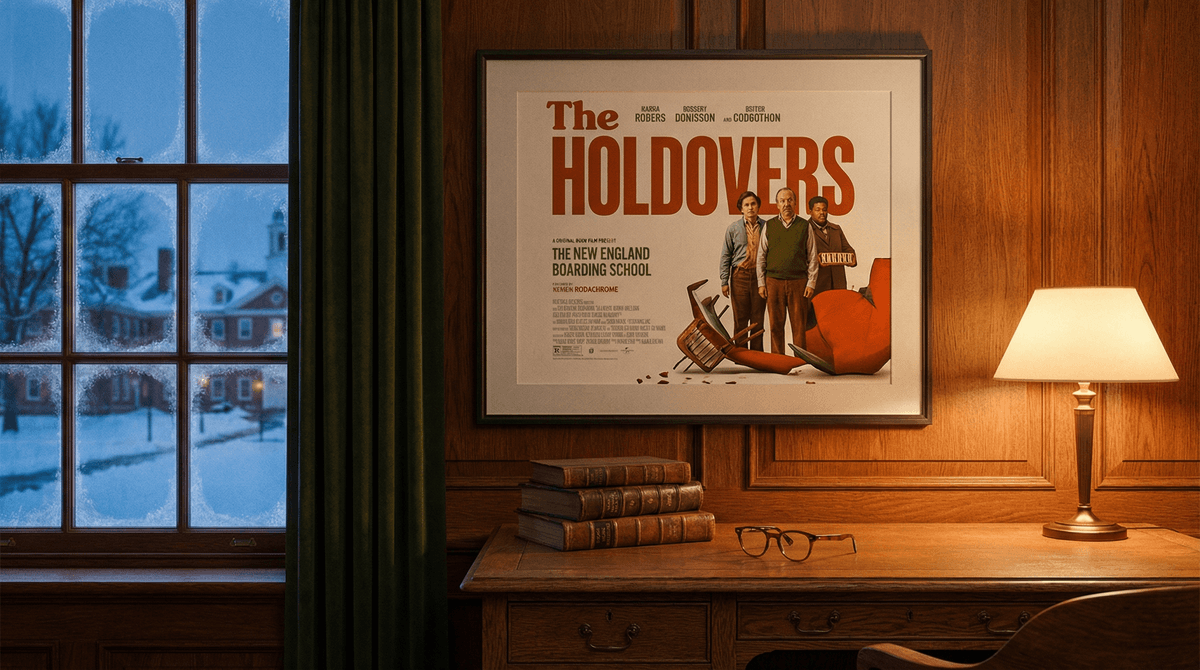
Is The Holdovers Safe for Teens? What Parents Need to Know About This R-Rated Drama
The Holdovers is a thoughtful, character-driven drama that earned its R rating primarily through frequent strong language (especially the f-word), some drinking and drug use, and mature thematic content about grief, loneliness, and class differences. For most families, ages 14+ is the sweet spot, though mature 13-year-olds who can handle profanity and complex emotional themes could be fine with parental guidance. This isn't gratuitous content—it's a genuinely moving film about connection and healing—but the language is pervasive enough that you need to know what you're walking into.
The Holdovers is Alexander Payne's 2023 period drama set during Christmas break 1970 at a New England prep school. Paul Giamatti plays Paul Hunham, a curmudgeonly classics teacher stuck babysitting students who can't go home for the holidays. He's left with one student—Angus Tully (Dominic Sessa), a smart but troubled teen—and the school's head cook Mary Lamb (Da'Vine Joy Randolph), who recently lost her son in Vietnam.
It's essentially a three-person character study about lonely people finding unexpected family during the darkest time of year. The film earned five Oscar nominations including Best Picture, and Randolph won for Best Supporting Actress. Critics loved it, calling it a throwback to 1970s character-driven cinema.
Language: The Big One
This is the primary concern. The f-word appears frequently—we're talking 30+ times throughout the film. It's not shock-value cursing; it's how these characters actually speak, especially the bitter, intellectual teacher and the frustrated teenage boy. You'll also hear multiple uses of "shit," "ass," "damn," "hell," and some uses of "bastard."
There's also one use of a homophobic slur in a period-appropriate context (it's 1970) and some crude sexual references in teenage boy conversations.
If your teen watches Stranger Things or The Bear, the language level is comparable—but more consistent throughout.
Substance Use
Several scenes show adults drinking alcohol, sometimes to excess. Paul Hunham drinks whiskey regularly, and there's a scene where he and Angus get drunk together at a party. Mary also drinks to cope with her grief.
There's marijuana use—Angus smokes weed in one scene, and there are references to drug use at the prep school.
A character mentions taking prescription medication (implied to be for mental health), which becomes a minor plot point.
None of this is glorified, but it's also not heavily condemned. It's presented as part of how these characters cope with pain.
Sexual Content
Minimal. There are some crude sexual jokes and references typical of teenage boys. One brief scene shows a woman in a bra. Some discussion of sex and relationships, but nothing graphic or explicit.
This is honestly one of the tamest R-rated films in this category.
Mature Themes
This is where parents need to think about their individual teen's emotional readiness:
- Grief and loss: Mary is mourning her son's death in Vietnam. It's heartbreaking and raw.
- Depression and suicidal ideation: Angus struggles with dark thoughts, and there are references to mental health struggles.
- Class and privilege: The film explores economic inequality and how wealth (or lack thereof) shapes opportunities.
- Parental abandonment: Angus feels rejected by his family, which drives much of his anger.
- War and death: Vietnam War references throughout, including the impact on families.
These aren't light topics, but they're handled with nuance and empathy. The film doesn't offer easy answers—it sits with discomfort in a way that's actually quite mature.
Violence
Very minimal. One brief physical altercation between students. No gore, no action sequences.
Here's the thing that makes The Holdovers different from a lot of R-rated content: it's not trying to be edgy or shocking. The mature content serves the story.
The teen character is genuinely well-written. Angus isn't a stereotype—he's smart, angry, vulnerable, and funny. Dominic Sessa (who was actually a high school student when cast) brings real authenticity to the role. Teens who feel like outsiders, who struggle with family dynamics, or who are intellectually curious but emotionally struggling will see themselves in Angus.
It's about found family and human connection. At its core, this is a film about three lonely people learning to care for each other. In an era of Marvel spectacle and TikTok attention spans, there's something valuable about a slow, character-driven story that rewards patience.
It treats teens as capable of complexity. The film doesn't talk down to young viewers or simplify difficult emotions. It trusts that you can sit with ambiguity and nuance.
Ages 13-14: Possible with parental co-viewing if your teen is mature and you're comfortable with strong language. Good for kids who already watch R-rated films with you or who are ready for more adult storytelling. Skip if profanity is a hard boundary in your home.
Ages 15-17: Appropriate for most teens. The language will be familiar to anyone in high school, and the themes are actually quite relevant to teenage experiences of feeling isolated or misunderstood.
Ages 18+: Obviously fine, though worth noting that college-age viewers often find this film particularly resonant.
Consider skipping if: Your teen is sensitive to themes of grief and loss (especially recent), struggles with depression or suicidal thoughts without strong support systems, or if you have zero tolerance for profanity.
If you decide this is right for your family, consider making it a co-viewing experience:
Before watching: Set expectations about the language and themes. You might say, "This has a lot of swearing, and it deals with some heavy stuff about loneliness and grief. But it's a really beautiful story about connection."
During: Don't feel like you need to pause and explain everything. Let the film breathe. But be present if your teen wants to talk about what they're seeing.
After: Ask open-ended questions:
- "What did you think about the relationship between Paul and Angus?"
- "Have you ever felt like Angus—like you didn't quite fit in anywhere?"
- "What do you think Mary was going through?"
This is also a great opportunity to talk about the 1970s setting—Vietnam War context, what boarding schools were like, how different (and similar) teenage life was 50+ years ago. Learn more about using period films as conversation starters .
.
If you're trying to gauge whether your teen can handle The Holdovers:
Similar in maturity to: The Perks of Being a Wallflower, Lady Bird, Dead Poets Society
Less intense than: The Breakfast Club (despite being PG-13, it has heavier content), Euphoria, anything by Tarantino
More mature than: Most PG-13 Marvel films, The Hunger Games series, Harry Potter films
Common Sense Media rates this 14+, which aligns with most parent reviews. The consensus is that the language is the main barrier, but the themes and emotional depth make it worthwhile for mature teens.
Some parents wish they'd waited until 15 or 16, primarily because younger teens didn't fully appreciate the film's slower pace and character focus. This isn't a criticism of the film—it's just honest about what engages different age groups.
The Holdovers is one of those rare films that's both critically acclaimed and genuinely meaningful for teenage viewers—if they're ready for it. The R rating is earned, mostly through pervasive strong language, but there's real value here: a thoughtful exploration of loneliness, connection, grief, and healing.
Watch it if: Your teen is 14+ and ready for mature language and complex emotional themes. You want to share a genuinely beautiful film that might spark meaningful conversation.
Skip it if: Frequent profanity is a dealbreaker, your teen prefers faster-paced entertainment, or they're not in a good emotional space to engage with heavy themes.
The smart move: Watch it yourself first if you're on the fence. It's only 133 minutes, and you'll know within 20 minutes whether the language and tone work for your family. Then you can make an informed decision about watching together.
Looking for other thoughtful films for teens that balance mature content with meaningful storytelling? Check out coming-of-age films for teenagers or movies that spark family conversations.