

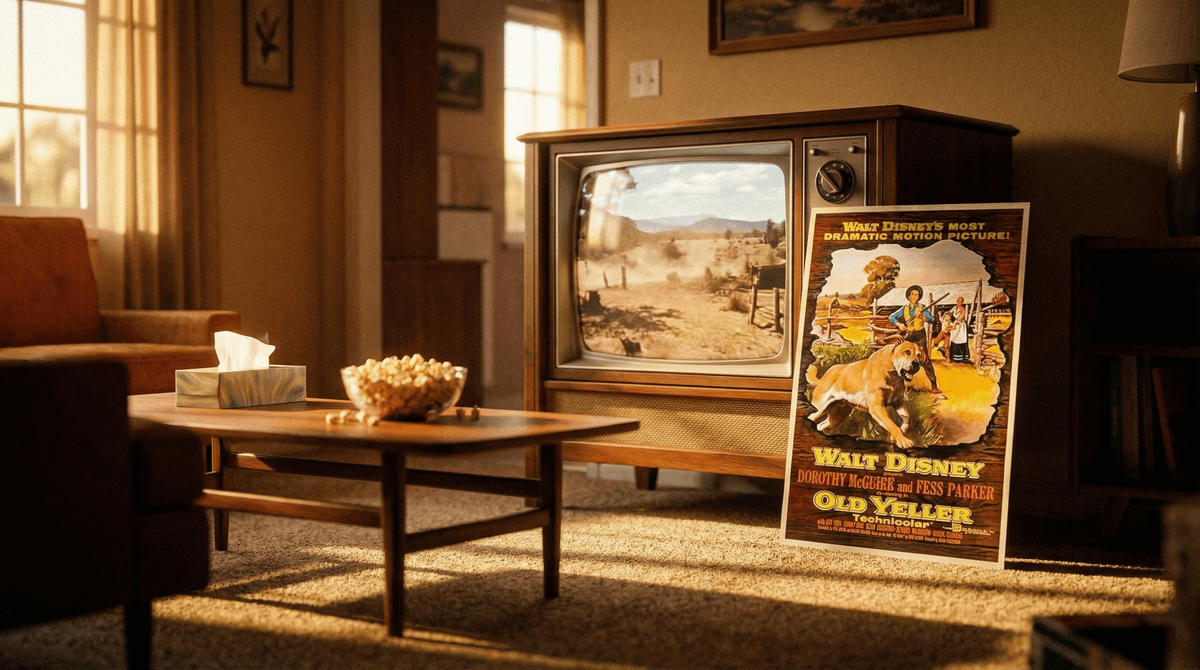
Is Old Yeller Too Intense for Your Child?
TL;DR: Old Yeller is recommended for ages 8+, but honestly, that ending hits hard even for adults. If your kid can handle emotional complexity, animal loss, and some tense action sequences, they're probably ready. If they're still recovering from when the fish died, maybe wait a year or two.
Released in 1957, Old Yeller is one of those Disney films that defined what "growing up" means for generations of kids. It's set in 1860s Texas, following 14-year-old Travis who's left in charge of the family farm while his father is away on a cattle drive. A stray yellow dog shows up, Travis initially hates him, they bond deeply, and then... well, we'll get to that.
The film tackles responsibility, love, loss, and what it means to do hard things when you're the one in charge. It's genuinely well-made, with strong performances and beautiful cinematography. But it's also emotionally devastating in a way that catches a lot of families off guard.
What's Actually Intense
Animal peril and violence: Old Yeller fights a bear, fights wild hogs, and gets attacked by a rabid wolf. These scenes are genuinely scary and realistic for their time. No cartoon physics here—when animals fight, it looks and sounds violent.
The rabies storyline: The wolf that attacks Old Yeller has rabies, and the film doesn't shy away from showing what that means. Kids see the infected wolf acting erratically, foaming at the mouth. They learn what rabies does. And they understand the implications before Travis's mother explains them out loud.
That ending: I'm not going to spoil it if somehow you've avoided this cultural touchstone for decades, but let's just say Old Yeller is famous for its ending the way Marley & Me is famous for its ending. Except Old Yeller's is more abrupt and arguably more traumatic because of the choice Travis has to make.
Mature themes about responsibility: This isn't just "sad dog movie." It's about a 14-year-old being forced to make an adult decision that will haunt him. The film treats this seriously and doesn't offer easy comfort.
What's NOT That Bad
The film is surprisingly clean by modern standards. No language issues, no inappropriate content, no scary monsters or jump scares. The violence is all animal-related and while intense, it's not gratuitous.
The pacing is also pretty slow by today's standards, which actually helps—there's time to process what's happening between the intense moments.
Ages 5-7: Too early for most kids. The animal violence will be scary, and the ending is too emotionally complex. They won't understand why certain things have to happen, which makes it more traumatic, not less. If your kid is still working through Charlotte's Web, they're not ready for Old Yeller.
Ages 8-10: This is the sweet spot, but know your kid. Can they handle:
- Seeing animals they love in danger?
- Understanding that sometimes there are no good choices, only hard ones?
- Processing grief that doesn't get neatly resolved?
If yes, they're probably ready. Have tissues handy and plan to talk afterward. This is the age where Old Yeller can be genuinely meaningful—they're old enough to understand the themes but young enough that it feels like a big, important story.
Ages 11+: Most kids this age can handle the content, though the ending will still hurt. At this age, they can appreciate the film's themes about growing up and responsibility. They might even recognize that Travis's journey mirrors their own transition into more adult responsibilities.
The highly sensitive kid exception: If your child is particularly sensitive to animal stories, add 1-2 years to these ranges. Some kids who can handle The Hunger Games at 11 will still be wrecked by Old Yeller at 13 because it's about a dog, and dogs hit different.
Set expectations: "This is a movie about a boy and his dog in the Old West. Some parts are exciting and some parts are really sad. The ending is especially sad, but it's an important story about growing up."
Context about the time period: Help them understand that this takes place in the 1860s on an isolated farm. No vets, no modern medicine, different rules about animals and survival. This context matters for understanding the choices characters make.
Check in during the movie: The wolf attack scene is a good natural pause point. "You doing okay? Want to keep going?" Giving kids agency over whether to continue can help them feel less overwhelmed.
Don't pre-spoil the ending: I know it's tempting to soften the blow, but part of what makes Old Yeller powerful is experiencing the story as Travis experiences it. If you warn them too specifically, you rob them of the emotional journey.
This is a different kind of Disney movie: If your kids are used to Encanto or Moana where everything works out and everyone learns to love themselves, Old Yeller is going to feel jarring. Classic Disney was comfortable with darker, more complex stories.
The historical context matters: Some elements of frontier life depicted in the film might need explanation—why they can't just call a vet, why certain decisions about animals were made differently, what rabies meant before modern medicine. Without this context, some of Travis's choices might seem cruel rather than tragic.
It's okay if they cry: In fact, it's kind of the point. Old Yeller is designed to make you feel deeply. Don't rush to fix their sadness or minimize it. "Yeah, this is really sad. It's okay to cry about it."
The film's message is actually hopeful: Despite the tragic ending, Old Yeller is ultimately about resilience, love, and the fact that even painful experiences are worth having. Travis's final scene with the new puppy suggests that opening your heart again after loss is possible and necessary.
If you're thinking "I want to introduce my kid to meaningful animal stories but Old Yeller sounds too intense," try these first:
- Charlotte's Web: Sad ending, but more gentle and philosophical about death
- The Incredible Journey: Adventure and peril, but everyone survives (spoiler: it's worth it for younger kids)
- My Dog Skip: Emotional but less intense, good bridge to Old Yeller
- Where the Red Fern Grows: Actually might be MORE intense than Old Yeller, but as a book first, kids can control the pacing
For kids who loved Old Yeller and want more stories about responsibility and growing up, check out our guide to coming-of-age movies for kids.
Old Yeller is intense, no question. It's meant to be. That's what makes it a rite of passage film rather than just another dog movie. The question isn't really "is it too intense?" but rather "is my kid ready for this kind of intensity?"
You know your kid is ready when:
- They can sit through emotionally complex stories without getting overwhelmed
- They've experienced some kind of loss (a pet, a grandparent, a friend moving away) and processed it reasonably well
- They're starting to understand that not all problems have happy solutions
- They're curious about what it means to grow up and take on responsibility
Wait a bit longer if:
- They're still having nightmares from Bambi
- They need every story to end happily or they feel anxious
- They're going through a particularly sensitive period (recent loss, big life changes)
- Your gut says wait—seriously, trust your gut on this one
The beauty of Old Yeller is that it'll still be there when they're ready. And when they are ready, it's one of those films that can spark really meaningful conversations about love, loss, and what it means to do the right thing even when it breaks your heart.
Just maybe don't schedule it for a lighthearted Friday movie night. This is more of a "Sunday afternoon when we have time to process afterward" kind of film.
Have questions about other classic films and whether they're right for your kid? See age-appropriate classic movies for your kid or check out our guide to emotional movies that help kids process big feelings.