

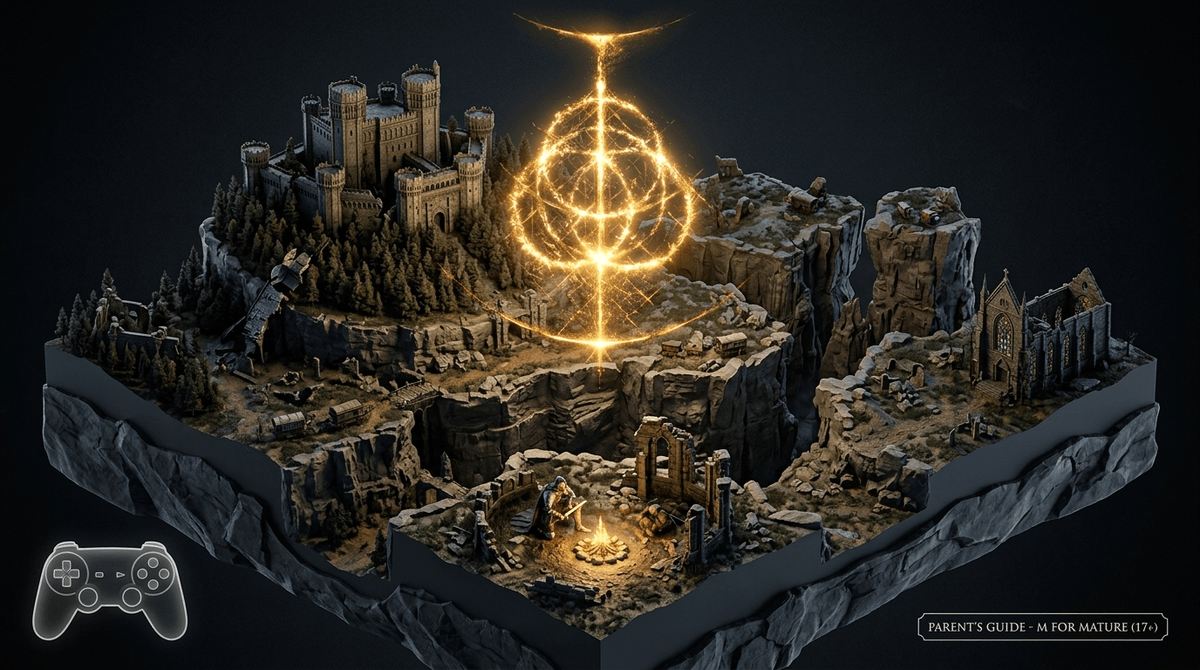
TL;DR: Elden Ring is a masterpiece of dark fantasy that is rated M for a reason. It features significant "body horror" (think creatures made of grafted limbs), intense boss battles, and a steep difficulty curve that can lead to genuine frustration. However, unlike many M-rated games, it lacks sexual content and mindless "shock value" violence. For many parents, it’s a "soft 17"—appropriate for mature 14 or 15-year-olds who can handle scary imagery and have the patience to fail repeatedly before succeeding.
Quick Links for Context:
- Is Elden Ring too violent for my 13-year-old?

- The Legend of Zelda: Tears of the Kingdom (A T-rated alternative)
- Hades (A stylized, high-action alternative)
- Understanding the "Soulsborne" genre
If you’ve heard your teen yelling about "Malenia" or "Margit" or complaining that they just lost 20,000 "Runes," they are likely deep in the Lands Between.
Elden Ring is an open-world action role-playing game developed by FromSoftware. If that name sounds familiar, it’s because they created the Dark Souls series, known for being some of the most difficult games ever made. For this one, they even brought in George R.R. Martin (of Game of Thrones fame) to write the backstory and lore.
The game is massive, beautiful, and intentionally cryptic. Players control a "Tarnished" character who must explore a decaying kingdom, defeat demigods, and eventually become the Elden Lord. There are no quest markers, no easy modes, and almost everything in the world is trying to kill you.
It’s easy to dismiss Elden Ring as just another violent game, but that misses why it has become a cultural phenomenon.
- The Ultimate Flex: Finishing this game is a badge of honor. In a world of "hand-holding" games, Elden Ring is a brutal test of skill. When a teen beats a boss they’ve been stuck on for three days, the dopamine hit is massive.
- Community and Lore: The story isn't told through cutscenes; it’s hidden in item descriptions and environmental details. This leads to kids spending hours on YouTube watching lore deep-dives or talking on Discord about strategy.
- Creative Freedom: You can play as a hulking knight, a sneaky assassin, or a powerful wizard. The "build" variety allows for a lot of personal expression and theory-crafting.
The ESRB gave Elden Ring an M (Mature 17+) rating. Here is what that actually looks like in practice:
Violence and Gore
The violence is frequent and intense, but it feels "fantasy-heavy." You’re fighting dragons, knights, and monsters. There is blood splatter when you hit enemies, and some "finishing moves" are cinematic and visceral. However, it doesn't have the realistic, modern-day cruelty found in games like Grand Theft Auto V.
Body Horror
This is the part that usually catches parents off guard. The game features "grafting," where characters sew extra limbs onto themselves. You will see giants with chests ripped open, creatures made of dozens of arms, and "Fingercreepers"—which are exactly what they sound like: giant, skittering hands. If your teen is sensitive to "creepy" or "gross" imagery, this is a bigger red flag than the actual violence.
Online Interaction
Elden Ring has a unique multiplayer system. Players can leave messages for each other on the ground. Most are helpful ("Try shield"), but some are classic internet trolling ("Jump off cliff" next to a deadly drop). There is also an "invasion" mechanic where other players can enter your teen's game to fight them. This can be frustrating, but it can be disabled by playing offline.
Check out our guide on managing online interactions in gaming
While the box says 17+, the "Screenwise" take is a bit more nuanced.
- Ages 12 and Under: Generally a no. Not just because of the horror elements, but because the game is legitimately difficult and obtuse. It requires a level of patience and abstract thinking that most middle-schoolers haven't quite mastered yet. It’s more likely to end in a broken controller than a fun afternoon.
- Ages 13-15: This is the "Parental Discretion" zone. If your teen has played The Legend of Zelda: Breath of the Wild and is looking for something "darker" and more challenging, they might be ready. Watch a few minutes of gameplay with them—specifically a boss fight—to see if the imagery sits okay with you.
- Ages 16+: Most teens in this bracket are well-equipped to handle the themes and difficulty. At this point, it’s less about "safety" and more about "time management," as the game can easily suck up 100+ hours.
We use the term "brain rot" for low-effort, mindless content (looking at you, Skibidi Toilet). Elden Ring is the exact opposite. It is "High-Effort Media."
To succeed, a player has to:
- Practice Persistence: They will fail. A lot. Learning to handle that frustration without quitting is a genuine life skill.
- Analyze Systems: Understanding how "scaling," "stats," and "buffs" work is basically a math and logic puzzle.
- Collaborate: Whether it's reading a Wiki or summoning a friend to help with a boss, the game encourages community problem-solving.
If your teen is asking for Elden Ring right now, they are likely actually asking for the expansion, Shadow of the Erdtree.
It’s important to know that the expansion is even harder than the base game. It’s designed for players who have already finished the main story. If they haven't played the original game yet, don't buy the expansion bundle—make them prove they can handle the base game first.
If you decide Elden Ring is a bit too much "body horror" for your household, there are great ways to scratch that itch without the M-rating:
The gold standard for open-world exploration. It has the same "go anywhere" vibe but with a much friendlier T-rating and a focus on creative building.
This is a "roguelike" where you die and restart constantly, much like Elden Ring. It’s fast, has incredible art, and is rated T for Teen. It’s a great way to test if your kid actually likes "hard" games or if they just like the hype.
Don't let the cute fox fool you. This game is heavily inspired by Dark Souls. It’s challenging, mysterious, and has no hand-holding, but it’s much more visually appropriate for younger players.
If you’re on the fence, sit down with your teen and ask these three questions:
- "I’ve heard this game is famous for being incredibly frustrating. How do you plan to handle it when you get stuck on a boss for two hours?"
- "The game has some pretty weird 'body horror' stuff—extra limbs, creepy monsters. Does that kind of thing bother you, or are you okay with the 'dark fantasy' vibe?"
- "Since this is a massive game, how are we going to make sure it doesn't swallow your entire weekend/homework time?"
Elden Ring is a grim, beautiful, and punishingly difficult game. It isn't "trashy" or "toxic," but it is intense.
If your teen is a "gamer's gamer" who loves a challenge and isn't easily rattled by creepy monsters, it’s one of the most rewarding digital experiences they can have. If they tend to get "tilted" (angry) easily or prefer lighthearted stories, this will be a $60 exercise in misery.
- Check the Community Data: See what percentage of 9th graders in the Screenwise community are playing Elden Ring
- Set a Trial: Let them play for a weekend and see if they can manage their frustration levels.
- Watch Together: Have them show you the "Tree Sentinel" (the first big boss). If you can handle watching it, they can probably handle playing it.
Explore more guides on high-stakes gaming and digital wellness