

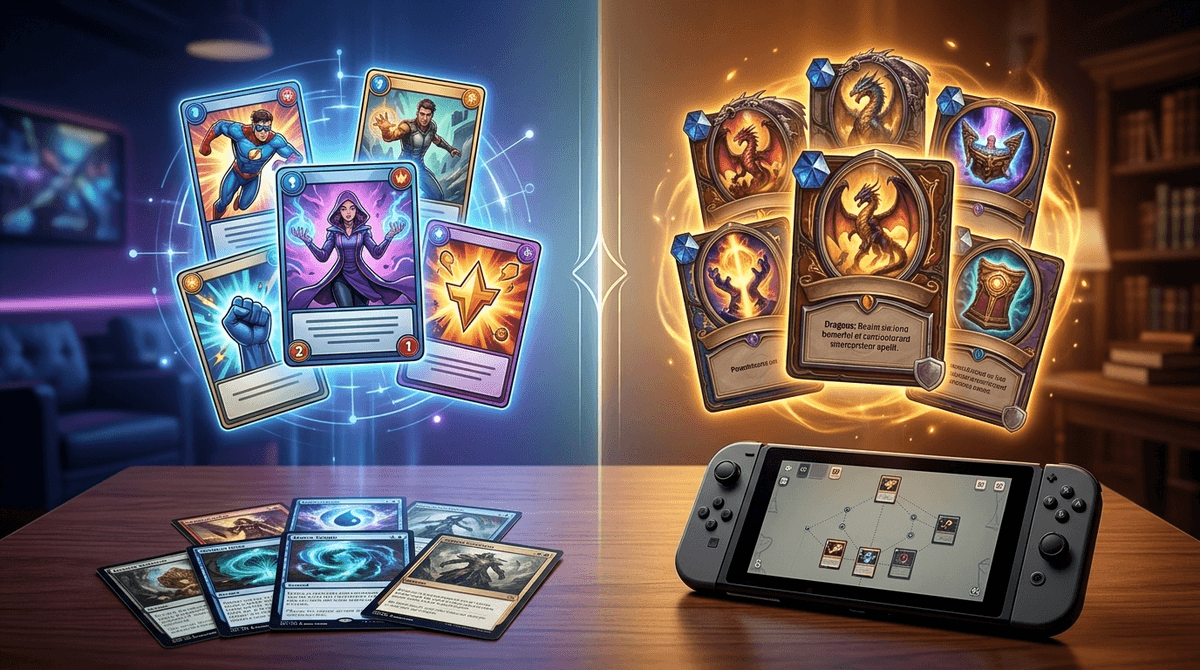
TL;DR: If your kid is into superheroes and fast-paced action, Marvel Snap is the current king of "just one more round." If they prefer deep, chess-like strategy and high-fantasy lore, Hearthstone remains the heavyweight champion. Both are great for teaching probability and resource management, but both are designed to make "card packs" feel more exciting than Christmas morning.
Quick Recommendations:
- For the 9-12 crowd: Marvel Snap (Fast, intuitive, low barrier to entry).
- For the 13+ strategist: Hearthstone (Complex, rewarding, but can be a major time/money sink).
- The "Analog" Alternative: Magic: The Gathering (The physical card game that started it all).
Digital Collectible Card Games (CCGs) are essentially the 2026 version of us trading Pokémon or baseball cards on the playground, but with flashy animations, orchestral soundtracks, and a 24/7 global marketplace.
In Hearthstone and Marvel Snap, players build "decks" of digital cards. These cards represent characters, spells, or abilities. Players go head-to-head, using their cards to outsmart the opponent. While it sounds simple, these games are basically high-speed math problems disguised as superhero brawls or wizard duels.
It’s the perfect storm of collection, competition, and customizability.
Kids love the "pull"—that hit of dopamine when they open a digital pack and see a "Legendary" card glow orange. There’s also a massive social element. If your kid is talking about "the meta" or "net-decking," they’re participating in a global conversation about strategy. They aren't just playing a game; they’re solving a puzzle that changes every few weeks.
This is the "TikTok" of card games. Matches take exactly three minutes. The rules are simple: there are three locations, and you need to win two of them by having more "power" there than your opponent.
The hook? The "Snap" mechanic. If a player feels confident, they can "Snap" to double the stakes of the game. It’s essentially teaching kids how to bluff and bet. It features every character from The Avengers to obscure X-Men, which keeps the Marvel-obsessed kids coming back.
This is the "Old Guard." Produced by Blizzard (the World of Warcraft people), it’s much more complex. Games can last 10-15 minutes. There are different "classes" (Mage, Warrior, Rogue) and thousands of cards to learn.
Hearthstone is less about quick reflexes and more about long-term planning. It’s the kind of game where you have to think three turns ahead. It’s brilliant for brain development, but it’s also notoriously expensive to stay competitive if you aren't playing for hours every day.
See the differences between Marvel Snap and Hearthstone
Strategy: Is it educational?
Yes, actually. Both games require:
- Basic Arithmetic: Constantly adding up power levels and mana costs.
- Probability: "What are the odds I draw the card I need right now?"
- Resource Management: You only have a certain amount of "energy" or "mana" each turn. Using it wisely is the difference between winning and losing.
If you want to lean into the educational side, check out games that teach logic and strategy.
Spending: The "Gacha" Trap
Here’s where we need to be real. These games are "Free to Play," which we all know is parent-code for "expensive if you don't watch out."
- Marvel Snap uses a "Season Pass" model. You pay about $10 a month to get the newest, coolest card. It’s relatively "fair," but the FOMO (Fear Of Missing Out) is intense. If you don't get the card now, it might be months before you can get it again.
- Hearthstone is a bit more traditional (and aggressive). You buy "packs." It is, for all intents and purposes, a form of loot-box gambling. You might spend $50 on packs and not get a single card you actually wanted.
Learn more about how "Free to Play" games actually make money
Recommended Age: 9+ The game is bright, fast, and the text is easy to read. There is no open chat, so you don't have to worry about a 30-year-old in a basement yelling at your 4th grader. The only communication is through pre-set "emotes" (like a thumbs up or a Spider-Man pointing meme).
- The Risk: The "Snap" mechanic is very close to gambling logic. "I’m losing, but if I Snap, maybe they’ll retreat!" It can lead to some frustration and "tilt."
Recommended Age: 12+ The complexity level is much higher. A 9-year-old might get frustrated by the intricate "keywords" and the sheer volume of cards.
- The Risk: While there’s no open chat during games, players can "friend" each other after a match. This is often where "salt" happens—players adding each other just to complain about a loss. I’d recommend keeping the "allow friend requests" setting turned off.
1. The "Meta" is a moving target
In these games, the developers "balance" cards constantly. That card your kid spent $20 to get might be "nerfed" (made weaker) next week. This is a great lesson in the volatility of digital goods, but it can be a heartbreaking lesson for a kid who used their birthday money on a specific deck.
2. The "Daily Quest" Hook
Both games use "Daily Quests" to keep players logging in. "Play 3 games as a Marvel Hero" or "Destroy 40 minions." This is designed to build a habit. If you notice your kid getting anxious about "missing their dailies," it might be time for a screen time reset.
3. Entrepreneurship or Money Pit?
Some parents argue that card games teach "entrepreneurship" because players have to manage a "collection" and "craft" cards (in Hearthstone) using "dust" (a currency gained from breaking down old cards). The No-BS Take: It’s more like a casino than a lemonade stand. While there is resource management, the house always wins. They are learning how to operate within a closed economy designed to extract value.
Check out our guide on teaching kids about in-game currencies
If you love the strategy but hate the microtransactions, consider these:
- Pokemon TCG Live: If they already collect the physical cards, every physical pack comes with a code for a digital pack. It’s a great way to bridge the two worlds.
- Slay the Spire: This is a "Roguelike" card game. You pay once (around $10-20), and you own the whole game. No packs, no microtransactions, just pure strategy.
- Magic: The Gathering Arena: The digital version of the classic. It's very complex, definitely for the older teens (14+), but it’s the gold standard of card game design.
Digital card games like Marvel Snap and Hearthstone are essentially high-speed logic puzzles. They are significantly better for the brain than "brain rot" content like Skibidi Toilet or mindless scrolling.
However, they are also expertly engineered to be "sticky."
Next Steps for Parents:
- Play a few rounds with them. Ask them why they put a certain card in their deck. You'll be surprised at the logic they're using.
- Set a "Pack Budget." If they want to spend, treat it like a hobby allowance. Once the $10 for the month is gone, it’s gone.
- Watch for the "Tilt." If they are slamming the iPad after a losing streak, the "Snap" mechanic might be hitting their dopamine levels a little too hard.