

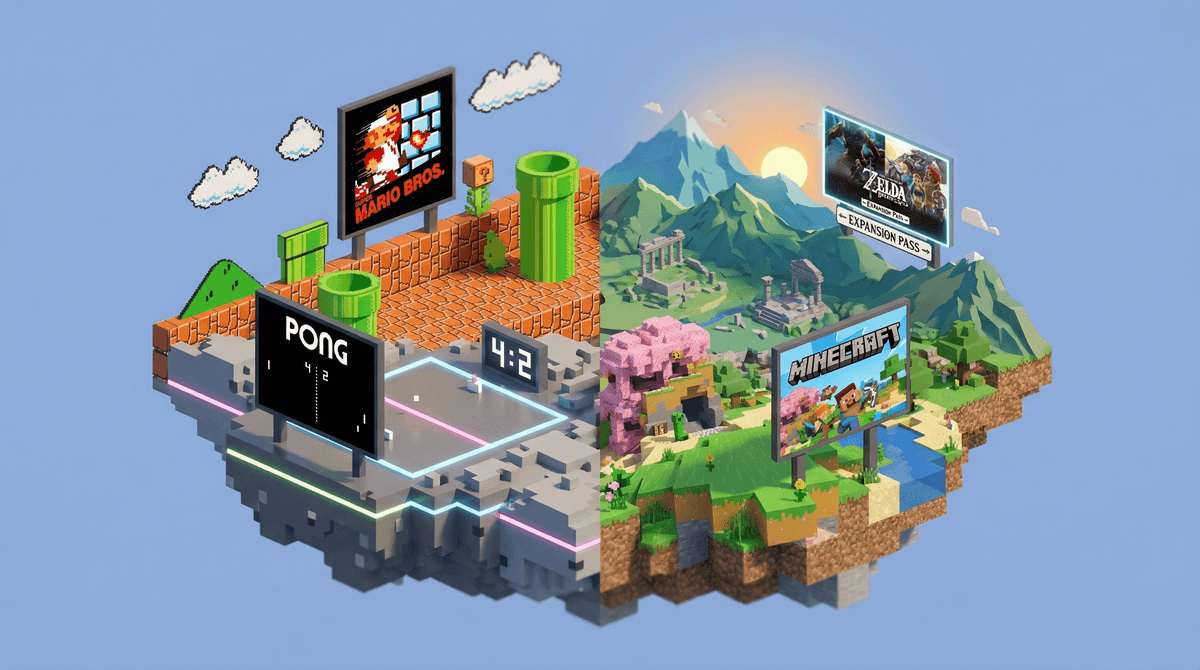
Look, when your kid says they want to play video games, it's easy to lump everything together as "screen time" and call it a day. But here's the thing: some games genuinely changed everything about how we play, think about play, and even learn. These aren't just nostalgic classics your partner gets misty-eyed about—they're the foundation for understanding why your kid is obsessed with Minecraft or why Roblox is basically teaching them game design.
Groundbreaking games are the ones that introduced mechanics, ideas, or entire genres that didn't exist before. They're the reason we have battle royales, open-world exploration, and yes, even the ability to play games with friends across the country. Understanding these games helps you understand what your kids are actually doing when they're "just playing games."
Pong (1972) - Yeah, two rectangles hitting a square back and forth. Revolutionary? Absolutely. This was the game that proved video games could be a thing people would pay money for. It's the ancestor of every game your kid plays today.
Super Mario Bros. (1985) - This wasn't just a plumber jumping on turtles. Nintendo figured out how to make games that taught you how to play them without a manual. Every level built on what you learned before. That design philosophy? It's in basically every game now, including the ones teaching your 6-year-old problem-solving skills.
The Legend of Zelda (1986) - The original open-world game. You could explore in any direction, figure things out yourself, discover secrets. Sound familiar? That's because Breath of the Wild and Tears of the Kingdom are direct descendants, and they're some of the best games you can hand a kid who's ready for complex problem-solving.
Doom (1993) - Look, I'm not recommending this for your 8-year-old. But Doom invented the first-person shooter and, more importantly, online multiplayer gaming. Without Doom, there's no Fortnite, no Splatoon, no understanding of how to move through 3D space in games.
The Sims (2000) - A game about... living? No objectives, no winning, just creating and managing virtual lives. This opened the door for games as creative expression and simulation. Your kid playing Animal Crossing? Thank The Sims.
World of Warcraft (2004) - Built the blueprint for massive online worlds where millions of players could exist together. The social dynamics, the guilds, the coordination required—this is where kids learned that online gaming could be deeply social. For better and worse.
Minecraft (2011) - Possibly the most important game for today's generation of kids. Infinite creativity, problem-solving, collaboration, and yes, actual learning opportunities . It proved that games didn't need cutting-edge graphics or complex stories—they needed freedom and tools.
Here's what's wild: these groundbreaking games didn't just create entertainment—they created languages. When your kid talks about "grinding" or "farming" or "speedrunning," they're using vocabulary that came from these games and their descendants.
Understanding this history helps you see that:
Games teach design thinking. When kids play Minecraft or Roblox, they're not just consuming content—they're creating it. That comes directly from games that gave players agency and tools.
Multiplayer isn't just chaos. Games taught an entire generation how to coordinate, communicate, and collaborate with people they've never met. That's a real skill, even if it sounds like gibberish when you overhear their Discord calls.
Difficulty curves matter. Good games teach you how to play them. When your kid gets frustrated with a game, sometimes it's because the game design is actually bad, not because they lack perseverance.
Ages 5-8: You can absolutely introduce them to the legacy. Games like Super Mario Odyssey carry forward that brilliant Nintendo design philosophy. Kirby games are similarly well-designed for learning.
Ages 8-12: This is prime time for Minecraft, Zelda: Breath of the Wild (if they can handle mild combat), and creative games like Dreams or even Roblox Studio for actual game creation.
Ages 12+: They can start understanding and appreciating games as art and design. Games like Journey, Celeste, or Hades show how far game design has come.
Not all "groundbreaking" means "appropriate." Doom changed everything, but it's still ultra-violent. Many revolutionary games were made for adults. The good news? Their innovations trickled down into age-appropriate games.
The best modern games stand on these shoulders. When you're trying to figure out if a game is worth your kid's time, look for ones that innovate or build on these foundations rather than just copying them badly.
"Old" games can still be great. A 10-year-old game that was groundbreaking might still be more engaging and better designed than something released last week. Don't dismiss something just because it doesn't have 2025 graphics.
Game literacy is real literacy. Understanding how games work, what makes them good or exploitative, how they're designed—this is increasingly important. Games are a bigger industry than movies and music combined.
You don't need to become a gaming historian, but understanding that video games have a history—with genuine innovations and artistic merit—helps you have better conversations with your kids about what they're playing and why.
When your kid says "this game is so good," you can ask what makes it good. What's innovative? What's fun? What did they learn? Those questions matter way more than "how long have you been playing?"
The groundbreaking games taught us that play can be creative, social, challenging, and meaningful. The best games your kids play today are carrying forward those lessons. Your job isn't to memorize gaming history—it's to help your kids think critically about what they're playing and why it matters to them.
Want to find games that actually innovate rather than just extract money from your wallet? Check out our guide to games that respect your kid's time and your money. Or dive into understanding Minecraft's educational value to see how groundbreaking game design translates into actual learning.