

ESRB & PEGI Ratings Explained: The Ultimate Parent's Guide
TL;DR: Those letter ratings on game boxes? They're actually useful once you understand them. ESRB (North America) and PEGI (Europe) tell you age appropriateness AND specific content warnings. E10+ means mild cartoon violence, M means what you think it means, and T is the tricky middle ground where most parent arguments happen. Learn the system, check the content descriptors on the back, and you'll know exactly what you're buying before the first "Mom, can I get this?" at Target.
You're standing in the game aisle, your kid is holding up Fortnite or the latest Call of Duty, and you're squinting at a little box on the corner that says "T" or "M" or "PEGI 16." What does any of this actually mean? And more importantly, should you trust it?
The short answer: yes, mostly. These ratings aren't perfect, but they're a solid starting point that can save you from accidentally buying your 8-year-old a game with graphic violence or your teen a game that's genuinely too mature even for them.
ESRB (Entertainment Software Rating Board) is the rating system used in North America. It's been around since 1994, created after Congress got concerned about violent games like Mortal Kombat. Think of it like the MPAA ratings for movies (G, PG, PG-13, R), but for games.
PEGI (Pan European Game Information) is the European equivalent, used across most of Europe and some other countries. It works similarly but has slightly different age categories and symbols.
Both systems do two things:
- Give you an age rating (the big letter or number on the front)
- List content descriptors (the specific stuff inside that earned that rating)
The age rating is what catches your eye. The content descriptors are what actually matter.
E (Everyone)
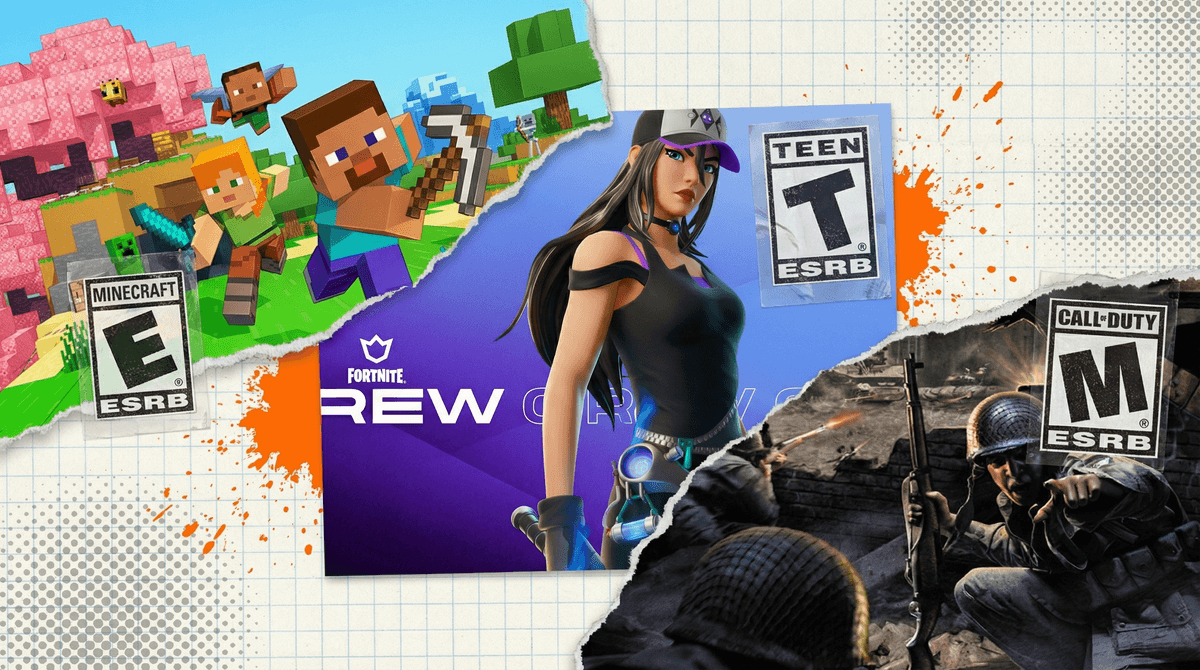
Think Minecraft in peaceful mode or Mario Kart. Suitable for all ages. Might have minimal cartoon violence (like bouncing on a Goomba's head), but nothing that would make you flinch.
E10+ (Everyone 10+)
This is where you start seeing more action. Games like Super Smash Bros or Splatoon land here. Mild cartoon violence, some comic mischief, minimal suggestive themes. Most kids 8-10 can handle this content, but the rating gives you a heads-up that it's not quite as innocent as pure E-rated games.
T (Teen)
This is where it gets interesting. T-rated games are for ages 13+, but in practice, this is the most debated category among parents. Fortnite is T-rated. So is Apex Legends. So is The Sims 4.
T-rated games can include:
- Violence (but not super graphic)
- Suggestive themes
- Crude humor
- Minimal blood
- Simulated gambling
- Infrequent strong language
The range here is HUGE. Some T-rated games are fine for mature 11-year-olds. Others are genuinely pushing the boundary of what should be M-rated. Always check the content descriptors on the back of the box.
M (Mature 17+)
Intense violence, blood and gore, sexual content, strong language. Games like Grand Theft Auto, Red Dead Redemption, most Call of Duty games.
If your 12-year-old is asking for an M-rated game, you can dig into whether it's appropriate for your family , but know that these ratings exist for a reason. The content is genuinely mature.
AO (Adults Only 18+)
Extremely rare. Prolonged graphic violence, explicit sexual content, or real gambling. Most major retailers won't even stock AO games. If you see this rating, it's a hard no for kids.
PEGI uses numbers instead of letters, which is honestly more straightforward:
- PEGI 3: Suitable for all ages (like ESRB E)
- PEGI 7: May contain mild violence or scary scenes (like ESRB E10+, but younger)
- PEGI 12: Violence in a fantasy setting, mild bad language (similar to ESRB T, but more conservative)
- PEGI 16: Realistic violence, strong language, sexual innuendo (like ESRB T/M boundary)
- PEGI 18: Graphic violence, strong language, sexual content, drugs (like ESRB M)
PEGI also uses content icons on the front of the box showing what earned the rating: violence, bad language, fear, drugs, sex, discrimination, gambling, in-game purchases.
Here's what most parents miss: the age rating is just a suggestion. The content descriptors tell you what's actually in the game.
A T-rated game might say:
- "Fantasy Violence"
- "Mild Blood"
- "Comic Mischief"
That's very different from a T-rated game that says:
- "Violence"
- "Blood"
- "Suggestive Themes"
- "Strong Language"
Both are rated T, but one is clearly more intense. Always flip the box over (or look up the rating online) and read what specific content is included.
Common content descriptors to understand:
- Fantasy Violence = not realistic (cartoon fighting, magic battles)
- Violence = more realistic depictions
- Blood = you'll see red
- Intense Violence = graphic, sustained, realistic
- Suggestive Themes = sexual innuendo, flirting, revealing outfits
- Sexual Content = actual sexual situations
- Strong Language = the F-word and similar
- Crude Humor = bathroom jokes, gross-out comedy
- Use of Alcohol/Tobacco/Drugs = characters using substances
You'll see "Online Interactions Not Rated by the ESRB" on almost every multiplayer game. This is critical to understand: the rating system only covers the game content itself, not what other players might say or do.
Roblox might be rated E10+, but if your kid is playing with randoms online, they could encounter inappropriate language, bullying, or worse. Fortnite is T-rated for violence, but the voice chat can be way more mature than the game itself.
This is why parental controls and communication matter more than the rating alone when it comes to online multiplayer games.
About 60% of kids ages 12-14 have played M-rated games, according to various surveys. So yes, your kid is probably telling the truth when they say "everyone" is playing Call of Duty.
That doesn't mean you have to say yes. But it does mean you should:
- Actually understand what's in the game (not just react to the M rating)
- Have a real conversation about why you're saying yes or no
- Consider alternatives that scratch the same itch but are more age-appropriate
If your 13-year-old wants Call of Duty, maybe Fortnite or Apex Legends (both T-rated) could work instead. If they want Grand Theft Auto, maybe Spider-Man or Batman: Arkham games offer similar open-world action without the criminal glorification.
Elementary (K-5): Stick with E and E10+ games. Most kids this age aren't ready for realistic violence or complex themes, even if they think they are. Mario, Minecraft, Splatoon, Animal Crossing are all solid choices.
Middle School (6-8): T-rated games become appropriate for many kids, but not all T-rated games are created equal. Fortnite at 11? Probably fine for most families. Assassin's Creed at 11? Maybe wait a year or two. Check those content descriptors.
High School (9-12): Most teens can handle T-rated content easily. M-rated games are a family-by-family decision. Some 14-year-olds are mature enough for certain M-rated games (especially those rated M primarily for violence rather than sexual content or drug use). Others aren't ready until 16 or 17.
- Check the rating before you buy (obviously)
- Read the content descriptors on the back or on the ESRB website
- Watch gameplay videos on YouTube to see what the game actually looks like
- Read parent reviews on Common Sense Media or Screenwise
- Play with your kid when possible, especially for new games
- Revisit your rules as your kids mature
The rating systems aren't perfect. They tend to be more lenient with violence than with sexual content (a very American thing). They don't account for the addictive nature of some games, predatory monetization, or online toxicity.
But they're still useful. A game rated E10+ is genuinely different from a game rated M. The system works if you actually use it.
Also: ratings are assigned by playing through the game, but some content might be hidden or unlockable. The ESRB relies on publishers to disclose all pertinent content, but occasionally something slips through. This is rare, but it's why staying involved matters.
ESRB and PEGI ratings are like nutrition labels for games. They won't tell you everything, but they give you enough information to make an informed decision. The age rating is your starting point. The content descriptors are your real guide.
When your kid asks for a new game:
- Check the rating
- Read what content earned that rating
- Watch a gameplay video if you're unsure
- Make a decision based on your family's values and your individual kid's maturity
And remember: saying no to one game doesn't mean saying no to gaming. There are thousands of games out there. Help your kid find ones that match both their interests and your comfort level.
The ratings exist to help you, not to make you feel like a bad parent for letting your 12-year-old play Fortnite or for saying no to GTA for your 15-year-old. Use them as a tool, not a rulebook.
- Browse age-appropriate games for your kids
- Learn about setting up parental controls on gaming consoles
- Check out alternatives to popular M-rated games
- Read our guide on how to talk to kids about violent video games