

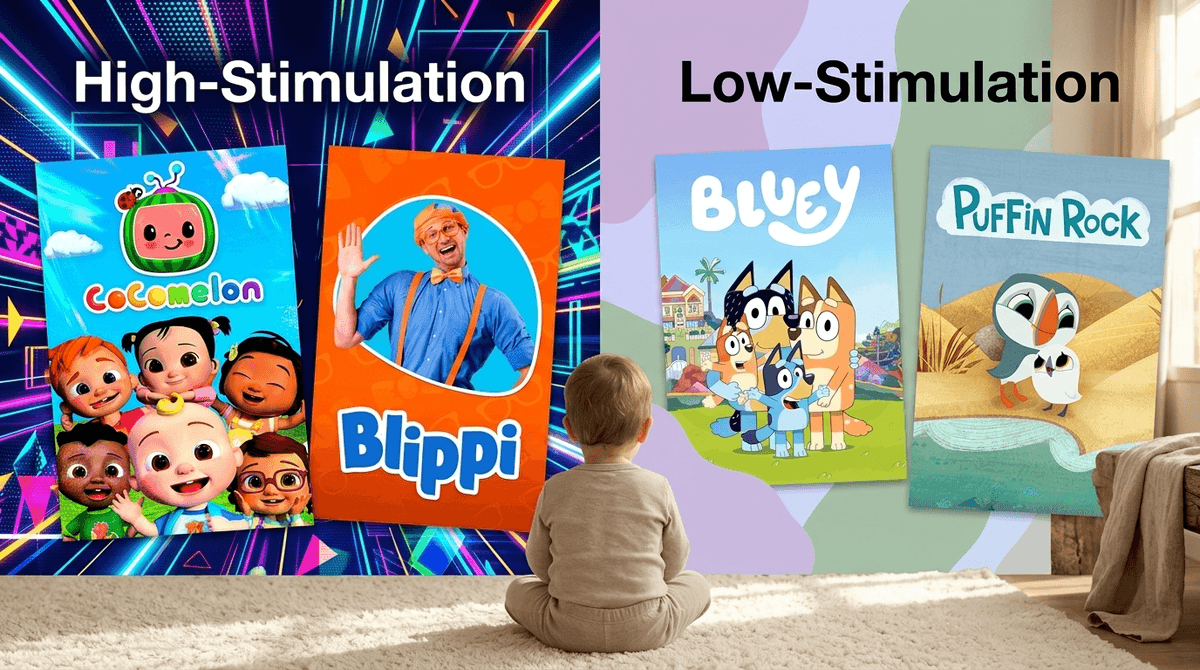
TL;DR: The Quick Cheat Sheet
If you only have 30 seconds before a toddler starts climbing the curtains, here’s the deal: Not all "educational" content is created equal. Many shows marketed as "learning tools" are actually high-octane visual candy that can lead to overstimulation and epic meltdowns.
The "Avoid" List (High-Stimulation):
- Cocomelon — The "Vegas Slot Machine" of toddler TV.
- Blippi — High energy, chaotic pacing, questionable educational value.
- Little Angel — Rapid scene cuts and constant noise.
The "Green Light" List (Low-Stimulation & High Value):
- Bluey — The gold standard for emotional intelligence.
- Puffin Rock — Gentle, beautiful, and narrated like a soft hug.
- Trash Truck — Slow-paced, sweet, and calm.
- Ms. Rachel (Songs for Littles) — Uses actual speech therapy techniques.
- Tumble Leaf — Encourages scientific thinking through play.
Get a playlist based on your toddler's interests
We’ve all been there. You’re trying to cook dinner or finish an email, so you put on an "educational" show. Your toddler sits there, eyes glazed, completely motionless. You think, "Great, they’re learning their ABCs and I’m getting stuff done."
But then, the second you turn the TV off, the "zombie" transforms into a screaming whirlwind of chaos.
This is the Pacing Paradox. Many modern shows for toddlers use "hyper-pacing"—scene cuts every 1–3 seconds, bright neon colors, and constant, upbeat background music. While the content might be "educational" (counting apples! colors!), the delivery is so overstimulating that the toddler’s brain can’t actually process the information. They aren't learning; they’re just being mesmerized by a digital strobe light.
When the screen goes dark, their brain suddenly has to deal with the "boring" real world where things don't change every two seconds. The result? A total sensory crash.
Research into how fast pacing affects toddler focus suggests that high-stimulation media can shorten attention spans and make it harder for kids to engage in "slow" activities, like reading a book or playing with blocks.
A toddler’s brain is a construction site. When we flood it with rapid-fire imagery, we’re essentially blowing a leaf blower at a house made of cards. Real learning requires "processing time." If a character asks a question and then immediately answers it while a rainbow explodes in the background, your child hasn't actually thought about the answer.
Compare this to Mister Rogers' Neighborhood, where Fred Rogers would literally sit and wait for the child to think. That silence is where the magic happens.
Let's be real: Cocomelon is designed to be addictive. The camera never stops moving. It zooms, pans, and cuts constantly. It’s the "Skibidi Toilet" of the nursery rhyme world—pure sensory input with very little cognitive output. If your kid acts like they’re going through a literal withdrawal when you turn it off, this is why. It’s just too much.
Blippi is a polarizing figure in the parent world. While he takes kids to cool places like museums and playgrounds, the editing is frantic and his persona is... a lot. It’s high-energy entertainment masquerading as education. There are better ways to learn about tractors without the frantic shouting.
You’ve heard the hype, and for once, the internet is right. Bluey is a masterpiece. The pacing is natural, the colors are soft, and the "educational" aspect isn't about rote memorization of numbers—it's about conflict resolution, imaginative play, and how to be a person. It’s a show that respects a child’s intelligence.
If you’re looking for actual speech development, Ms. Rachel is the real deal. She uses "parentese," slow mouth movements, and pauses that actually encourage your child to respond. It’s the closest thing to a real-life interaction you’ll find on a screen.
If you want to move away from "brain rot" and toward content that actually nourishes your toddler, here are our top picks organized by "vibe."
The "Calm & Gentle" Category
These shows are perfect for winding down before naptime or when you need a peaceful house.
- Beautiful Irish animation. It’s quiet, educational about nature, and the narrator (Chris O'Dowd) is incredibly soothing.
- On Netflix. It follows a boy and his best friend, a giant trash truck. It’s slow, sweet, and emphasizes friendship and curiosity.
- A classic for a reason. Maurice Sendak’s illustrations come to life with a classical score and stories that move at a human pace.
The "Actually Educational" Category
These shows focus on concepts like math, science, and literacy without the "Vegas" bells and whistles.
- This is hands-down the best show for teaching early math. It uses visual representations of numbers that actually make sense to a toddler's brain.
- Available on Amazon Prime. It’s stop-motion (which naturally feels more "real" and grounded) and focuses on "figuring out" how things work through play.
- The spiritual successor to Mister Rogers. It uses catchy songs to teach social-emotional skills that you will find yourself singing in the grocery store to prevent a meltdown.
The "Interactive" Category
- If you want to move from passive watching to active engagement, the PBS Kids Website has games that are actually designed by educational experts, not just engagement hackers.
When you’re vetting a new show, you don’t need a PhD in child development. Just use the 3-Second Rule:
- Count the cuts: Pick a random 30-second segment. Every time the camera angle changes or the scene cuts, count. If you’re counting every 1–2 seconds, it’s high-stimulation.
- Listen to the background: Is there constant "mickey-mousing" (music that mimics every single movement)? Is there a non-stop upbeat drum track?
- Check the colors: Are the colors natural, or do they look like a neon highlighter factory exploded?
- Observe the "Aftermath": The best way to tell if a show is wrong for your kid is to watch them when the TV goes off. If they are irritable, aggressive, or "lost," the show was likely too much for their nervous system.
Read more about setting up a "Digital Sabbatical" for your toddler
Look, we live in 2026. Screens are part of our lives. If you let your kid watch Cocomelon so you could take a shower without someone eating a crayon, you are not a bad parent.
The goal isn't "zero screens" or "perfect educational content only." The goal is intentionality. Once you know that certain shows act like caffeine for a toddler’s brain, you can save those for "emergency use only" and stick to the "whole grain" content like Bluey for everyday use.
Not all "educational" labels are honest. If a show feels like a fever dream to you, it probably feels like one to your toddler, too. Switch to slower-paced, story-driven content that respects your child’s developing brain. You’ll likely find that their behavior improves, their play becomes more imaginative, and you might actually enjoy watching the show with them.
Next Steps
- Audit your "Watch Next" list: Remove the hyper-stimulating shows and replace them with Puffin Rock or Trash Truck.
- Try a "Slow Media" week: Stick to shows with natural pacing and see if you notice a change in your child's post-screen behavior.
- Check out our full guide on low-stimulation shows for toddlers.