

TL;DR: The Quick List
If you’re in the middle of a toddler meltdown and just need to know what to put on right now, here are the gold-standard picks that won’t fry your kid’s brain:
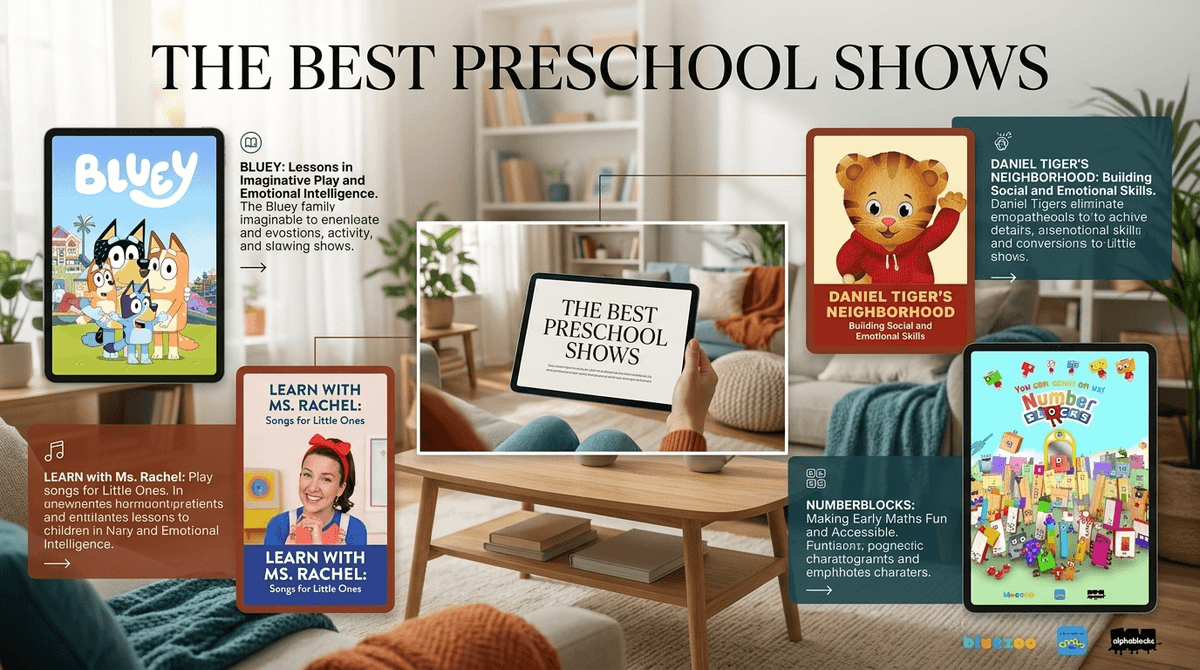
- The Emotional GOAT: Bluey
- The Speech & Language Savior: Ms. Rachel
- The Social-Emotional Manual: Daniel Tiger’s Neighborhood
- The Low-Stimulation Chill Vibe: Trash Truck or Puffin Rock
- The Math Genius: Numberblocks
Get a playlist based on your child's interests
The preschool years are a weird, beautiful, and utterly exhausting transition. One minute they’re a baby who just stares at the ceiling fan, and the next, they’re a "threenager" demanding to know why they can’t eat a battery.
In this stage, screen time often becomes a necessary tool for survival—whether you need to cook dinner, take a 10-minute mental health break, or actually finish a sentence. But not all preschool TV is created equal. There is a massive difference between a show that respects a child’s developing brain and a show that is designed like a digital slot machine to keep them glued to the screen with "zombie eyes."
Before we get into the "what," we have to talk about the "how." You’ve probably noticed that after some shows, your kid is chill, and after others, they act like they’ve just been through a 48-hour bender in Vegas.
This usually comes down to pacing. Shows like Cocomelon or certain Blippi episodes use incredibly fast cuts—sometimes changing the camera angle every 1-2 seconds. For a preschooler’s developing brain, this is overstimulating. It triggers a dopamine loop that makes it very hard for them to turn the TV off without a massive meltdown.
On the flip side, "slow" shows or "low-stimulation" shows use longer shots, more natural colors, and calmer audio. These shows allow the brain to process what’s happening, which is where actual learning occurs.
Let’s be real: Bluey is as much for parents as it is for kids. It follows a family of Blue Heelers in Australia, and it is arguably the best show ever made for this age group.
- Why it’s worth it: It models imaginative play in a way that actually gives kids ideas for what to do off the screen. It also shows parents (Bandit and Chilli) who aren't perfect but are deeply engaged.
- The Vibe: Wholesome, hilarious, and occasionally will make you sob.
If Bluey is the "fun" show, Daniel Tiger is the instruction manual. Based on the legacy of Mister Rogers, this show uses catchy "strategy songs" to help kids navigate big feelings.
- Why it’s worth it: When your kid is screaming because they can't have a cookie, you can literally sing, "When you feel so mad that you want to roar, take a deep breath and count to four," and it actually works. It’s basically therapy for toddlers.
If you have a toddler or preschooler, Ms. Rachel is likely a permanent resident in your home. Her background in speech pathology is evident; she uses "parentese" (that slow, high-pitched way of talking), leaves pauses for kids to respond, and focuses heavily on mouth movements to help with speech.
- Why it’s worth it: It’s the closest thing to an interactive 1-on-1 session you can get for free. It’s highly educational and specifically designed for language development.
I have seen 4-year-olds explain the concept of square numbers because of this show. Numberblocks turns math into characters and stories.
- Why it’s worth it: It visualizes math concepts (like addition, subtraction, and multiplication) in a way that makes sense to a visual learner. It’s brilliant, catchy, and genuinely educational.
Ever had a kid ask "How do ears hear?" or "Why is the sky blue?" and you realize you have no idea? StoryBots is your answer.
- Why it’s worth it: It’s fast-paced but in a "smart" way, not a "brain-drain" way. The music is top-tier (think Snoop Dogg and John Legend cameos) and it respects the intelligence of the child.
If you need something to put on while your kid is winding down for a nap or if they are prone to sensory overload, these are the "calm" picks.
This show is like a warm hug. It’s about a boy named Hank and his best friend, a giant honking trash truck.
- Why it’s worth it: The color palette is muted, the voices are soft, and the stories are simple and sweet. It’s the antithesis of the "loud" kids' show.
Narrated by Chris O'Dowd, Puffin Rock follows a family of puffins on an Irish island.
- Why it’s worth it: It’s beautiful to look at and teaches basic nature facts without any of the frantic energy of typical preschool TV.
I’m not here to tell you to ban these shows—sometimes you just need 20 minutes of peace and Cocomelon is the only thing that works. But here’s the no-BS take:
- Cocomelon: It is essentially "digital candy." It’s designed to be hyper-stimulating. If you notice your kid "trancing out" or having massive tantrums when you turn it off, this is why. Use sparingly.
- Blippi: It’s high-energy, it’s loud, and frankly, it can be a bit unhinged. While it does show kids cool things like museums and playgrounds, the educational value is often surface-level.
- Caillou: Just... why? The main character is famous for whining, and kids are world-class mimics. There are better ways to spend your screen time minutes.
Learn more about the research behind overstimulating kids' media
- Ages 2-3: Focus on language development and simple social cues. Ms. Rachel and Sesame Street are your best friends here. Keep sessions short (15-20 minutes).
- Ages 4-5: Kids this age can handle more complex narratives and humor. This is the prime time for Bluey, Wild Kratts, and Molly of Denali.
If you can avoid it, keep preschoolers off the main YouTube app. Even with YouTube Kids, the "Up Next" algorithm can sometimes surface weird, AI-generated content or "Elsagate" style videos that look like kids' shows but aren't.
Stick to dedicated streaming apps like Netflix, Disney+, or the PBS Kids website and app, where the content is curated and there are no weird algorithmic surprises.
The best way to make screen time "educational" isn't the show itself—it's you. You don't have to sit there for every second (we have laundry to do!), but "co-viewing" for even 5 minutes and asking questions like, "Why do you think Bluey is sad?" or "What number do you think comes next?" bridges the gap between passive consumption and active learning.
Preschool TV doesn't have to be "brain rot." We live in a golden age of high-quality, emotionally intelligent content for little kids. If you stick to the "slow and steady" shows that prioritize character and story over flashing lights and loud noises, you’re doing great.
And if you have a day where they watch three hours of Paw Patrol because you’re sick or just done? Don’t sweat it. Digital wellness is about the long game, not a single Tuesday.
- Audit the queue: Take a look at what your kid is currently watching. If it’s mostly high-stim stuff, try swapping in one "slow" show like Trash Truck this week.
- Set a timer: Preschoolers have no concept of time. Use a physical timer or a "one more episode" rule to make transitions easier.
- Explore alternatives: If you want to move away from the TV entirely but need a "break" tool, check out our guide on the best podcasts for preschoolers or the Khan Academy Kids app.