

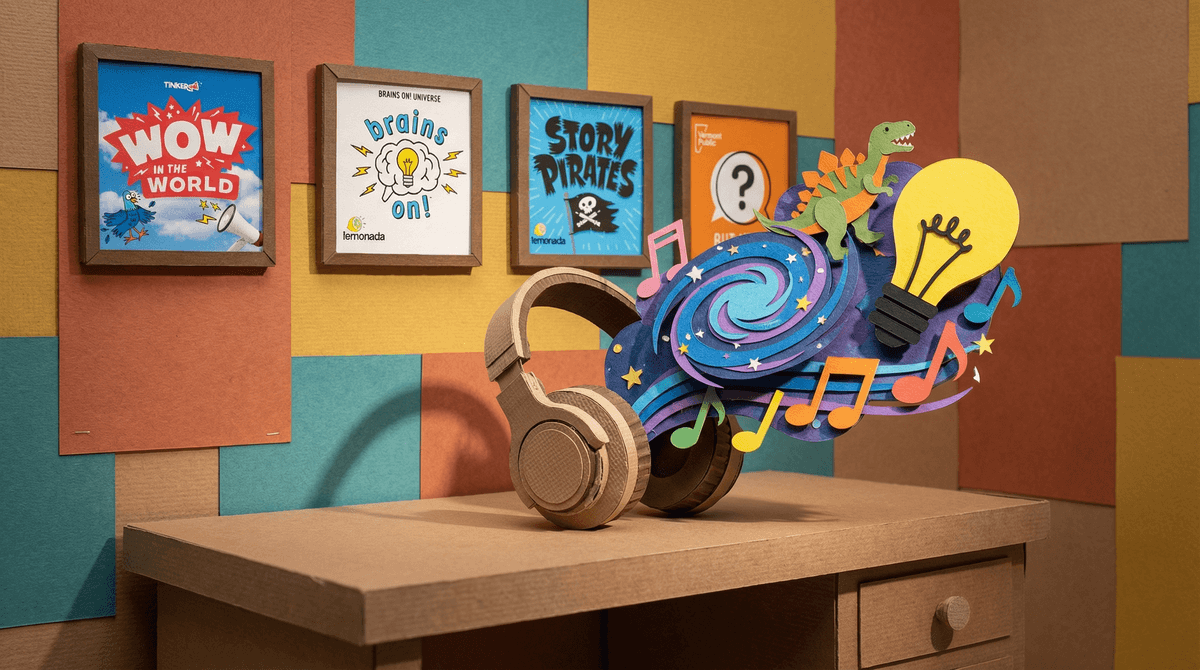
Educational podcasts are audio shows designed to teach, inspire, and spark curiosity in young listeners—without requiring a screen. They cover everything from science and history to storytelling and philosophy, packaged in engaging formats that work during car rides, chores, or quiet time.
And here's the thing: podcasts are having a moment with kids right now. They're not just for NPR-loving adults anymore. Kids are genuinely choosing to listen to shows about black holes, Greek mythology, and how toilets work—voluntarily.
The best part? While your kids are averaging around 4 hours of screen time on weekdays (based on Screenwise data), podcasts offer a way to feed their curiosity without adding to that total. It's learning that happens while they're drawing, building LEGOs, or staring out the car window.
Let's be real—getting kids to voluntarily consume educational content is usually an uphill battle. But podcasts have a few things going for them:
They're screen-free. No notifications, no related videos pulling them into YouTube rabbit holes, no "just one more episode" autoplay spiral. It's just audio, which means kids can listen while doing other things.
They're designed for short attention spans. Most kids' podcasts run 20-30 minutes—perfect for a car ride or before bed. Episodes are self-contained, so kids can drop in and out without losing the thread.
They feel like entertainment, not homework. Shows like Brains On! and Wow in the World are hosted by enthusiastic adults who genuinely sound like they're having fun. There are sound effects, jokes, and mysteries. Kids don't feel like they're being lectured to.
They can go deep. Unlike a lot of kids' TV that stays surface-level, podcasts can dive into complex topics—quantum physics, the French Revolution, ethical dilemmas—because they're not competing with visual stimulation. Kids who love a topic can really geek out.
Ages 5-8: Playful and Curious
Story Pirates turns kids' creative writing into sketch comedy. It's silly, imaginative, and celebrates kids' ideas.
But Why: A Podcast for Curious Kids answers real questions from real kids. "Why do we have to wear clothes?" "How do you make paint?" It's straightforward and perfect for the relentless "why" phase.
Circle Round adapts folktales from around the world with professional actors. Each story comes with a gentle lesson, but it never feels preachy.
Ages 8-12: Ready for Complexity
Brains On! tackles science questions with humor and depth. Episodes like "Why do we itch?" or "What would happen if the sun disappeared?" are genuinely fascinating.
Wow in the World covers the latest in science news with high energy and lots of sound effects. It's hosted by NPR's Mindy Thomas and Guy Raz, and it feels like a party.
Short & Curly is an ethics podcast for kids from Australia. It presents real moral dilemmas—"Is it okay to lie to protect someone's feelings?"—and lets kids think through the complexity.
The Past & The Curious makes history feel like a detective story. Each episode explores a weird historical event or figure with humor and storytelling.
Ages 12+: Sophisticated Listeners
Radiolab for Kids is a curated feed of Radiolab episodes appropriate for younger audiences. It's the same high-quality science storytelling, just without the heavy existential dread.
Smash Boom Best is a debate show where two debaters argue for opposite sides—"Pirates vs. Ninjas" or "Cats vs. Dogs"—and kids judge. It teaches critical thinking and argumentation in a fun format.
Six Minutes is a sci-fi mystery serialized podcast. It's like a novel for your ears, with cliffhangers and complex plotting.
Not all "educational" podcasts are created equal. Some are genuinely engaging and well-produced. Others feel like someone reading a textbook aloud. Preview a few episodes before committing—you'll know pretty quickly if it's going to hold your kid's attention.
Podcasts can be a gateway to deeper interests. If your kid gets obsessed with a Brains On! episode about space, that's a great opportunity to check out library books, visit a planetarium, or watch a documentary together. Learn more about how to build on podcast interests .
.
They're not passive. Kids often want to talk about what they've heard. Be ready for questions like "Mom, what IS a tardigrade?" or "Did people really used to think the Earth was flat?"
Some podcasts have ads. Most kids' podcasts are free, which means they're ad-supported. The ads are usually for other podcasts or kids' products, but it's worth noting if you're trying to limit commercial exposure.
They work best as part of a routine. Podcasts during breakfast, car rides, or before bed can become a ritual. It's a nice alternative to scrolling or watching TV during transition times.
Educational podcasts are one of the easiest wins in the digital wellness toolkit. They're screen-free, they're genuinely educational, and kids actually like them. They fit into the 4-5 hours of daily screen time your family is already navigating without adding to it.
Start with one or two shows that match your kid's interests. Let them pick episodes. See what sticks. The worst-case scenario is they don't like it and you turn it off. The best-case scenario is they discover a new passion, learn something fascinating, and you get 20 minutes of peace in the car.
Try a starter pack: Download 2-3 episodes of Brains On!, Wow in the World, and But Why. Let your kid pick which one to try first.
Make it a routine: Pick one time of day—breakfast, car rides, before bed—and offer podcasts as an option.
Ask for feedback: After a few episodes, ask your kid what they liked or didn't like. Let them have a say in what you listen to next.
Explore more options: Check out our full guide to kids' podcasts for more recommendations organized by age and interest.