

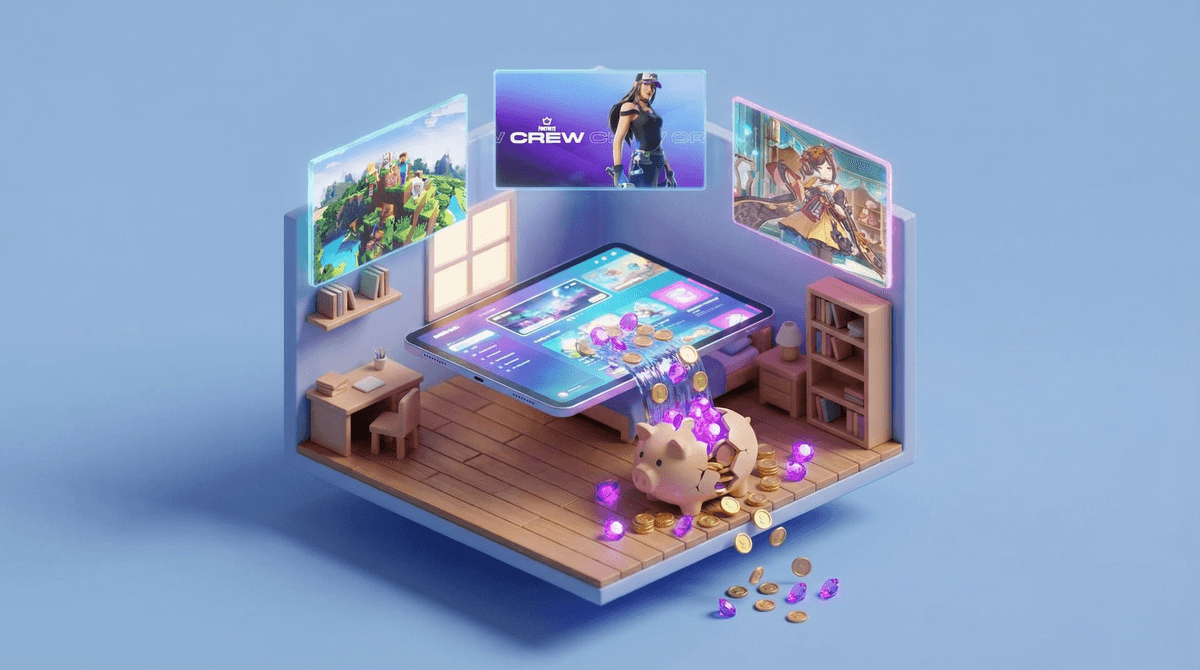
You know that sinking feeling when your kid asks to download a "free" game, you say yes, and then two weeks later there's a $47.99 charge on your credit card for 5,000 V-Bucks? Yeah, we need to talk about in-app purchases.
In-app purchases (IAPs) are exactly what they sound like: buying stuff inside an app or game. Could be cosmetic items (skins, outfits, emotes), game currency (Robux, V-Bucks, gems), power-ups, or unlocking new levels. The games are technically free to download, but they're designed to make you want to spend money once you're hooked.
And here's the thing — these aren't accidental design choices. Game developers employ entire teams of behavioral psychologists to figure out exactly how to make kids (and adults, let's be honest) want to spend money. Limited-time offers. Exclusive items. Battle passes. The friend who has the cool skin you don't have. It's sophisticated, it's effective, and it's everywhere.
Kids don't have the same concept of money that adults do. A third-grader doesn't necessarily understand that $20 in Roblox is the same as $20 at Target. Digital currency creates this abstraction layer that makes spending feel less real.
Plus, games are designed to create FOMO (fear of missing out). That exclusive skin is only available for 24 hours! Your friends all have the Battle Pass! You're stuck on this level and just need one more power-up! The psychological pressure is real, and kids don't have fully developed impulse control. Hell, most adults struggle with it.
And let's not forget the social component. When everyone at school is talking about their Fortnite skins or their Minecraft Marketplace purchases, your kid feels left out if they're the only one without access. It's not just about the game — it's about belonging.
Here's what the industry doesn't advertise: the average "free to play" game makes way more money than traditional $60 games. How? By getting a small percentage of players to spend hundreds or thousands of dollars. Kids with access to payment methods can rack up charges shockingly fast.
Some horror stories from parents:
- A 7-year-old spent $2,500 on in-app purchases in a mobile game over three months
- A teen racked up $800 in Genshin Impact trying to get a specific character through the gacha system
- Multiple $9.99 charges that parents didn't notice for weeks because they seemed small
But even if your kid isn't going into four-figure territory, those $5 and $10 purchases add up. Fast.
1. Turn Off In-App Purchases Entirely
This is the nuclear option, but sometimes it's the right call, especially for younger kids. On iOS, go to Settings > Screen Time > Content & Privacy Restrictions > iTunes & App Store Purchases > In-App Purchases > Don't Allow. On Android, open Google Play Store > Settings > Require authentication for purchases > For all purchases through Google Play on this device.
2. Require Password for Every Purchase
Even if you allow in-app purchases, require password approval for each one. This creates a natural pause where your kid has to ask you, and you can have a conversation about whether it's worth it. No more accidental or impulse buys.
3. Use Gift Cards Instead of Credit Cards
Remove your credit card from the account entirely. If your kid wants to make purchases, they can use gift cards they've earned or received. This creates a finite budget and makes the spending more tangible. When the $25 gift card is gone, it's gone.
4. Create a Monthly Digital Allowance
Some families give kids a set amount per month for in-app purchases — maybe $10 or $20. Once it's spent, that's it until next month. This teaches budgeting and prioritization. Do you want that skin now, or save up for something bigger?
5. Earn It Through Chores or Screen Time Trade-Offs
Connect in-app purchases to real-world effort. Want Robux? Do extra chores. Want the Battle Pass? Trade it for reduced screen time in other areas. This helps kids understand that digital items have real value.
6. Have the "Digital Money Is Real Money" Conversation
Sit down and actually show your kid what things cost. "This $20 in V-Bucks is the same as the $20 LEGO set you wanted. Which would you rather have?" Make the abstract concrete. Learn more about how Robux is in fact real money .
.
7. Explain the Psychology
Age-appropriate for tweens and teens: explain how these games are designed to make you want to spend. Talk about FOMO, artificial scarcity, and how game designers use psychology to influence behavior. When kids understand they're being manipulated, they're more resistant to it.
8. Find Games That Aren't Built on IAPs
There are plenty of great games that either have no in-app purchases or very limited ones. Stardew Valley, Terraria, and Hollow Knight are all pay-once games with no IAPs. Apple Arcade and Netflix Games offer subscription-based gaming with no additional purchases. Check out our guide to games without in-app purchases.
If your kid has already racked up charges, take a breath. You're not the first parent this has happened to, and you won't be the last.
First, check if you can get a refund. Apple and Google both have refund request processes, especially if the purchases were made by a minor without permission. Success isn't guaranteed, but it's worth trying.
Second, use it as a teaching moment (once everyone has calmed down). Don't just punish and move on — help your kid understand what happened and why it's a problem. This is a chance to build financial literacy.
Third, implement some of the guardrails above so it doesn't happen again.
Let's address the elephant in the room: what do you do when your kid is the only one without skins/passes/items and feels left out?
This is hard. Social belonging matters, especially in middle school. But it's also an opportunity to talk about values, peer pressure, and the difference between wants and needs.
Some families compromise: "You can have the Battle Pass this season, but that's your birthday present." Or "You can earn money for skins, but we're not just buying them because your friends have them."
Other families hold firm: "We don't spend money on digital items in this family." That's valid too. Your kid might be annoyed, but they'll survive, and they'll learn that not everyone makes the same choices.
In-app purchases aren't inherently evil, but they are designed to separate you from your money as efficiently as possible. The key is being intentional about how and when your family engages with them.
Set clear boundaries. Have ongoing conversations about digital spending. Teach kids to recognize when they're being manipulated. And remember: you're allowed to say no.
The goal isn't to raise kids who never spend money on digital items — it's to raise kids who understand the value of money, can resist artificial pressure, and make thoughtful choices about what's worth spending on.
- Right now: Check your device settings and make sure you've got password protection on purchases
- This week: Have a conversation with your kids about how in-app purchases work and what the family rules are
- This month: Review your credit card statements and see what's actually being spent on IAPs
- Ongoing: Check in regularly about what your kids want to buy and why
Need help explaining specific games or their monetization strategies? Screenwise can break down how Fortnite, Roblox, or any other game makes money and what to watch out for.