

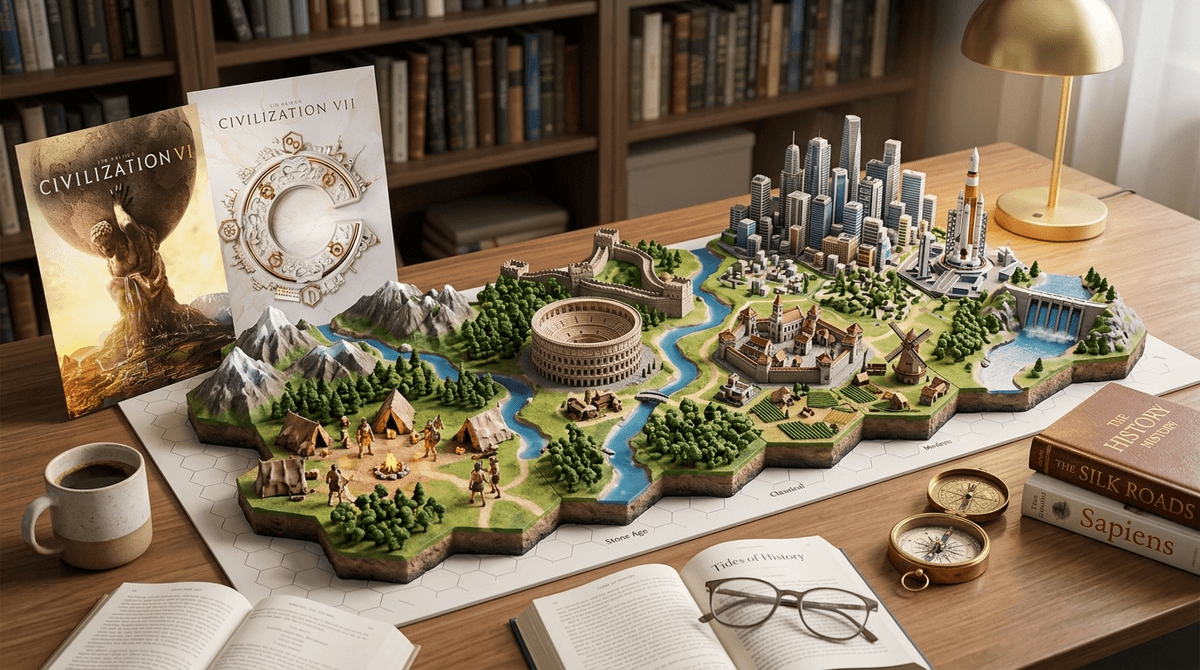
TL;DR: Civilization VI (and the upcoming Civilization VII) is the gold standard of "smart" gaming. It’s a deep, turn-based strategy game where you lead a historical nation from the Stone Age to the Space Age. It’s educational, complex, and high-brow, but it comes with a massive "time sink" warning. If your kid is playing this, they aren't rotting their brain—they’re learning about irrigation, diplomacy, and why you should never trust a nuclear-armed Mahatma Gandhi.
Quick Links:
- Best for ages 10+ (due to complexity, not content)
- Civilization VI
- Civilization VII
- Check out our guide on the best strategy games for kids
If you’ve heard your kid muttering about "production yields," "settling on a river," or "declaring a surprise war on Rome," welcome to the world of Sid Meier’s Civilization (often just called "Civ").
Unlike the fast-paced, chaotic energy of Fortnite or the sandbox creativity of Minecraft, Civ is a "4X" game: eXplore, eXpand, eXploit, and eXterminate. (Don't let that last one scare you; the "extermination" is usually just little 3D units bumping into each other on a map).
The game starts with a single settler and a warrior in 4000 BC. Over the next several hours (or days), the player builds cities, researches technologies like pottery and nuclear physics, adopts governments, and interacts with other historical leaders. It’s basically a digital version of the most complex board game you’ve ever seen—think Catan or Risk but on steroids and with a much better UI.
There is a specific kind of "brain itch" that Civilization scratches. It makes you feel like a genius. When you finally finish building the Pyramids or launch a satellite before your AI rivals, the sense of accomplishment is real.
But the real secret sauce is the "One More Turn" loop. Because the game is turn-based, there is no natural stopping point. You’re always three turns away from finishing a Library, two turns away from a new Governor, and five turns away from discovering Gunpowder. It’s a constant stream of short-term goals that makes it incredibly hard to put the controller down. It’s not "brain rot" in the sense of mindless scrolling on TikTok, but it is a "time trap" that can lead to a 10-year-old realizing it’s 11:00 PM on a school night.

Honestly? Yes. It’s probably the most "stealth-educational" game on the market.
- History & Geography: Your kid will learn who Mansa Musa, Hojo Tokimune, and Eleanor of Aquitaine were. They’ll understand why cities need fresh water and how mountains provide a natural defense.
- Systems Thinking: This is the big one. Civ teaches kids how different systems interact. To have a big army, you need a strong economy. To have a strong economy, you need a happy, educated population. To have that, you need resources. It’s a masterclass in cause-and-effect.
- The Civilopedia: Inside Civilization VI, there is a massive encyclopedia of historical facts. Many kids spend hours just reading about the actual history of the units and buildings they’re using.
If your kid is obsessed with Civ, they might actually start finding history class "mid" because they’ve already "lived" through the Industrial Revolution in their save file.
The ESRB rating is E10+, mainly for "Alcohol Reference" (you can build wine resources) and "Fantasy Violence."
The real barrier isn't the content—it's the complexity.
- Ages 7-9: They might enjoy the "pretty colors" and moving the units around, but the math and strategy will likely be over their heads. They’ll probably get frustrated when their empire collapses because they forgot to build farms.
- Ages 10-12: This is the sweet spot for starting. They’re old enough to handle the systems but might still need a little help understanding the more abstract concepts like "Culture Victory" or "Religious Pressure."
- Ages 13+: They’ll likely be better at the game than you are within a week.
Learn more about the best educational games for middle schoolers
Here is the good news: Civilization is a breath of fresh air compared to the predatory monetization we see in many modern games.
- No Loot Boxes: You buy the game, and you own it. There are no "surprise mechanics" or digital gambling.
- DLC (Downloadable Content): There are expansion packs like Rise and Fall and Gathering Storm. These are legitimate additions to the game, not "pay-to-win" microtransactions. They add things like climate change and loyalty systems.
- Multiplayer: While there is an online mode, it’s not a "lobby" full of toxic strangers in the way Call of Duty is. Most people play "Play by Cloud" or local multiplayer with friends. It’s slow, thoughtful, and generally very safe.
- Violence: When a unit "dies," it just disappears or falls over. There’s no gore. It’s very abstracted—more like a chess piece being taken than a cinematic execution.
The biggest "risk" with Civilization is the disappearance of time.
Because the game doesn't have "rounds" that end (like a 20-minute match in Brawl Stars), it is very difficult for a child to find a "natural" place to stop. If you tell them "five more minutes," they might literally only get through two turns, which feels like nothing.
The Pro-Tip: Switch the "clock" setting on in the game interface. It’s hidden in the settings, but having the actual real-world time visible on the screen helps ground players who have entered the "Civ trance."
If you want to connect with your kid about their game, don't ask "Are you winning?" (because a game of Civ can take 15 hours). Instead, try these:
- "Which civilization are you playing as this time?"
- "What’s your plan for winning? Are you going for a Science victory or a Culture victory?"
- "Has Gandhi tried to nuke you yet?" (This is a long-running joke in the Civ community—it’ll give you instant street cred).
- "I saw you're building the Eiffel Tower—do you know why that was originally built?"
If your kid loves the idea of building things but finds Civilization a bit too "spreadsheety," consider these:
- Polytopia: A "Civ-lite" that is much easier to pick up and play on a tablet.
- Age of Empires IV: More focus on real-time combat and base building.
- SimCity BuildIt: Focuses purely on city management without the war and diplomacy.
- Humankind: A very similar "historical 4X" game with a slightly different take on culture.
Civilization is the "prestige TV" of gaming. It’s deep, intellectual, and genuinely enriching. It encourages a "growth mindset" because losing a game usually teaches you exactly what you need to do better next time.
As long as you keep an eye on the clock and ensure they aren't staying up until 3 AM trying to colonize Mars, this is a game you can feel very good about having in your home. It’s not "Ohio" weird; it’s just a really, really good way to spend a rainy Saturday.
Check out our full review of Civilization VI
Next Steps:
- Check if they are playing on PC, Switch, or Tablet (the Switch version is great for car rides!).
- Ask them to show you their "Capital City."
- Set a hard "stop" time, not a "turn" limit—because we all know "just one more turn" is a lie we tell ourselves.