

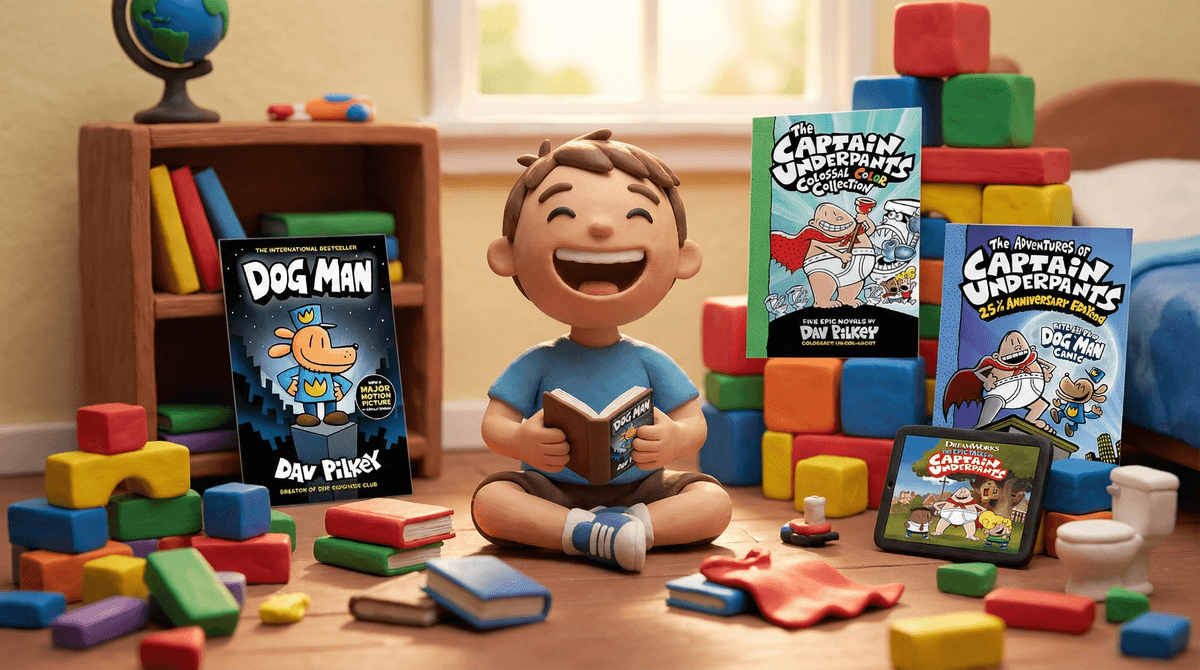
Captain Underpants is a wildly popular children's book series by Dav Pilkey that follows two fourth-graders, George and Harold, who hypnotize their mean principal into becoming a superhero who fights crime in his underwear. The series, which started in 1997, has sold over 80 million copies worldwide and includes 12 main books, plus spin-offs, graphic novels, and even a Netflix series.
The books are known for their deliberately crude humor – talking toilets, "flip-o-rama" action sequences, and jokes about bodily functions on nearly every page. Words like "poop," "pee," and "butt" appear with gleeful frequency. The illustrations are intentionally simple and cartoonish, and the books even include comic strips supposedly created by the main characters themselves.
If you're a parent who grew up reading more traditional children's literature, Captain Underpants can feel like... a lot. But here's the thing: there's actually more going on here than meets the eye (or nose).
It speaks their language. Around ages 6-9, kids are absolutely obsessed with bathroom humor. This isn't a sign of poor parenting or declining standards – it's a completely normal developmental phase. Kids this age are learning about their bodies, testing social boundaries, and figuring out what makes adults uncomfortable. Potty humor gives them a safe way to explore all of that.
It validates their sense of humor. Most "appropriate" books for this age group are written from an adult perspective about what kids should find funny. Captain Underpants is different – it's genuinely written for kids, by someone who remembers exactly what made him laugh at that age. Kids can tell the difference.
It makes reading fun for reluctant readers. This is huge. The books are relatively short (around 125-175 pages), heavily illustrated, and fast-paced. For kids who struggle with reading or find it boring, Captain Underpants can be a genuine gateway. Teachers and librarians consistently report that these books hook kids who previously resisted reading.
The format builds confidence. The mix of traditional text, comics, and "flip-o-rama" pages means kids get multiple entry points into the story. Struggling readers can follow along with the pictures, while stronger readers enjoy the wordplay and more complex vocabulary that's actually hidden throughout.
Here's what often gets lost in the potty humor panic: Captain Underpants books are surprisingly pro-reading, pro-creativity, and pro-friendship.
The main characters, George and Harold, are best friends who create their own comics together. They're imaginative, loyal to each other, and consistently stand up to bullies. Yes, they're troublemakers, but they're not mean-spirited – they pull pranks on adults who abuse their power, not on vulnerable kids.
The books also model creative collaboration. George is the writer, Harold is the artist, and they work together to create stories. For kids interested in making their own comics or stories, this is genuinely inspiring. Many kids who read Captain Underpants go on to create their own "flip-o-rama" books or comic strips.
The vocabulary is actually more advanced than you'd think. Pilkey sneaks in words like "subsequently," "perplexed," and "anthropomorphic" alongside the potty jokes. Kids are so engaged by the humor that they absorb these words without realizing they're learning.
That said, let's be honest about the concerns:
-
The authority-figure problem: Nearly every adult in these books is either mean, stupid, or both. The principal is the main antagonist. This can feel uncomfortable if you're trying to teach respect for teachers and authority.
-
The behavior modeling: George and Harold are constantly breaking rules, and their pranks are celebrated. For kids who already struggle with impulse control or following directions, this might not be the best influence.
-
The humor ceiling: Some kids get stuck in potty humor phase longer than others, and these books definitely don't encourage them to move on.
Ages 6-8 (Early Elementary): This is peak Captain Underpants age. Most kids this age find the humor hilarious, and the books are appropriately challenging for emerging readers. If your child is reading them, you're in good company – this is probably the most common age range.
Ages 9-11 (Upper Elementary): Many kids naturally move on from Captain Underpants around 4th or 5th grade, but plenty still enjoy them. If your 10-year-old is still reading them, that's totally fine. Some kids just enjoy the comfort of familiar humor, especially during stressful times.
Ages 12+ (Middle School): If your middle schooler is still exclusively reading Captain Underpants, it might be worth exploring other options that match their sense of humor but offer more complexity. Books like Diary of a Wimpy Kid or The Terrible Two series might be good bridges.
Instead of banning or shaming these books, try this approach:
Acknowledge the humor: "I can see why you think that's funny!" goes a lot further than "That's disgusting." Kids who feel validated are more likely to listen to your next point.
Draw boundaries around context: "It's fine to laugh at potty jokes in Captain Underpants, but we don't use that language at the dinner table" teaches kids about appropriate contexts rather than labeling the humor as inherently bad.
Use it as a bridge: "I love that you're reading so much! What other books are you interested in?" If they're only reading Captain Underpants, visit the library together and find similar books that might expand their horizons. Dog Man (also by Dav Pilkey) or The Bad Guys series are natural next steps.
Talk about the real themes: Ask questions like "Why do you think George and Harold are such good friends?" or "What makes Mr. Krupp so mean?" This helps kids think more deeply about the story beyond the surface-level jokes.
Captain Underpants isn't going to turn your kid into a delinquent, and it's not going to permanently stunt their literary development. For most kids, it's a phase – and often a really important one that helps them discover that reading can actually be fun.
The books have genuine literary merit (they've won multiple children's choice awards), they promote creativity and friendship, and they get reluctant readers excited about books. Yes, there's a lot of poop humor. But there's also a lot of heart.
If your child is reading Captain Underpants, they're reading. And that's worth celebrating, even if it means enduring a few weeks of "Tra-la-laaaa!" echoing through your house.
- Set up a reading routine that includes Captain Underpants alongside other books – maybe they read one Captain Underpants, then try something new
- Visit your local library and ask the children's librarian for recommendations for kids who love Captain Underpants (librarians are amazing at this)
- Consider the Netflix series as a family watch – it's surprisingly well-done and might scratch the itch without requiring more books
- Encourage creativity – if your kid loves the comic-within-a-book format, get them supplies to make their own comics
- Don't stress about it – this phase will pass, usually right around the time you've finally memorized all the characters' names
Want to understand more about what your kids are reading and watching? Take the Screenwise survey to see how your family's media habits compare to others in your community.