

We're talking about stories where Latino/Latina/Latine characters aren't just the side character who shows up for one chapter or the "diverse friend" — they're the main characters, the heroes, the complex humans driving the story forward. These are books written by Latino authors who bring authentic cultural details, family dynamics, language mixing, and lived experiences to the page.
And look, this isn't just about representation for Latino kids (though that's huge). This is about all kids getting to see the world as it actually is — diverse, multilingual, and full of different ways of being a family, celebrating, grieving, and growing up.
The research is pretty clear here: kids who see themselves in books develop stronger reading identities and literacy skills. And kids who read about people different from themselves? They develop empathy and cultural competence. It's the whole "mirrors and windows" thing — books should be both mirrors (where you see yourself) and windows (where you see others).
Latino kids make up about 28% of all children in the U.S., but Latino characters and authors are drastically underrepresented in children's publishing. We're talking single digits in terms of percentage of books published. That's a massive gap.
And here's the thing — when Latino characters do appear in books, they're often stereotyped or written by authors without lived experience. You get the "spicy Latina," the immigrant sob story, or the magical realism trope without any real cultural grounding.
Good books with Latino characters do something different. They show the incredible diversity within Latino communities — different countries of origin, different immigration stories (or no immigration story at all, because many Latino families have been here for generations), different languages, different skin colors, different everything. Because "Latino" isn't a monolith.
It's not just for Latino families. If you're not Latino, you might feel weird about this — like you're intruding or you don't have "permission" to read these books with your kids. But that's exactly backwards. These stories belong in every kid's library. Your kids need to read about people who aren't exactly like them. That's how they learn the world doesn't revolve around their specific experience.
Language mixing is a feature, not a bug. Many of these books include Spanish words and phrases, sometimes without translation. This is intentional. It reflects how many bilingual families actually talk. Your kid doesn't need to understand every word to get the story. Context clues work. And honestly? It's good for kids to sit with not understanding everything. That's real life.
Picture books are just the start. There are incredible middle grade novels, YA books, and graphic novels with Latino protagonists. Don't stop at Last Stop on Market Street (though it's lovely).
Picture Books (Ages 3-8)
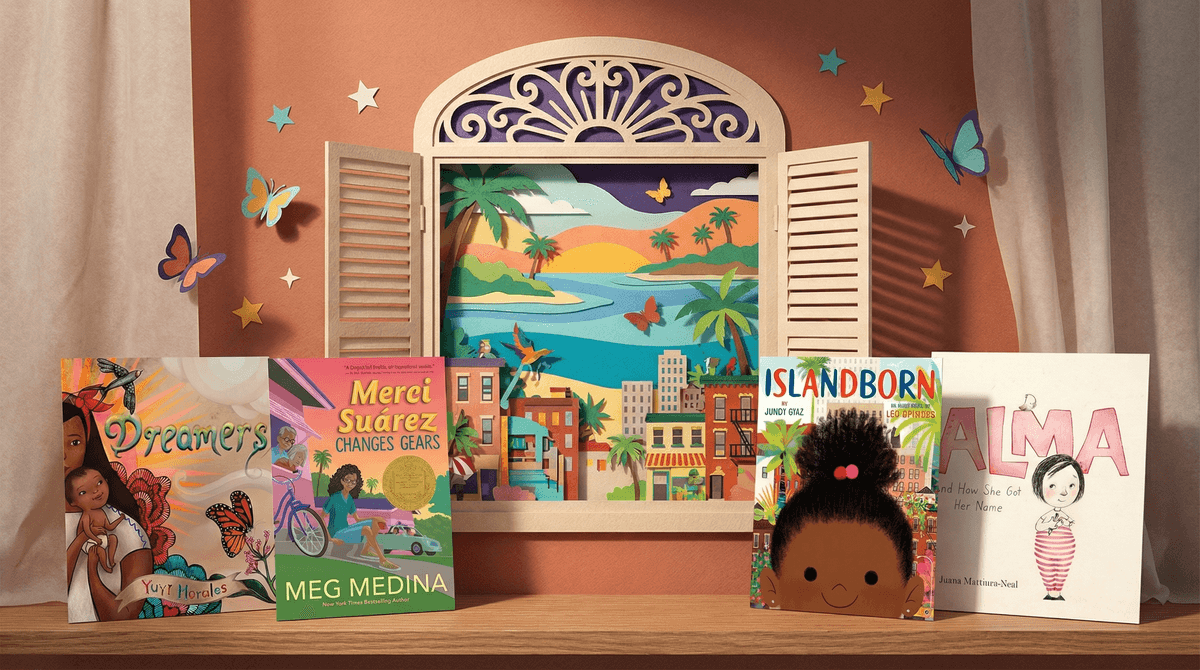
Alma and How She Got Her Name by Juana Martinez-Neal is perfect for kids wondering about their own names and family history. It's about a girl with a very long name who learns she's named after family members, each with their own story.
Islandborn by Junot Díaz (yes, that Junot Díaz) is about a girl who left the Dominican Republic as a baby and doesn't remember it — so she asks her community to help her remember. It's gorgeous and deals with immigration without being heavy-handed.
Dreamers by Yuyi Morales is an autobiographical picture book about immigrating from Mexico to the U.S. with her young son. The library becomes their sanctuary. It's stunning and will make you cry.
Early Readers & Chapter Books (Ages 6-10)
Juana & Lucas by Juana Medina is a chapter book series about a Colombian American girl who loves drawing and her dog. It's funny, warm, and the Spanish is woven in naturally.
Sal and Gabi Break the Universe by Carlos Hernandez is a wild sci-fi adventure about a Cuban American kid who can reach into alternate universes. It's hilarious and weird and deals with grief and blended families in really smart ways.
Middle Grade (Ages 8-12)
The Total Eclipse of Nestor Lopez by Adrianna Cuevas is about a kid who moves to a small Texas town and can suddenly talk to animals. It's got mystery, magic, and deals with military families and fitting in.
Ghost Squad by Claribel A. Ortega is about a girl in the Bronx who can see ghosts and has to save her neighborhood. It's spooky, funny, and deeply rooted in Dominican culture.
Merci Suárez Changes Gears by Meg Medina (Newbery winner) is about a Cuban American girl at a fancy private school dealing with her grandfather's declining health. It's beautiful and real.
YA (Ages 12+)
The Poet X by Elizabeth Acevedo is a novel in verse about a Dominican American girl in Harlem finding her voice through slam poetry. It deals with religion, family expectations, first love, and self-expression. It's powerful.
I Am Not Your Perfect Mexican Daughter by Erika L. Sánchez is about a Mexican American girl in Chicago dealing with her sister's death and family secrets. It's raw and doesn't shy away from mental health, sexuality, or complicated family dynamics.
Cemetery Boys by Aiden Thomas is a paranormal romance about a trans Latinx teen trying to prove himself to his traditional family of brujos (witches). It's got ghosts, romance, and authentic representation of both Latino and trans experiences.
For younger kids: Just read the books. You don't need to make a big announcement about diversity. Kids will absorb the normalcy of seeing different kinds of families and experiences.
For older kids: You can have more explicit conversations. "Have you noticed that a lot of books we read are about white kids? Let's make sure we're reading stories about all kinds of people." Or "This author is writing from her own experience growing up Puerto Rican in New York. What details feel specific to her culture?"
If your kid asks about words they don't know: Great! Look them up together. Talk about how many people in the world speak multiple languages and mix them naturally. If you speak another language, make the connection to your own experience.
If you're worried about "getting it right": You probably will mess up at some point. That's okay. The goal isn't perfection, it's exposure and respect. If you mispronounce a Spanish word, correct yourself and move on. Model that learning is ongoing.
Building a diverse bookshelf isn't about checking boxes or performing wokeness. It's about giving your kids a fuller, truer picture of the world they live in. Latino stories are American stories. They're funny, sad, magical, ordinary, extraordinary — just like any other stories.
The books above are genuinely great books that happen to center Latino experiences. They're not homework. They're not medicine. They're just good stories that your kids will love, and they'll come away understanding a little more about people whose lives might look different from theirs (or exactly like theirs).
Start with one. See what lands. Build from there.
Want more recommendations? Check out Pura Belpré Award winners — it's given annually to Latino authors and illustrators whose work celebrates Latino culture.
Looking for books about other cultures? We've got guides for that too. The same principles apply: seek out own-voices authors, look for authentic details, and just... read widely.
Wondering how to balance screen time with reading time? Let's talk about that.