

Let's be real: we're talking about making sure the books on your shelves reflect the actual world we live in. Books with Black characters aren't a "special category" — they're just... books. But given that publishing has historically been overwhelmingly white, and that representation in children's literature still lags behind reality, it's worth being intentional about building a home library that shows Black kids they're the main character, and shows all kids that Black people are doctors, astronauts, silly, brave, ordinary, and extraordinary.
This isn't about checking a diversity box. It's about making sure your kids grow up seeing the full spectrum of humanity in the stories they love.
For Black children: Seeing yourself in stories is fundamental. Research consistently shows that when kids see characters who look like them doing amazing things, being loved, solving problems, and going on adventures, it shapes their sense of possibility. It tells them: you belong here. Your stories matter. You're not the sidekick.
For all children: If your kids only see white characters in books, they're getting a wildly inaccurate picture of the world. Representation builds empathy, challenges stereotypes, and prepares kids to live in a diverse society. Plus, they're missing out on incredible stories.
The data is stark: A 2023 study found that only about 12% of children's books published featured Black characters, despite Black people making up about 14% of the U.S. population. And many of those books are still written by white authors, which brings its own complications around authenticity and whose stories get told.
Start Early, Make It Normal
Don't wait for some "teachable moment" about diversity. Just... have diverse books. From board books onward. If your toddler's bookshelf has Goodnight Moon, it should also have books by Kadir Nelson or Vashti Harrison. Make representation the default, not the exception.
Own Voices Matter (But Aren't Everything)
Books written by Black authors about Black experiences bring authenticity and nuance that's hard to replicate. That said, Black authors also write fantasy, science fiction, silly stories about dinosaurs, and everything else. Don't pigeonhole Black authors into only writing "about race." And yes, white authors can write Black characters — but be thoughtful about it, especially for stories centered on Black experiences.
Beyond the Trauma Narrative
A lot of well-meaning parents gravitate toward books about the Civil Rights Movement, slavery, or racism. These stories are important. But if those are the only books with Black characters you have, you're telling kids that Black stories are only about suffering. Make sure you've also got adventure stories, romances, comedies, fantasies, and books where Black kids are just... being kids.
Age-Appropriate Guidance
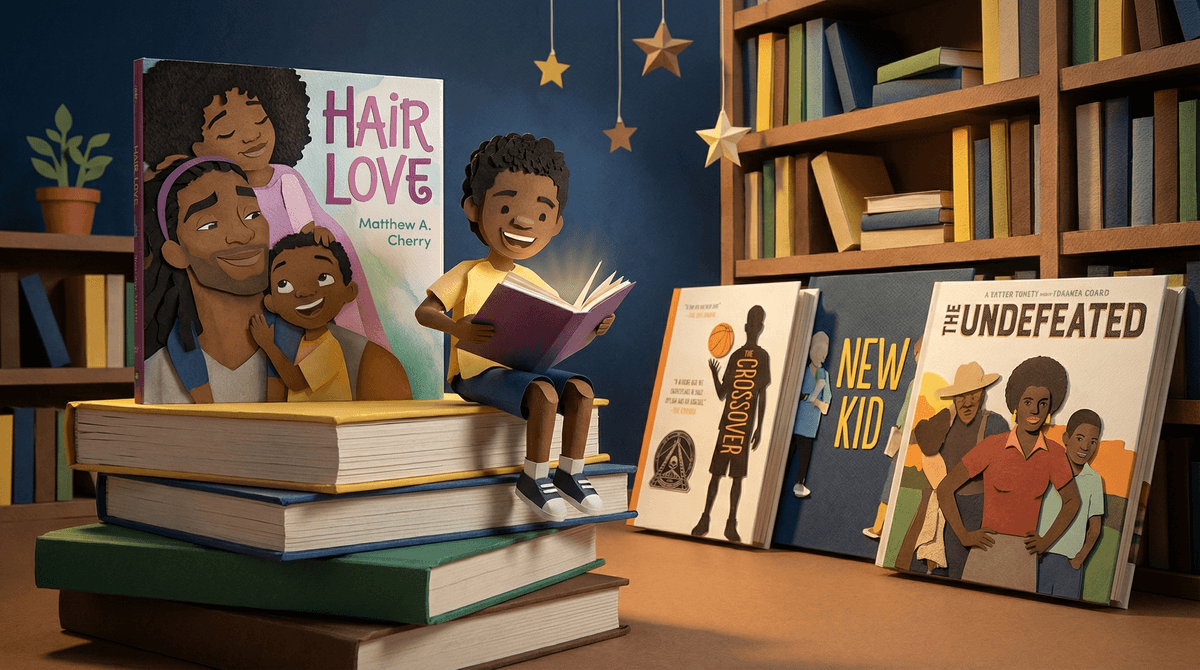
Ages 0-3: Board books and picture books are perfect for normalizing diversity. Look for books where Black characters are just living life — going to the park, celebrating birthdays, loving their families. Hair Love by Matthew A. Cherry is a beautiful example.
Ages 4-7: Picture books can get more complex. This is where you can introduce stories about identity, family, and yes, some age-appropriate history. The Undefeated by Kwame Alexander is stunning. Also great: funny books like anything by Derrick Barnes.
Ages 8-12: Chapter books and middle grade fiction. This age group devours series, so look for diverse options: The Crossover by Kwame Alexander, Ghost by Jason Reynolds, or New Kid by Jerry Craft (a graphic novel that won basically every award for good reason).
Ages 13+: Teen readers can handle everything from contemporary realistic fiction to sci-fi and fantasy. The Hate U Give by Angie Thomas is essential reading. Children of Blood and Bone by Tomi Adeyemi brings West African mythology to YA fantasy. Long Way Down by Jason Reynolds is a gut-punch of a novel in verse.
Don't Overthink It
You don't need to become an expert in Black literature overnight. Start with award winners: look for Coretta Scott King Award winners, Newbery winners, Caldecott winners. Ask your librarian. Follow Black bookstagrammers and educators on social media.
Mix It Up
Have books where race is central to the story AND books where Black characters are just... there. A Black kid solving a mystery. A Black family going on vacation. A Black girl who's really into science. Representation means showing the full range.
Check Your Classics
If your kid is reading "classics," be aware that many have racist content or stereotypes. That doesn't mean you can't read them, but you might want to have conversations about historical context. And make sure those classics aren't the only older books they're reading.
Support Black-Owned Bookstores
If you can, buy from Black-owned bookstores (many ship nationwide). It puts money directly into Black communities and they often have incredible curated selections.
This isn't complicated: kids need to see themselves in books, and they need to see others. If you're white and you've never thought about whether your home library is diverse, that's... kind of the point. Privilege means not having to think about representation because you've always been represented.
The good news? There are SO many incredible books with Black characters across every genre, age range, and interest area. You're not sacrificing quality for diversity — you're just reading great books.
Start with one. Add to your library gradually. Let your kids see that stories come in all colors, and that Black kids (and adults, and families, and communities) are funny, brave, flawed, brilliant, and everything in between.
- Audit your current library: What percentage of books feature Black characters? If it's under 10%, you've got work to do.
- Ask your kids what they're interested in, then find books with Black characters in those genres
- Visit your local library and ask for recommendations — librarians are incredible resources
- Follow diverse book accounts on social media for ongoing recommendations
- Learn more about building a diverse media diet
 beyond just books
Representation in reading isn't a nice-to-have. It's foundational to raising kids who see the full humanity in everyone, including themselves.