

Books for Young Activists: Raising Kids Who Want to Change the World
Let's be real: "activist" might sound like a heavy word for a seven-year-old who just wants to save the sea turtles, but kids have always cared deeply about fairness, justice, and making things better. Young activist books are stories—fiction and nonfiction—that help kids understand social issues, historical movements, and how ordinary people (including kids!) have created change.
These aren't your standard "be kind" picture books. We're talking about books that tackle real topics: civil rights, climate change, gender equality, immigration, disability justice, LGBTQ+ rights, and more. Some are biographies of changemakers, some are novels where kids organize and advocate, and some are practical guides for taking action.
The goal? To help kids see themselves as people who can make a difference, not just someday when they're grown-ups, but right now.
Here's what I've noticed: kids are already activists. They're the ones calling out unfairness on the playground, asking why their friend's family can't afford lunch, or sobbing over videos of polar bears on melting ice. They haven't yet learned to be cynical or resigned. That's actually beautiful.
But here's the tricky part: caring deeply without tools or context can be overwhelming. A nine-year-old who learns about deforestation might spiral into eco-anxiety. A middle schooler passionate about racial justice might feel paralyzed by the enormity of systemic racism.
Good activist books do two critical things:
- They provide historical context so kids understand that change is possible because people before them made it happen
- They offer concrete, age-appropriate actions so caring doesn't turn into despair
Also—and I cannot stress this enough—these books can help kids develop critical thinking skills and media literacy. Understanding how movements work, how misinformation spreads, and how to evaluate sources? That's digital wellness too. These skills matter in an age where kids are getting their news from TikTok .
.
Ages 4-7: Planting Seeds
At this age, focus on empathy, fairness, and small actions. Kids this young aren't ready for systemic analysis, but they can absolutely understand that people deserve to be treated fairly.
Top picks:
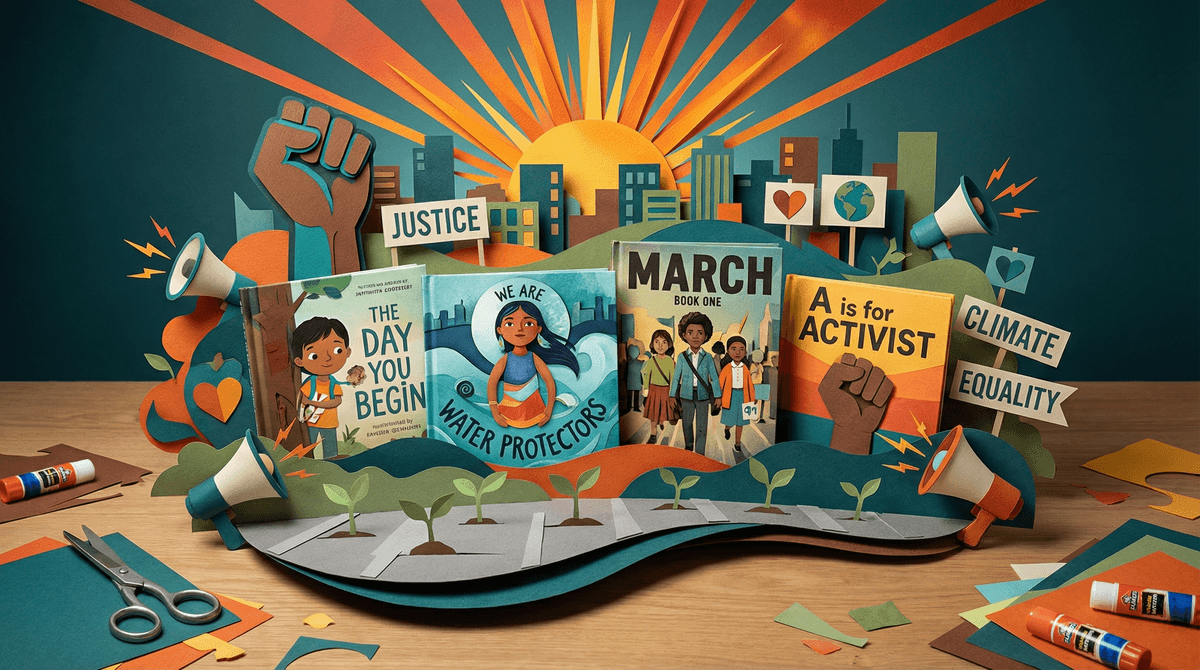
- A is for Activist by Innosanto Nagara - An ABC book that introduces social justice concepts without being preachy. "C is for Creative Counter to Corporate Culture" might go over their heads, but the colorful art and rhythm work beautifully.
- The Day You Begin by Jacqueline Woodson - About feeling different and finding courage to share your story. Gorgeous and gentle.
- We Are Water Protectors by Carole Lindstrom - Indigenous perspectives on environmental protection. Won the Caldecott Medal for a reason.
Ages 8-11: Building Understanding
This is the sweet spot for biographies, historical movements, and kid-led action. They're old enough to understand cause and effect, but still young enough to believe wholeheartedly that they can change things.
Top picks:
- Who Was series - Yes, I know these are everywhere, but they're accessible entry points to figures like Ruth Bader Ginsburg, Harriet Tubman, and Malala Yousafzai.
- Ghost Boys by Jewell Parker Rhodes - A powerful novel about police violence and racism. This one's heavy but important for kids ready to engage with difficult truths.
- The Girl Who Buried Her Dreams in a Can by Tererai Trent - True story of a Zimbabwean girl who achieved her dreams of education despite massive obstacles.
- Hey, Kiddo by Jarrett J. Krosoczka - Graphic memoir about growing up with a parent struggling with addiction. Not explicitly "activist" but builds empathy for people facing challenges.
Ages 12+: Deep Dives and Complexity
Tweens and teens can handle nuance, systemic analysis, and moral complexity. They're also more likely to actually do something—organize a walkout, start a petition, volunteer.
Top picks:
- Stamped: Racism, Antiracism, and You by Jason Reynolds and Ibram X. Kendi - A remix of Kendi's "Stamped from the Beginning" for young readers. Essential reading on the history of racist ideas in America.
- The Hate U Give by Angie Thomas - If they haven't read this yet, now's the time. Police violence, code-switching, and finding your voice.
- All Boys Aren't Blue by George M. Johnson - A memoir about growing up Black and queer. Honest, funny, and frequently banned (which tells you it's important).
- This Book Is Anti-Racist by Tiffany Jewell - A workbook-style guide with exercises and activities. Great for kids who want practical tools.
You don't have to have all the answers. Seriously. Your kid asks, "Why did people enslave other people?" and you're allowed to say, "That's a really good question. Let's read about it together and talk about what we learn."
Match the book to your kid's temperament. Some kids are energized by learning about injustice and immediately want to make protest signs. Others get anxious and need more time to process. A sensitive kid might do better with Each Kindness by Jacqueline Woodson (about small acts of kindness) before diving into March by John Lewis (graphic novel about the civil rights movement).
Balance learning with action. Reading about problems without any sense of agency can be paralyzing. After finishing a book, ask: "What's one small thing we could do?" Maybe it's donating to a relevant organization, writing to a representative, or volunteering locally. Help them understand that small actions matter.
Expect pushback if your kid's values start diverging from yours. This is actually healthy development! A teen who reads about labor rights and suddenly lectures you about your Amazon habit? Annoying, yes. But also: they're thinking critically. You can have boundaries about how they express their views while still respecting that they have views.
Watch for performative activism. Older kids especially might post infographics on Instagram and think they've done the work. Books can help them understand the difference between awareness and action, between virtue signaling and actual organizing.
Start conversations, don't deliver lectures. After reading together (or after they finish independently), try:
- "What surprised you in that book?"
- "Did anything make you angry? Sad? Hopeful?"
- "The author thinks [X]. What do you think?"
- "If you could talk to [historical figure], what would you ask them?"
Connect books to current events (age-appropriately). If you're reading about the civil rights movement and there's a local protest, you might say, "People are still fighting for some of the same things we read about. Want to learn more about what's happening now?"
Create a "change the world" shelf. Let your kid curate it. Seeing these books together signals that activism and justice aren't one-time lessons—they're ongoing parts of life.
Don't force it. Some kids will devour these books and organize their entire fourth grade to protest the cafeteria's plastic straws. Others will read them, absorb the lessons quietly, and express their values in different ways. Both are fine.
Raising kids who care about justice doesn't mean raising kids who are perpetually angry or anxious. It means giving them:
- Knowledge about how the world works and how it's failed people
- Hope from stories of people who made change happen
- Tools to take action in age-appropriate ways
- Community of people who share their values
Books are just one piece of this, obviously. You're also modeling through your own choices, having hard conversations, and supporting their interests. But stories? Stories are powerful. They let kids see themselves as heroes of their own narratives, not just passive consumers of whatever world adults hand them.
And honestly, in 2026, when kids are drowning in curated content and algorithmic feeds designed to make them feel powerless, giving them stories about people who organized, resisted, and changed things? That's radical. That's necessary.
Start where your kid already cares. Obsessed with animals? Try books about environmental activism. Passionate about fairness at school? Look into books about education equity or disability rights.
Visit your library. Librarians are incredible resources for this. Ask for "books about kids making change" or "biographies of activists" and they'll load you up.
Make it a family thing. Pick one book to read aloud together, even with older kids. Family read-alouds are underrated and create natural spaces for discussion.
Follow their lead. If your kid finishes a book and wants to do something—help them figure out what that looks like. Even if it's small. Especially if it's small.
You've got this. And your kid who wants to change the world? They've got you.