

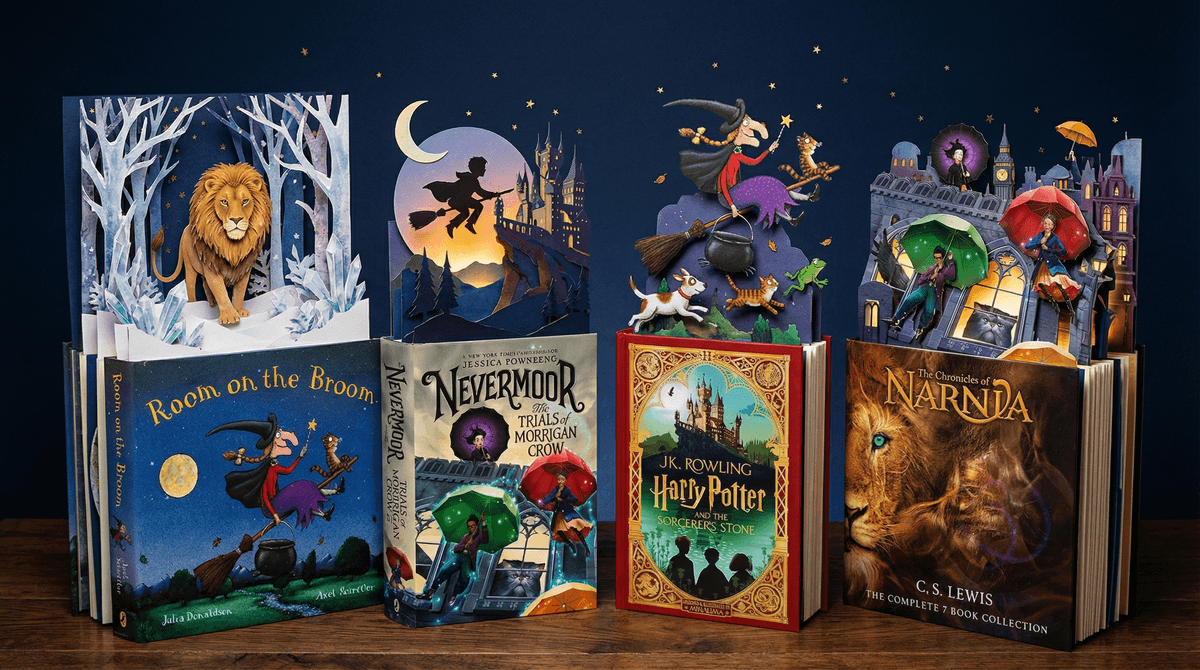
Books about magic have been captivating young readers for generations—from Harry Potter to Percy Jackson, from The Chronicles of Narnia to newer series like Nevermoor. These stories feature wizards, witches, spells, magical creatures, and fantastical worlds where the impossible becomes possible.
But here's where it gets tricky for parents: not all magical content is created equal, and not all families feel the same way about what's acceptable. Some parents worry about witchcraft references, others are concerned about occult themes, and many are just trying to figure out what's age-appropriate versus what's going to give their 7-year-old nightmares.
The reality is that "magic" in children's literature exists on a massive spectrum—from talking animals and fairy godmothers to detailed spell-casting systems and darker supernatural elements. Understanding that spectrum is key to making choices that work for your family.
Magic in books does something screens often can't: it sparks imagination in a deeply personal way. When kids read about magic, they're not just consuming content—they're building entire worlds in their minds, creating mental images of what spells look like, how potions bubble, what a dragon's scales feel like.
These stories also tackle real-world themes through a fantastical lens. Friendship, courage, loss, identity, good versus evil—all get explored in ways that feel safer and more digestible when wrapped in a magical framework. A kid processing anxiety about starting middle school might find comfort in reading about a young wizard navigating their first year at a magical academy.
Plus, let's be honest: magic is just cool. The idea that you could have special powers, attend a secret school, or discover you're destined for something extraordinary? That's catnip for kids navigating a world where they often feel powerless.
Let's address the elephant in the room: some families have genuine religious or philosophical concerns about witchcraft and occult themes in children's media. This is a real consideration, and it's not about being "uptight"—it's about family values.
Here's what matters: the intent and framing of the magic in the story.
There's a meaningful difference between:
- Fantasy magic (magic as a plot device, like superpowers or technology—think Harry Potter or The Worst Witch)
- Fairy tale magic (wands, wishes, talking animals—think Disney-style enchantment)
- Spiritual/religious magic (stories that incorporate actual religious practices, rituals, or belief systems)
Most popular children's books fall into the first two categories. The magic is clearly fictional—a storytelling tool, not an invitation to actual occult practice. That said, some books do incorporate more realistic witchcraft elements, tarot, or pagan traditions, which might cross a line for some families.
The key question to ask yourself: Does this book present magic as pure fantasy entertainment, or does it encourage real-world spiritual practices that conflict with our family's beliefs?
Ages 3-6: Pure Wonder At this age, magic is everywhere and everything. Talking animals, fairy godmothers, magic beans—it's all the same to them. Great options include:
- Room on the Broom (friendly witch, very gentle)
- The Paper Bag Princess (dragon-focused, empowering)
- Any fairy tale collection
Ages 6-9: Chapter Book Magic This is when kids start devouring series and want more complex magical worlds, but still need clear good-versus-evil frameworks:
- The Magic Tree House series (time travel magic, educational)
- Junie B. Jones and the Stupid Smelly Bus (no magic, but listing for comparison—realistic fiction alternative)
- Ella Enchanted (fairy tale retelling, curse-breaking)
- The Worst Witch (witch school, but very wholesome and British)
Ages 9-12: Complex Magical Systems Now they're ready for detailed world-building, moral complexity, and longer series:
- Harry Potter (the obvious one—starts lighter, gets darker)
- Percy Jackson (Greek mythology, less "witchy," more adventure)
- Nevermoor (magical trials, found family themes)
- The School for Good and Evil (fairy tale deconstruction)
Ages 12+: Nuanced Fantasy Teens can handle moral ambiguity, darker themes, and more sophisticated magical systems:
- The Hunger Games (dystopian, minimal magic but listing for genre comparison)
- Six of Crows (heist fantasy, complex magic system)
- A Darker Shade of Magic (parallel Londons, mature themes)
Read it yourself (or at least skim it). Seriously. You don't need to read every page, but knowing the general plot, tone, and magical framework helps you have informed conversations. If your kid is reading Harry Potter, you should know what a Horcrux is.
Talk about fantasy versus reality early and often. Even young kids can understand "this is pretend, like when we play pretend." As they get older, you can have more nuanced conversations about why people write fantasy stories and what themes they're exploring.
Watch for content that might be scary, not just "magical." The bigger issue in many magical books isn't the magic itself—it's the violence, darkness, or frightening scenes. Harry Potter gets progressively darker. Coraline is straight-up creepy. Know your kid's tolerance for scary content.
Use it as a springboard for values conversations. These books are full of teachable moments about courage, friendship, prejudice, power, and choice. "Why do you think Hermione stood up for the house elves?" is a much better dinner conversation than "how was school?"
Don't stress about "gateway" fears. There's zero evidence that reading Harry Potter turns kids into actual witchcraft practitioners. If your kid asks about "real magic" after reading these books, it's usually curiosity, not a spiritual crisis. Answer honestly: "In these books, magic is pretend. Some people believe in different kinds of spiritual things in real life, but that's different from what's in this story."
If witchcraft themes are genuinely off-limits for your family, you have options:
Mythology-based fantasy often feels less "witchy" because it's rooted in ancient stories:
- Percy Jackson (Greek gods)
- The Kane Chronicles (Egyptian mythology)
- Magnus Chase (Norse mythology)
Science fiction gives you the wonder without the witchcraft:
Christian fantasy exists and is actually quite good:
- The Chronicles of Narnia (explicit Christian allegory)
- The Green Ember series
You can also check Common Sense Media reviews, which often flag specific content concerns including magic/witchcraft themes.
Books about magic aren't inherently good or bad—they're tools for imagination, and like any tool, the value depends on how they're used and whether they align with your family's values.
For most families, magical books are an incredible gateway to reading, critical thinking, and meaningful conversations. They teach kids that ordinary people can do extraordinary things, that choices matter more than circumstances, and that friendship and courage can overcome darkness.
If you have concerns about specific content, read alongside your kid (or at least stay informed about what they're reading). Use these stories as conversation starters, not conversation enders.
And remember: a kid who's deep into a 400-page fantasy novel is building vocabulary, comprehension, focus, and imagination—all while not staring at a screen. That's a parenting win in 2026, full stop.
- Check out our guide on age-appropriate book series for more recommendations
- Get book recommendations based on your child's age and interests for personalized book recommendations based on your child's age and interests
- Read our guide to balancing screen time with reading time