

February rolls around and suddenly every streaming service has a "Black History Month" collection, your kid's school assigns a project, and you're standing in front of Netflix thinking "okay, which of these movies is actually going to spark a real conversation and not just check a box?"
Here's the thing: Black history isn't a February thing. It's American history. It's world history. And the best movies, shows, books, and art about Black experiences aren't homework—they're powerful stories that help kids (and honestly, adults) understand identity, justice, resilience, and creativity in ways that stick.
This guide is about finding media that matters. Not the stuff that feels like eating your vegetables, but the films and shows and music that actually connect. The ones where your 10-year-old asks questions during dinner, or your teenager suddenly wants to talk about something real.
Your kids are growing up in a world where they're going to encounter conversations about race, identity, and justice whether you start them or not. They're seeing it in their classrooms, on their feeds, in their friend groups. The question isn't whether they'll form opinions—it's whether they'll form them from TikTok comments or from thoughtful, age-appropriate media you've experienced together.
Plus, representation matters. If your kids are Black, seeing their history and culture reflected in powerful, joyful, complex ways is essential. If they're not, understanding that the American story is deeply intertwined with Black history and culture isn't "extra credit"—it's basic literacy.
Elementary (Ages 5-10)
Start with joy and discovery, not trauma. Young kids don't need to process slavery or police violence yet—they need to see Black excellence, creativity, and everyday life.
Shows & Movies:
- Encanto isn't explicitly about Black history, but it's a great entry point for talking about Afro-Latino culture and identity
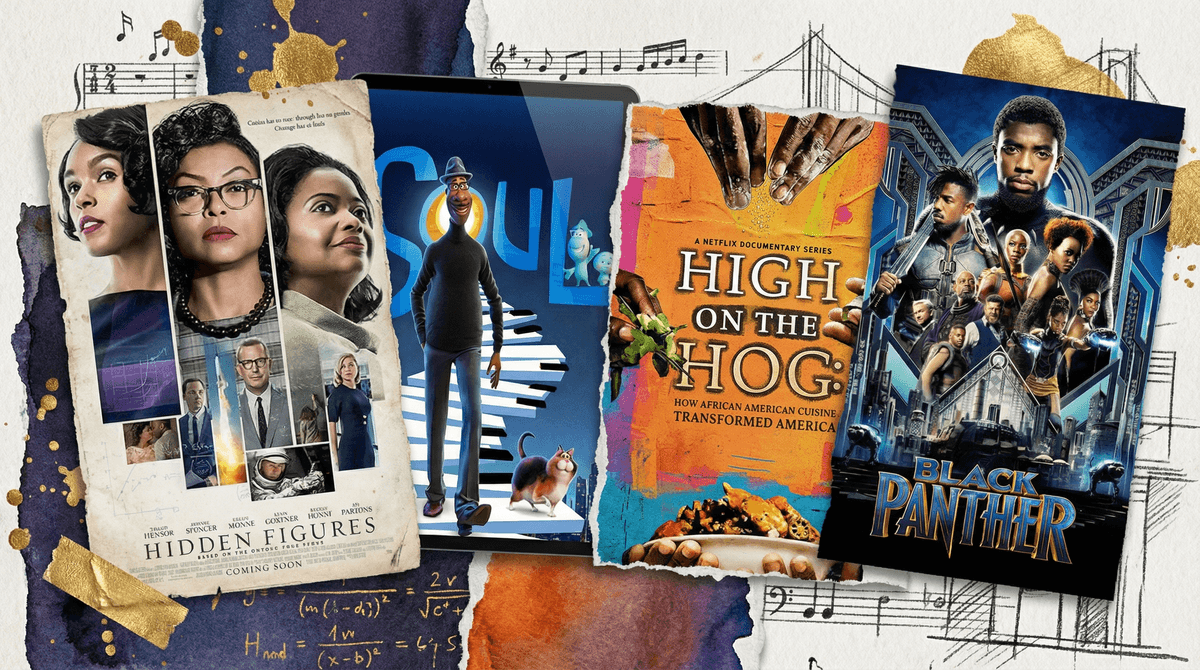
- Soul (Pixar) beautifully explores purpose, jazz, and Black culture in NYC—and it's genuinely moving for adults too
- The Proud Family: Louder and Prouder on Disney+ is a reboot that handles contemporary issues with humor and heart
- Rise Up Sing Out (Disney+) uses short musical episodes to introduce concepts like anti-racism to little kids
Books to pair:
- Anything by Jacqueline Woodson (especially Brown Girl Dreaming)
- The Undefeated by Kwame Alexander—gorgeous illustrations, powerful poetry
Middle School (Ages 10-14)
This is when kids can start handling more complexity and historical context, but you still want stories with hope and agency.
Shows & Movies:
- Hidden Figures is perfect for this age—brilliant women, space race, actual triumph over racism without graphic violence
- The Watsons Go to Birmingham (Hallmark movie based on the beloved book) tackles the Civil Rights era through a family road trip
- Selma is powerful but requires some context-setting beforehand—watch it together
- Black Panther isn't a history lesson, but the themes about African identity, diaspora, and power are rich conversation starters
Documentaries:
- High on the Hog (Netflix) about Black food history is genuinely fascinating and not heavy
- 13th by Ava DuVernay is essential but intense—better for mature 13+ with discussion
High School (Ages 14+)
Now you can go deeper. These are the films and shows that don't pull punches but also don't exploit trauma for shock value.
Shows & Movies:
- When They See Us (Netflix) about the Central Park Five is devastating but essential—watch together and be ready to talk
- Judas and the Black Messiah about Fred Hampton and the Black Panthers is incredibly well-made
- I Am Not Your Negro based on James Baldwin's writing—intellectually challenging in the best way
- Moonlight is a masterpiece about Black masculinity, identity, and sexuality (mature themes, definitely 16+)
Music as History: Don't sleep on music. Create a playlist together: Nina Simone's protest songs, Kendrick Lamar's To Pimp a Butterfly, the Hamilton soundtrack (yes, it's complicated, but it's also a gateway drug to history). Let them see how art has always been resistance and celebration.
Don't make it homework. The fastest way to kill a meaningful conversation is to assign a five-paragraph essay afterward. Watch together. Pause when someone has a question. Ask "what did you think?" not "what did you learn?"
Let them lead sometimes. Your teenager might want to watch Fruitvale Station or The Hate U Give because their friends are talking about it. That's actually great—meet them there.
Context matters. Before watching something set during slavery or the Civil Rights era, give a 2-minute primer. After, be ready to answer questions honestly. "I don't know, let's look that up together" is a perfectly good answer.
Follow up with the real stuff. After Hidden Figures, look up Katherine Johnson's actual story. After Selma, find footage of the actual march. The movie is the hook; the history is the meal.
Talk about what's missing. Hollywood still has a problem with telling only certain kinds of Black stories (trauma, sports, slavery). Point that out. Ask your kids: "What kinds of stories about Black people do we not see enough of?" That's media literacy.
The White Savior Industrial Complex: Movies like The Help or Green Book aren't evil, but they center white comfort over Black experience. If you watch them, talk about whose story is actually being told and why that matters.
Trauma porn: Some films use Black suffering for Oscar bait without actually saying anything new. If a movie's entire pitch is "look how terrible this was" without context, purpose, or hope, maybe skip it.
The "one movie solves racism" trap: Watching 12 Years a Slave doesn't make you or your kids experts on anything. It's one piece of a much larger conversation.
The goal isn't to turn your living room into a classroom. It's to build cultural literacy and empathy through stories that are actually good. The best Black history media isn't "eat your vegetables"—it's Coco levels of "we're all crying but in a good way."
Start where your kids are. A 7-year-old doesn't need Eyes on the Prize; they need Soul. A 15-year-old can handle 13th if you're there to process it together.
And remember: this isn't a February thing. Keep these movies in rotation year-round. Black history is American history, and the stories are too good to save for one month.
Make a list together. Sit down with your kids and pick three things from this guide that sound interesting. Let them choose.
Check out Screenwise's full media database for ratings, age recommendations, and parent reviews on any of these titles.
Need help figuring out what's right for your specific kid? Find age-appropriate Black history media based on their interests and maturity level.
Go beyond the screen. Visit a museum, attend a local cultural event, find Black authors at the library. Media is the starting point, not the destination.