

Look, February rolls around and suddenly every school sends home a list of "recommended reading" for Black History Month. But here's the thing: building an anti-racist library for your kids shouldn't be a once-a-year panic scramble. It should be an ongoing, intentional part of how we raise humans who understand that Black history is American history, full stop.
Black history books for young kids range from picture books celebrating everyday Black joy to age-appropriate biographies of civil rights leaders, from stories about the Underground Railroad to contemporary tales about Black families just living their lives. The best ones don't just show up in February—they live on your shelves year-round, normalized as part of your family's reading rotation.
And real talk: if the only books featuring Black characters on your shelf are about slavery and struggle, we need to rebalance. Kids need to see Black excellence, Black joy, Black normalcy, and yes, also the hard truths about our history. It's not either/or.
By age 3, kids notice racial differences. By age 5, they're already forming biases based on what they see around them—in their neighborhoods, their schools, and yes, their bookshelves. Representation in books literally shapes how kids see the world and their place in it.
For Black kids, seeing themselves in stories builds identity, pride, and belonging. For non-Black kids, diverse books build empathy, challenge assumptions, and normalize a world that actually reflects reality. For all kids, these books are just... good books. With great stories. That happen to feature Black characters and history.
The research is clear: kids who grow up with diverse books show more empathy, less prejudice, and better critical thinking skills. But beyond the studies, it's just common sense—you can't raise anti-racist kids in a literary vacuum where everyone looks the same.
Ages 2-5: Board Books & Picture Books
Start simple. At this age, you're building foundational awareness that people look different and that's beautiful.
The everyday joy category:
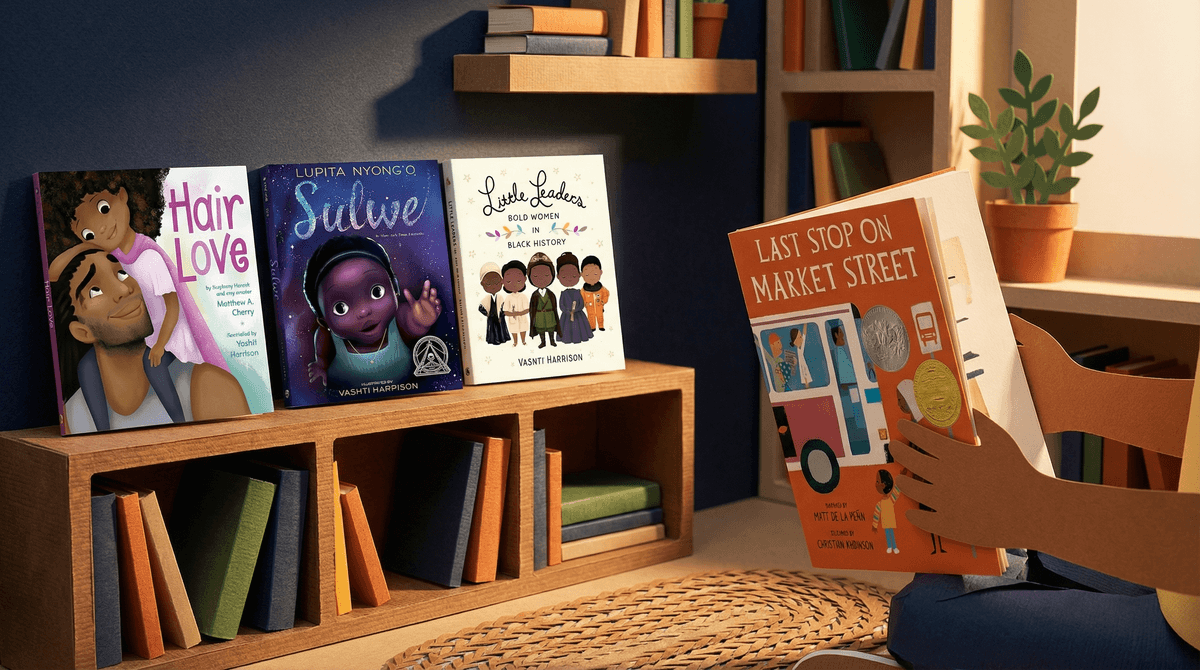
- Hair Love by Matthew A. Cherry - A dad learning to do his daughter's hair. It's sweet, it's funny, and it won the Oscar for the animated short. Kids love it because it's about a dad trying really hard. Parents love it because it normalizes Black beauty.
- The Snowy Day by Ezra Jack Keats - A classic for a reason. Peter plays in the snow. That's it. That's the plot. And it's perfect.
- Sulwe by Lupita Nyong'o - About a girl with dark skin learning to love herself. Gorgeous illustrations, important message about colorism even young kids can grasp.
The "let's talk about real people" category:
- Little Leaders: Bold Women in Black History by Vashti Harrison - Bite-sized bios with beautiful illustrations. Not overwhelming, just inspiring.
Ages 6-8: Early Readers & Chapter Books
Now you can introduce more complexity—both in reading level and in historical content.
Historical but age-appropriate:
- Henry's Freedom Box by Ellen Levine - The true story of Henry "Box" Brown who mailed himself to freedom. It's heavy, but told in a way that 6-8 year olds can process. Read it together.
- Ruby Bridges Goes to School by Ruby Bridges - Told by Ruby herself about integrating an all-white school at age 6. Powerful because kids this age can imagine themselves in her shoes.
Contemporary stories:
- The Proudest Blue by Ibtihaj Muhammad - About a girl whose sister wears hijab for the first time. Intersectional representation matters, and this book nails it.
- Last Stop on Market Street by Matt de la Peña - A boy and his grandmother take the bus across town. It's about finding beauty everywhere and economic diversity, with a Black family at the center.
Ages 9-12: Middle Grade
At this age, kids can handle more nuanced discussions about racism, systemic injustice, and complex historical figures.
The heavy hitters:
- The Watsons Go to Birmingham—1963 by Christopher Paul Curtis - Historical fiction about a Black family from Michigan visiting Alabama during the civil rights movement. It's funny until it's devastating. Read it with them.
- Brown Girl Dreaming by Jacqueline Woodson - Memoir in verse about growing up Black in the 1960s-70s. Beautiful writing, accessible format.
- March trilogy by John Lewis - Graphic novel memoir by the late congressman about his role in the civil rights movement. The format makes it engaging; the content is essential.
Contemporary must-reads:
- Ghost Boys by Jewell Parker Rhodes - About a 12-year-old boy shot by police. It's tough. It's necessary. It connects Emmett Till's story to today.
- New Kid by Jerry Craft - Graphic novel about a Black kid navigating a predominantly white private school. Funny, relatable, and addresses microaggressions kids actually experience.
Don't wait for the "right moment." There's no perfect time to introduce these books. Just put them on the shelf and read them. If your kid asks questions, answer them honestly and age-appropriately. If they don't ask questions, you can still talk about what you're reading together.
It's okay to feel uncomfortable. Especially if you're a white parent reading about racism to your kids, you might stumble over words or not know how to answer every question. That's normal. Learn alongside your kids rather than pretending you have all the answers.
Follow Black authors, illustrators, and educators. People like Jacqueline Woodson, Jason Reynolds, Kwame Alexander, Vashti Harrison, and Jerry Craft are creating incredible work. Make sure you're actually supporting Black creators, not just reading books about Black people written by white authors.
Diversify beyond February. If you only read Black history books in February, you're sending a message that this history is separate, optional, and time-limited. Mix these books into your regular rotation all year.
Check your school's library and curriculum. What are they reading? What's available? If the options are limited, advocate for more diverse books. Donate to classroom libraries. Request specific titles.
Building an anti-racist library isn't about checking boxes or performing wokeness or whatever tired criticism people throw around. It's about giving your kids a complete picture of the world they're growing up in—one where Black people have always been heroes, inventors, artists, leaders, and just regular people living their lives.
Start with one book. Read it together. Talk about it. Then add another. You don't need to overhaul your entire bookshelf overnight, but you do need to be intentional about whose stories you're bringing into your home.
The books above are a starting point, not a definitive list. Talk to your librarian, follow the Coretta Scott King Book Awards, and most importantly, pay attention to what your kids connect with. Some of these books will become favorites. Others might not land. That's okay—keep trying.
Because here's the thing: your kids are going to form ideas about race whether you talk about it or not. The question is whether you're going to be part of shaping those ideas with intention, empathy, and truth—or whether you're going to let silence do the teaching instead.
This week: Pick one book from the age range that fits your kid. Order it, borrow it from the library, or download it. Read it together this weekend.
This month: Take inventory of your home library. What percentage of books feature diverse characters and creators? Set a goal to shift that number.
Ongoing: Make diverse books the norm, not the exception. When your kid asks for a new book, default to authors and characters from different backgrounds. When gift-giving season comes around, send this list to grandparents and relatives.
And if you want more personalized recommendations based on your kid's specific interests and reading level, Find books for your kid for suggestions. Because every kid deserves to see themselves in stories—and to see others too.