

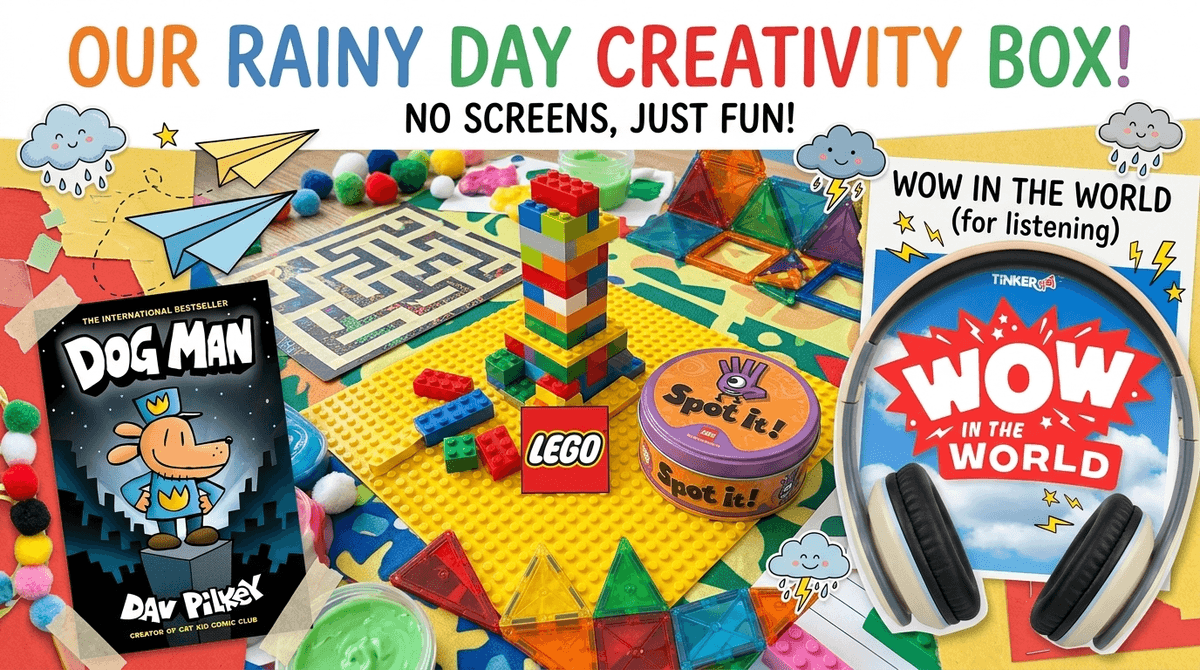
Indoor recess is usually the white flag of the school day—a rainy-day surrender where the default move is "movie day" or letting 30 kids vibrate at a frequency that threatens the structural integrity of the building. But you don't have to default to a Pixar rerun or chaotic boredom. The best screen-free indoor recess activities for K-5 kids are the ones that channel that "trapped" energy into something competitive, creative, or collaborative.
TL;DR: The win for indoor recess is variety—balancing high-energy movement games with low-friction strategy games. Skip the mindless coloring pages and lean into building challenges with LEGO, fast-paced card games like Spot It!, or movement-based games like Sonic Simon Says to burn off the playground energy without the playground.
When the playground is a puddle, the biggest problem is the physical energy that has nowhere to go. If you don't give kids a way to move, they’ll find a way—usually by climbing the furniture.
Structured Movement and Managed Chaos
The goal here is 10 to 15 minutes of structured movement. "The Floor is Lava" is a classic for a reason, but you can level it up with "Tape Mazes" on the carpet or "Balloon Volleyball" (the only indoor sport that won't break a window). The trick is to give the energy a target: a finish line, a points system, a "no feet on the lava" rule. Structure is what turns a riled-up room into a game instead of a wrestling match.
Another easy win is "Dance Freeze, no DJ"—one kid hums or claps a beat, everyone moves, and when the sound stops, the room freezes. The kid running the beat gets to call out anyone who wiggles. It burns energy, it's self-policing, and it needs nothing but a willing 8-year-old with a sense of rhythm.
Paper Airplane Olympics
This is the ultimate low-supply, high-engagement activity. All you need is a stack of recycling-bin paper and some masking tape for a finish line. Categorize the "events": Longest Distance, Best Stunt, and Most Creative Design. It’s stealth physics disguised as a competition, and it keeps 2nd through 5th graders occupied for the entire period.
Most classroom board game stashes are a graveyard of missing Monopoly pieces and games that take too long to finish. For recess, you need "snackable" games—stuff that can be explained in 60 seconds and finished in 15 minutes.
This is the gold standard for K-5. It’s a visual perception game that’s fast, loud, and can be played by a kindergartener and a 5th grader on a level playing field. It fits in a pocket, it’s indestructible, and it’s genuinely fun for adults, too.
For the 3rd-5th grade crowd, Sushi Go! is the perfect "gateway" strategy game. It teaches card drafting and probability without being a slog. It’s colorful, the rounds are fast, and it rewards kids who can think one step ahead.
The classics are classics for a reason. Uno is the universal language of the elementary school cafeteria. Connect 4 is the "I have five minutes left" MVP. They’re durable and require zero setup.
Building activities are the best way to occupy the "tinkerers"—the kids who want to get lost in a project.
LEGO and Magnatiles
If you have the budget, Magnatiles are the superior choice for K-2 because they go up fast and come down satisfyingly. For the older kids, a "Random Parts" LEGO bin is better than a specific set. Give them a prompt: "Build a vehicle that can carry a pencil," or "Build the tallest tower that can survive a desk-shake earthquake."
Exquisite Corpse (The Drawing Game)
No supplies needed besides paper and pencils. One kid draws a head, folds the paper over so only the neck shows, the next draws a torso, folds it, and the third draws legs. The reveal is always a hit. It’s collaborative, hilarious, and works for any skill level.
Not every kid wants to play balloon volleyball. Some kids find the noise of indoor recess overwhelming and just want to disappear into a story.
Audiobooks and "Literacy Practice"
Listening is literacy. At Screenwise, we’re big on the idea that audiobooks and podcasts build the language comprehension strands of the reading rope. Setting up a "listening station" with a podcast like Story Pirates or Wow in the World gives those kids a high-value way to opt out of the noise.
Graphic Novels
If you want to keep the "screen-free" vibe but ensure the kids are actually engaged, stock the shelf with graphic novels. Dog Man is the obvious heavy hitter, but Hilda or The Last Kids on Earth are the real-deal picks that keep kids flipping pages until the bell rings.
The hardest part of indoor recess isn't the activity—it's the transition. Kids get "riled up" by movement games and "locked in" to building projects. The pro-tip: give a two-minute warning that's actually a two-minute warning. If they're mid-LEGO build, let them leave it on a "Works in Progress" shelf. That small bit of respect for their work prevents the "rainy day meltdown."
Q: What are the best indoor recess games for small spaces? Card games like Spot It! or Uno are the kings of small spaces. If they need to move, "Heads Up Seven Up" or "Silent Ball" (tossing a soft ball in total silence) are classroom classics that don't require moving desks.
Q: Is "movie day" really that bad for indoor recess? It’s not "bad," it’s just mid. It’s a low-effort default that usually results in half the kids zoning out and the other half getting restless because they aren't actually engaged—and recess is supposed to be the one stretch of the day that isn't a screen. The better swap is a single "anchor" activity that runs the whole period: a Spot It! tournament, a building challenge with a prize, or a Paper Airplane Olympics with a real finish line. It takes the same 20 minutes and the kids actually come back to class regulated instead of glazed.
Q: How can I encourage my kid's teacher to try these activities? Don't just send a list; send the supplies. A "Rainy Day Box" filled with a deck of Uno, some Magnatiles, and a printout of paper airplane designs is a gift every elementary teacher will actually use.
Indoor recess is a choice between managed engagement and a chaotic free-for-all. By being intentional about the "menu" of activities—balancing the high-energy wiggles with the deep-focus building—you turn a "lost" 20 minutes into a highlight of the day.
- Browse more screen-free activities for homes and classrooms — co-op board games, low-mess building kits, and quiet-time bins.
- Check out our digital guide for elementary school for more on balancing tech and play.
- Browse our board game recommendations to find your next classroom donation.
- Get a personalized list of screen-free activities
