

Circle of Life or Circle of Trauma? The Best Nature Documentaries for Kids
TL;DR: If you want the "wow" factor without the "why is that lion eating the baby zebra?" trauma, stick to Tiny World on Apple TV+ or the Disneynature films like Elephant. For older kids who can handle the "circle of life" reality, Our Planet is the gold standard. Avoid Life on Our Planet if your kid is sensitive to "nature is metal" violence—the CGI predators are ruthless.
We’ve all been there. You want to do "wholesome" screen time. You’re over Skibidi Toilet and you’ve had enough Roblox for one lifetime. You think, "Let’s put on a beautiful nature documentary! It’s educational! It’s relaxing!"
Then, twenty minutes in, a pack of orcas starts "playing" with a seal pup, and suddenly you’re doing emergency therapy on the sofa while your seven-year-old weeps into their popcorn.
Nature is beautiful, but nature is also a literal bloodbath. Finding that sweet spot between "boredom" and "existential dread" is a parenting skill in itself. Here is the Screenwise breakdown of what to stream and what to skip based on your kid's "trauma threshold."
Before we dive into the list, let's be real: nature documentaries are the ultimate parenting cheat code. They are high-quality, visually stunning, and they actually teach something about biology, climate change, and the world outside our suburban bubbles.
In a world of YouTube shorts that have the attention span of a goldfish on espresso, a 50-minute episode of Planet Earth III is basically a meditative retreat for your kid's brain.
Learn more about the benefits of slow-paced media for kids
If your kid still cries when they drop a Lego piece, start here. These shows focus more on "look how cute this animal is" and less on "look how this animal is lunch."
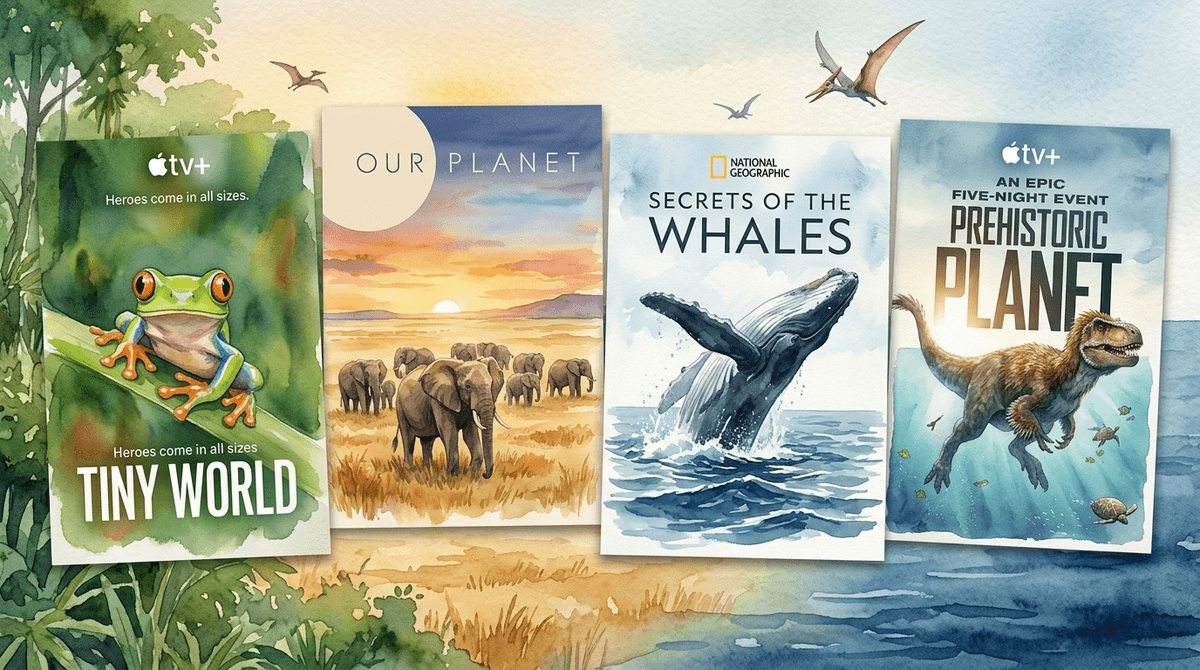
This is arguably the best entry point for young kids. Narrated by Paul Rudd (who is basically a human hug), it focuses on the smallest creatures on earth. Because the stakes involve things like "will this frog find a leaf to hide under?" rather than "will this buffalo be ripped apart?", the tension is manageable. It’s visually popping and feels like a real-life Pixar movie.
Narrated by Meghan Markle, this Disneynature film follows a family of elephants across the Kalahari. Disney is the master of "narrative-driven" nature docs. They give the animals names and storylines, which makes it very engaging for kids. Yes, there is some peril (dehydration is the big villain here), but it’s handled with a gentle touch.
Follows a tiny pufferfish through the Great Barrier Reef. It’s basically a live-action Finding Nemo. It’s short (about an hour) and the "scary" parts are mostly just bigger fish looking slightly menacing.
This is where the big-budget, "how did they film that?" stuff lives. These are incredible, but they don't shy away from the reality of the food chain.
The GOAT. David Attenborough’s voice is the soundtrack to my life at this point. It’s breathtaking, but it does have a heavy focus on climate change, which can trigger some "eco-anxiety" in sensitive kids. There are also some genuinely heartbreaking scenes (the walrus scene in Season 1 is a "parental warning" moment—maybe skip that specific bit).
If your kid is in their "Ohio" phase of calling everything weird or "alpha," they will love this. It uses cutting-edge CGI to show dinosaurs in a documentary style. It’s basically Jurassic Park but if it were filmed by a National Geographic crew. It’s intense because, well, T-Rexes eat things, but since it’s CGI, it somehow feels less "real-world" traumatic for some kids.
This is a James Cameron production, so it looks like Avatar. It’s more about animal culture and communication than just hunting. It’s fascinating and relatively low on the "blood and guts" scale compared to other ocean docs.
Find animal shows for 10 year olds
These are great, but they are for the kids who can handle the truth.
Don't confuse this with Our Planet. This one is produced by Steven Spielberg and uses CGI to show extinct species. It is violent. The first episode features a CGI predator literally ripping the throat out of another creature with a lot of sound effects. It’s cool for teens, but it’s "Circle of Trauma" territory for the little ones.
Using thermal cameras to see what happens at night. It’s super cool, but newsflash: animals do most of their killing at night. The "unseen" nature of the thermal footage makes it feel a bit like a horror movie at times.
When you're picking a show, consider these three "Stress Factors":
- The Hunt: Does the show focus on the chase or the kill? Most BBC/Attenborough docs show the chase and then cut away from the actual impact, but not always.
- The "Baby" Factor: Kids handle a lion eating a zebra okay. They do not handle a lion eating a baby zebra.
- The Climate Message: Some modern docs (especially on Netflix) are very heavy on the "we are destroying the planet" message. It’s important, but if your kid is already prone to worrying, maybe save the heavy stuff for a Saturday morning when you can talk about it, rather than right before bed.
If a "trauma scene" does happen, don't just scramble for the remote and turn it off in a panic (though that's the instinct).
- Validate the feeling: "Yeah, that was really sad to watch. It’s okay to feel bad for the seal."
- Explain the 'Why': "The mother polar bear has to feed her babies, too. It’s how the world stays in balance."
- Focus on the 'Helpers': If you’re watching a doc about conservation, talk about the people working to save the animals.
Nature documentaries are a fantastic alternative to the high-octane "brain rot" of YouTube Kids. If you want the safest bet for a family movie night, go with Tiny World or Secrets of the Whales.
If you’re feeling brave and your kids are older, Our Planet is a masterpiece that every human should see—just maybe keep a pillow nearby to hide behind during the hunting scenes.
- Audit your watchlist: Check the "Parents Guide" on IMDb or Common Sense Media for specific episodes.
- Set the vibe: Nature docs are best on the "big screen" (the TV), not a tablet. It encourages co-watching.
- Take the survey: If you haven't yet, walk through the Screenwise survey to see how your family's media diet compares to other intentional parents in your community.