

Look, we all want our kids to learn something from screens occasionally, right? History documentaries feel like the holy grail—educational content that doesn't make you feel guilty about screen time. But here's the thing: not all history documentaries are created equal, and honestly, some of the "educational" stuff out there is either dry as toast or so sensationalized it's basically historical fan fiction.
The good news? There are genuinely excellent history documentaries that can spark curiosity, teach critical thinking, and give your kids context for understanding the world. The kind that lead to dinner table conversations about "wait, so the Vikings actually made it to North America?" or "why didn't we learn about this in school?"
Beyond the obvious "learning about the past" thing, quality history documentaries teach kids how to think about sources, bias, and storytelling. They learn that history isn't just dates and dead people—it's about understanding why things happened and how those events shaped our world.
Plus, in an era where kids are getting their "history" from 60-second TikToks with questionable accuracy, sitting down with a well-researched documentary can be a genuinely valuable counterbalance. It teaches them that complex topics require more than a hot take and a trending sound.
Ages 8-12: Gateway Documentaries
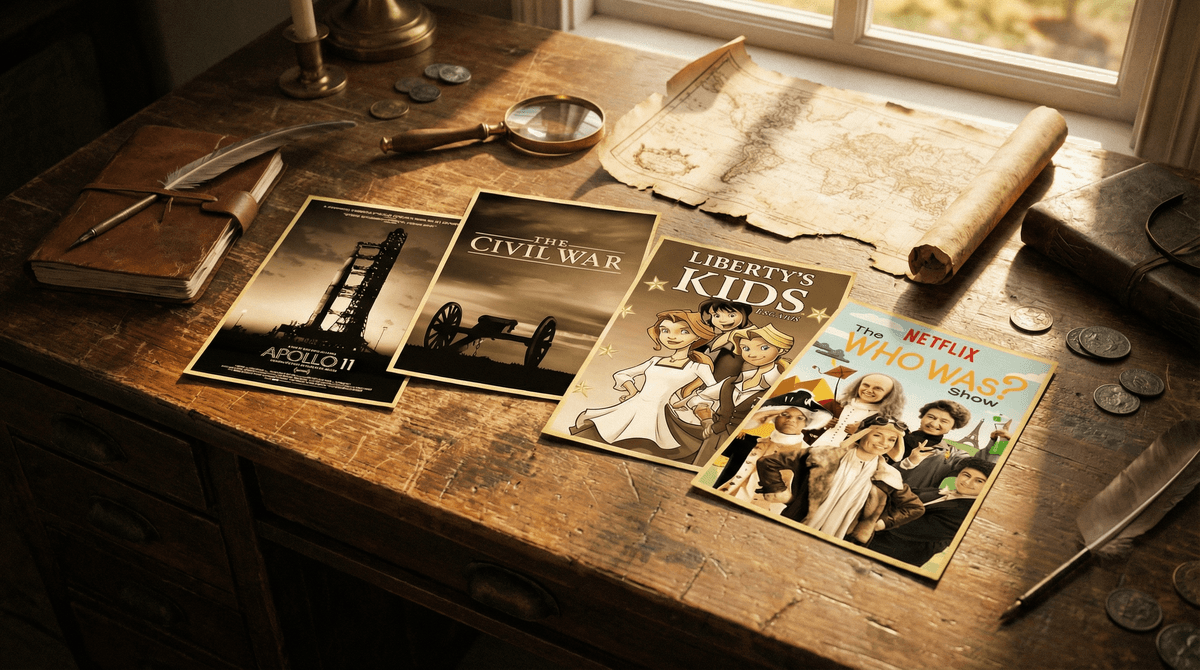
Liberty's Kids - Okay, it's animated, but it's legitimately good for introducing American Revolution concepts without being preachy. The characters are relatable, and it doesn't shy away from complexity.
Who Was? Show on Netflix - Based on those "Who Was?" books your kids probably devoured. Short episodes (under 30 minutes) covering historical figures with humor and actual facts. Perfect attention span for this age.
The Magic School Bus Rides Again: In the Time of Dinosaurs - Not strictly a documentary, but for younger kids interested in prehistoric history, it's a solid starting point that balances entertainment with education.
Ages 12-15: Building Critical Thinking
The Vietnam War by Ken Burns - Yes, it's long (18 hours), but you don't have to watch it all. Even a few episodes give teens incredible insight into a complex conflict. Fair warning: it doesn't pull punches about the realities of war, so preview it first.
13th on Netflix - Ava DuVernay's documentary about mass incarceration and racial inequality. This is the kind of documentary that sparks real conversations. It's heavy, but for teens ready to engage with difficult topics, it's essential viewing. Definitely watch together and be ready to pause and discuss.
They'll Love Me When I'm Dead - For film-obsessed teens, this doc about Orson Welles teaches film history while also being a meditation on creativity and legacy.
Ages 15+: Deep Dives
The Civil War by Ken Burns - The gold standard. Yes, it's from 1990, but it holds up. The storytelling, the primary sources, the way it weaves personal stories into the broader narrative—it's masterful.
Jiro Dreams of Sushi - Not traditional history, but it's about mastery, tradition, and cultural history. Plus it's gorgeous and only 81 minutes.
The Last Dance - Sports history that's really about leadership, competition, and the 90s. Even non-sports fans get pulled in.
Won't You Be My Neighbor? - About Fred Rogers, but really about kindness, media literacy, and how we talk to children. Honestly, parents might cry more than kids.
Not all history documentaries are created equal, and some are straight-up problematic:
Sensationalism over facts - Ancient Aliens, I'm looking at you. Some documentaries prioritize entertainment over accuracy, presenting fringe theories as legitimate scholarship. If it sounds too wild to be true, it probably is.
Bias and perspective - Every documentary has a point of view. That's not inherently bad, but it's worth discussing with your kids. Who made this? What's their perspective? What voices are missing?
Graphic content - War documentaries especially can include disturbing footage. Ken Burns doesn't shy away from the realities of conflict. Preview before watching with younger teens, and be ready to pause and process.
Boring = counterproductive - If a documentary is putting your kid to sleep, it's not doing its job. There's no virtue in forcing them through something dry just because it's "educational."
Watch together - At least for the first episode or segment. Your presence signals that this matters, plus you can pause for questions or context.
Follow their interests - Kid obsessed with space? Start with Apollo 11 or For All Mankind (okay, that one's dramatized, but it's based on real space race history). Into fashion? Try The September Issue.
Connect to current events - Watching a documentary about the Civil Rights Movement hits different when you can connect it to current conversations about justice and equality.
Don't force it - If your kid hates documentaries, that's okay. There are other ways to learn history. Maybe they'd prefer historical fiction, podcasts like Stuff You Missed in History Class, or even well-researched historical games.
Quality history documentaries can be genuinely transformative screen time—the kind that leads to questions, conversations, and deeper understanding. But they're not magic. A mediocre documentary won't suddenly make your kid love history, and a great one won't work if you're forcing it.
Start with topics they already care about, watch together when possible, and remember that the goal isn't to turn screen time into school. It's to show them that learning about the past can actually be interesting, relevant, and sometimes even entertaining.
And if they'd rather watch Bluey for the hundredth time? That's fine too. Not every screen moment needs to be a teaching moment.
Want to explore more educational content that doesn't feel like homework? Check out our guide to educational podcasts for kids or the best science shows that aren't boring. And if you're trying to balance educational screen time with everything else, let's talk about what "educational" even means .
.