

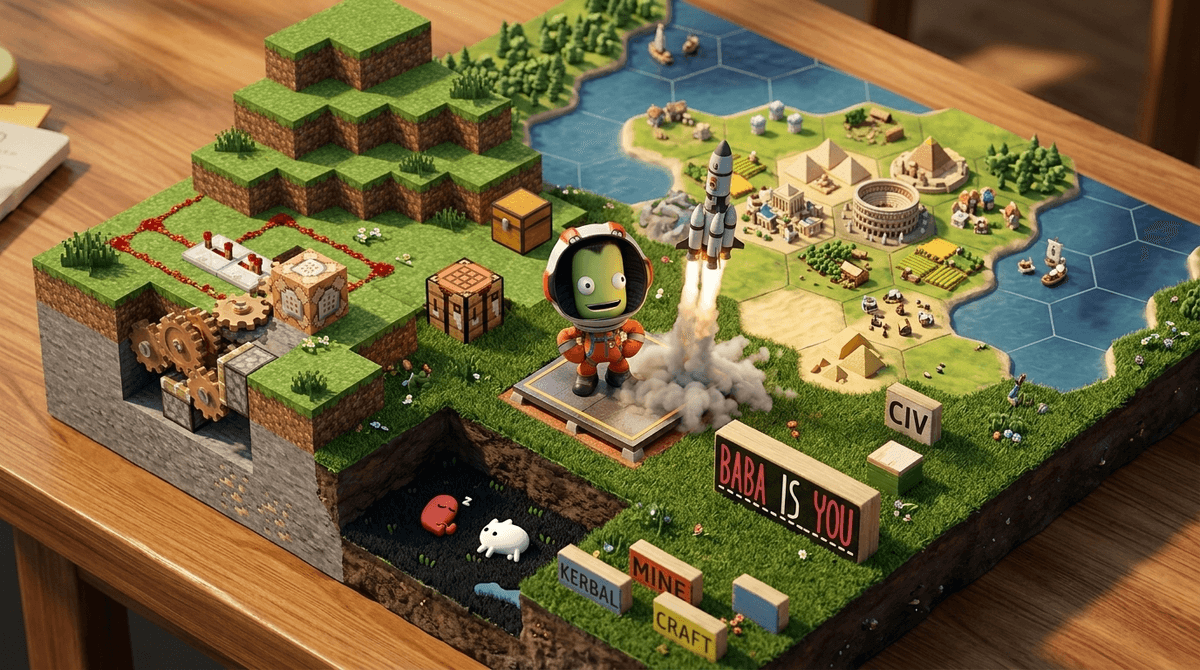
TL;DR: The Quick List If you want to skip the lecture and just get your kids playing something that won't liquefy their brains, here are my top picks for "stealth learning":
- Best for Logic/Coding: Baba Is You — A puzzle game that is secretly a lesson in syntax and logic.
- Best for History/Strategy: Civilization VI — High-level geopolitics and resource management.
- Best for Engineering/Physics: Poly Bridge 3 — Building bridges that don't collapse (usually).
- Best for Creative Systems: Minecraft — Specifically using Redstone for electrical engineering basics.
- Best for Math (that isn't boring): Prodigy — A Pokémon-style RPG fueled by math problems.
We’ve all been there. You’re looking at your kid hunched over a tablet, and you’re doing the mental math: Is this "Skibidi Toilet" marathon actually harming their development, or am I just being "Ohio" (weird/cringe) about it?
The truth is, most "educational" games designed for school are... well, they’re terrible. They are "drill and kill" flashcards wrapped in a thin, sugary coating of bad graphics. Kids smell the "homework" on them from a mile away. But there is a middle ground. There are games that were built to be games first, but they happen to require such high-level thinking, systems analysis, and creative problem solving that they are more educational than any worksheet could ever be.
Kids are naturally resistant to being taught, but they are incredibly hungry to master a system. When they play a game like Minecraft, they aren't thinking about geometry; they’re thinking about how many blocks they need for a roof. When they play Civilization VI, they aren't studying the Industrial Revolution; they’re trying to figure out why their citizens are unhappy and how to fix the economy before another country invades.
This is "stealth learning." It’s the process of acquiring complex skills because those skills are the only way to win the game.
Get a game plan for your kid's age
Ages 7+ This is quite possibly the smartest puzzle game ever made. In Baba Is You, the rules of the game exist as blocks on the screen that you can move. If the blocks say "Wall Is Stop," you can't walk through walls. But if you push the blocks so it says "Wall Is You," you become the wall. The Stealth Learning: This is pure coding logic. It teaches kids about syntax, variables, and "if/then" statements without ever showing a single line of code. It’s hard, it’s frustrating, and it makes them feel like geniuses when they solve a level.
Ages 10+ If you want your kid to understand why geography matters or how a "tech tree" works, this is it. You lead a civilization from the Stone Age to the Space Age. You have to manage diplomacy, trade, religion, and scientific research. The Stealth Learning: It’s a masterclass in systems thinking. They’ll learn that you can’t just build a massive army if you don't have the economy to pay for it. Plus, they’ll accidentally learn who Hammurabi and Eleanor of Aquitaine were. Check out our guide on how Civilization teaches strategy
Ages 8+ The goal is simple: build a bridge so a car can get across. The reality is: gravity is a jerk. Your kid will have to learn about stress points, triangles (the strongest shape!), and material costs. The Stealth Learning: Structural engineering and physics. When the bridge snaps and the car plunges into the water, they don't get a failing grade—they get a hilarious visual of why their design failed, and they go back to the drawing board to iterate.
Ages 11+ This game is literally used by NASA scientists. You build rockets for little green aliens (Kerbals) and try to get them into orbit. Most of the time, the rockets explode. The Stealth Learning: This is actual orbital mechanics. Your kid will learn about thrust-to-weight ratios, aerodynamics, and why you can't just point a rocket at the moon and hit "go." It’s physics at its most explosive and rewarding.
Ages 8+ Forget the green-and-black screen from our childhood. The modern remake (available on Apple Arcade and PC) is beautiful, culturally respectful to Native American history, and brutally difficult. The Stealth Learning: Resource management and historical empathy. Deciding whether to forge a river or pay for a ferry is a lesson in risk assessment that hits harder when your favorite party member dies of dysentery.
We can't talk about games without the 800-pound gorilla in the room. About 65% of kids ages 6-12 are on Roblox. Is it educational? The game itself? Mostly no. It’s a social hangout spot. However, Roblox Studio (the tool used to make the games) is a different story. If your kid is interested in making their own "obby" or simulator, they are learning Luau (a version of the Lua programming language) and 3D design. The No-BS Take: If they are just playing "Pet Simulator" and begging for Robux, it’s a digital playground. If they are opening Roblox Studio and trying to script a door to open, they are learning a career skill.
Learn more about how Robux is in fact real money
- Elementary (Ages 6-9): Focus on creative sandboxes like Minecraft (Creative Mode) or logic puzzles like Thinkrolls. Avoid anything with heavy "in-app purchase" loops.
- Middle School (Ages 10-13): This is the sweet spot for strategy games like Civilization VI or engineering sims. They have the cognitive load to handle complex systems but still need help with the "just five more minutes" impulse control.
- High School (Ages 14+): They can handle the "hard" sci-fi of Kerbal Space Program or even learning professional tools like Unity for game dev.
The biggest hurdle with these games isn't the content—it's the learning curve. A game like Baba Is You or Portal 2 can be genuinely hard. Your kid might get frustrated and want to quit. This is actually a "teachable moment" about grit and the "growth mindset" (to use the school buzzwords). Instead of giving them the answer, ask: "What have you tried so far?" or "What happens if you change that one rule?"
Most of the games listed above are single-player, which is great for digital wellness because there's no "toxic" chat to worry about. However, for games like Roblox or Minecraft (if they play on servers), you need to be aware of the social aspect.
- Turn off "Random" Chat: In Roblox, you can restrict chat to "Friends Only." Do it.
- Watch the Clock: These games are "sticky" because they are deep. Set a timer before they start.
Check out our guide on setting up Nintendo Switch parental controls
If you want your kid to learn from their screen time, stop looking for "Educational" with a capital E. Look for games that challenge their logic, force them to manage resources, and allow them to fail safely.
A kid who spends two hours failing to launch a rocket in Kerbal Space Program has done more "homework" than a kid who spent twenty minutes clicking on math balloons in a generic app.
- Pick one game from the list above based on your kid's current obsession (e.g., if they like building, try Poly Bridge 3).
- Sit with them for the first 20 minutes. These games have steep learning curves, and having you there to "figure it out together" makes it a bonding experience rather than a chore.
- Don't call it "educational." Seriously. Just call it a cool game you heard about. The moment you say "this will help with your math," the magic dies.