

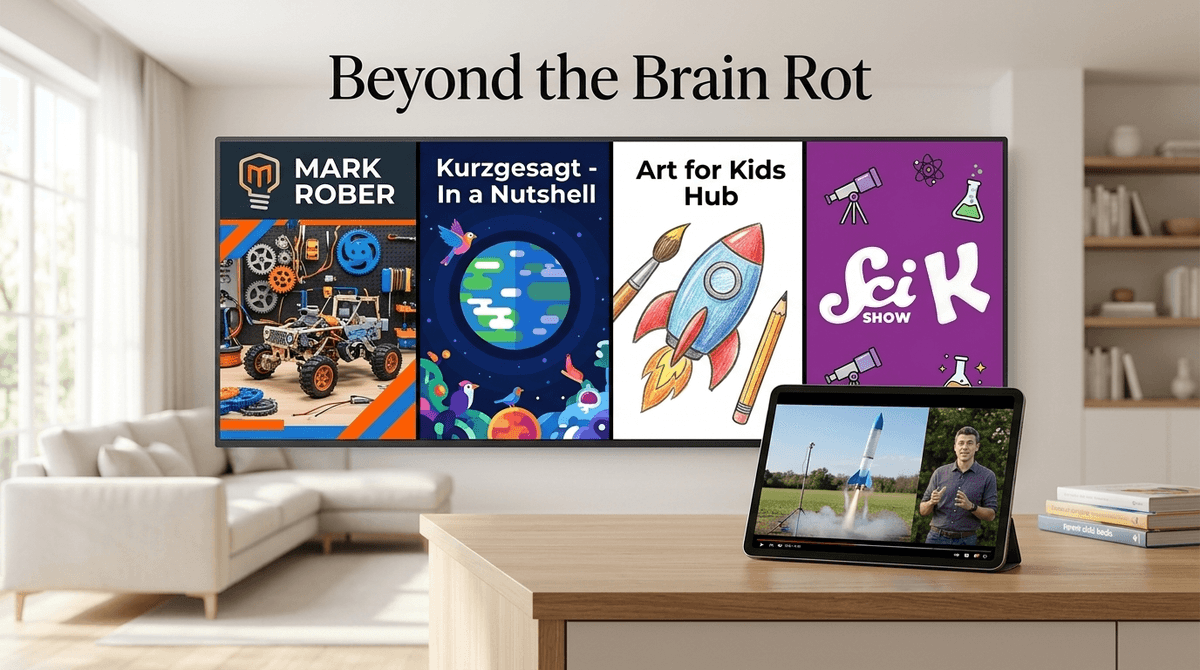
TL;DR: The Best YouTube Channels for Elementary Kids
If you need a quick list of high-quality, parent-vetted channels that won't make you want to throw the iPad out the window, start here:
- Best for STEM & Engineering: Mark Rober (Ages 7+)
- Best for Drawing & Art: Art for Kids Hub (Ages 5+)
- Best for Science Curiosity: SciShow Kids (Ages 5-9)
- Best for Movement: Cosmic Kids Yoga (Ages 4-8)
- Best for Deep Dives: Kurzgesagt – In a Nutshell (Ages 9+)
- Best for Literacy: Storyline Online (Ages 5-8)
Check out our full guide on setting up YouTube parental controls
We’ve all been there. You’re trying to get dinner on the table or finish one last email, and you realize the house has gone suspiciously quiet. You check on your seven-year-old, and they’re staring at a screen where a human head is emerging from a toilet singing a repetitive song. Or maybe they’re watching a high-pitched narrator scream about "Sigma" and "Ohio" while playing Roblox.
This is what parents are calling "brain rot"—content that is fast-paced, loud, nonsensical, and designed purely to hijack a child's dopamine system. But YouTube isn't all bad. In fact, it’s one of the best libraries of human knowledge ever created—if you know where to look.
The goal isn't to ban YouTube (good luck with that); it's to curate it. We want to move our kids away from passive consumption of "junk food" content and toward channels that spark a "Hey, can we try that?" moment.
Elementary kids are naturally curious about how the world works. These channels take that curiosity and run with it, using high production values and actual expertise.
Mark Rober (Ages 7-12)
Mark Rober is the undisputed king of "cool science." He’s a former NASA engineer who builds glitter bombs to catch porch pirates and giant liquid sand pools. His videos are long-form (often 15-20 minutes), which is great for building attention spans. He explains the engineering behind his builds in a way that makes kids feel like they’re in on the secret. Why it works: It’s high-energy enough to compete with "brain rot" but actually teaches physics and the scientific method.
SciShow Kids (Ages 5-9)
For the younger elementary set, SciShow Kids is a masterpiece. Hosted by Jessi and her robot rat, Squeaks, it answers the "why" questions kids actually ask: Why is the sky blue? Why do we have snot? How do dinosaurs poop? Why it works: The segments are short, the explanations are accurate, and it encourages kids to observe the world around them.
Operation Ouch (Ages 7-11)
If your kid is obsessed with the human body or wants to be a doctor, this is the one. It features twin doctors (Dr. Chris and Dr. Xand) who do incredible (and sometimes gross) experiments to show how our bodies work. It’s educational but has that "ew, cool!" factor that elementary kids live for.
YouTube is at its best when it gets kids off the couch. These channels provide a template for kids to create or move.
Art for Kids Hub (Ages 5-12)
This is a family-run channel where a dad (Rob) draws with one of his kids. The genius here is that the kid's drawing is never perfect—it shows that art is about the process, not just the result. My kids have spent hours with a stack of paper and this channel. Why it works: It’s incredibly easy to follow and covers everything from Pokémon characters to realistic animals.
Cosmic Kids Yoga (Ages 4-8)
Jaime Amor turns yoga into an adventure. She tells stories (often based on popular movies like Frozen or Star Wars) while leading kids through yoga poses. It’s a great way to burn off energy on a rainy day. Why it works: It combines screen time with physical activity and mindfulness.
5-Minute Crafts Play (Ages 6-10)
A word of caution: "5-Minute Crafts" can be hit or miss, but the "Play" version specifically for kids often has some fun, low-stakes DIY ideas. It’s great for kids who like to tinker with cardboard and glue.
As kids hit the 9-11 age range, they start getting interested in "big" topics—space, history, and how society works.
Kurzgesagt – In a Nutshell (Ages 9-14)
The name is a mouthful, but the content is brilliant. They use beautiful, minimalist animation to explain complex topics like black holes, evolution, and climate change. It’s visually stunning and intellectually stimulating. Note for parents: Some topics can be a bit heavy (existential dread is a recurring theme), so maybe watch a few with your kid first.
National Geographic Kids (Ages 5-11)
Exactly what you’d expect from the brand. Their "Weird But True" and "Animal Lol" segments are huge hits with the elementary crowd. It’s short, punchy, and high-quality.
It’s easy to judge Skibidi Toilet or the loud, neon-colored world of LankyBox. But we have to understand why kids like it. It’s fast. It’s weird. It’s part of their playground currency. If they don't know what "Skibidi" is, they might feel left out at lunch.
Instead of a total ban, try the "One for Me, One for You" rule. They can watch 15 minutes of their favorite (safe) gaming YouTuber, but then they have to watch a Mark Rober video or do an Art for Kids Hub tutorial.
A Note on MrBeast
Almost every kid over age 8 is watching MrBeast. While his videos are generally "clean" in terms of language, they are the ultimate "attention economy" content. They are edited to be hyper-stimulating. If you notice your kid is extra irritable after watching him, it might be time for a "fast-paced content" break.
YouTube is a "wild west" platform. Even with YouTube Kids, weird stuff can slip through.
- Use "Supervised Experiences": If your kid is over 9, YouTube Kids might feel too babyish. Use YouTube’s "Supervised Experience" setting to give them the regular app but with filters and no comments.
- Turn Off Autoplay: This is the biggest trap. Autoplay is how a kid goes from a "How to build a Lego car" video to "Top 10 Scariest Urban Legends" in three minutes.
- The "Living Room" Rule: YouTube should ideally be a big-screen experience. If it’s on the TV in the living room, you can hear the tone and see the content without hovering.
Read our guide on setting up a safe tech environment for elementary kids
If your kid says "That's so Ohio" or "You have no Aura," don't panic. It's just Gen Alpha slang. Most of it is harmless nonsense born from YouTube and TikTok trends.
The real thing to watch for isn't the slang, but the vibe. If a channel feels mean-spirited, uses "pranks" that humiliate people, or is just 20 minutes of someone opening mystery boxes and screaming, that’s where you want to step in.
YouTube doesn't have to be a digital babysitter that turns your kid's brain to mush. When used intentionally, it’s a tool for learning how to draw, how to code in Scratch, or how the solar system works.
Start by subscribing to a few of the channels above on your family's account. The algorithm will eventually start suggesting more high-quality content and less "brain rot."
- Audit the Subscriptions: Sit down with your kid and look at who they follow. Ask them why they like those channels.
- Set the Timer: Use the built-in "Remind me to take a break" feature in the YouTube settings.
- Create a Playlist: Curate a "Cool Stuff" playlist with videos from Mark Rober and Kurzgesagt for when they "don't know what to watch."
Check out our guide on the best educational websites for kids
Find a YouTube recommendation based on your kid's interests