

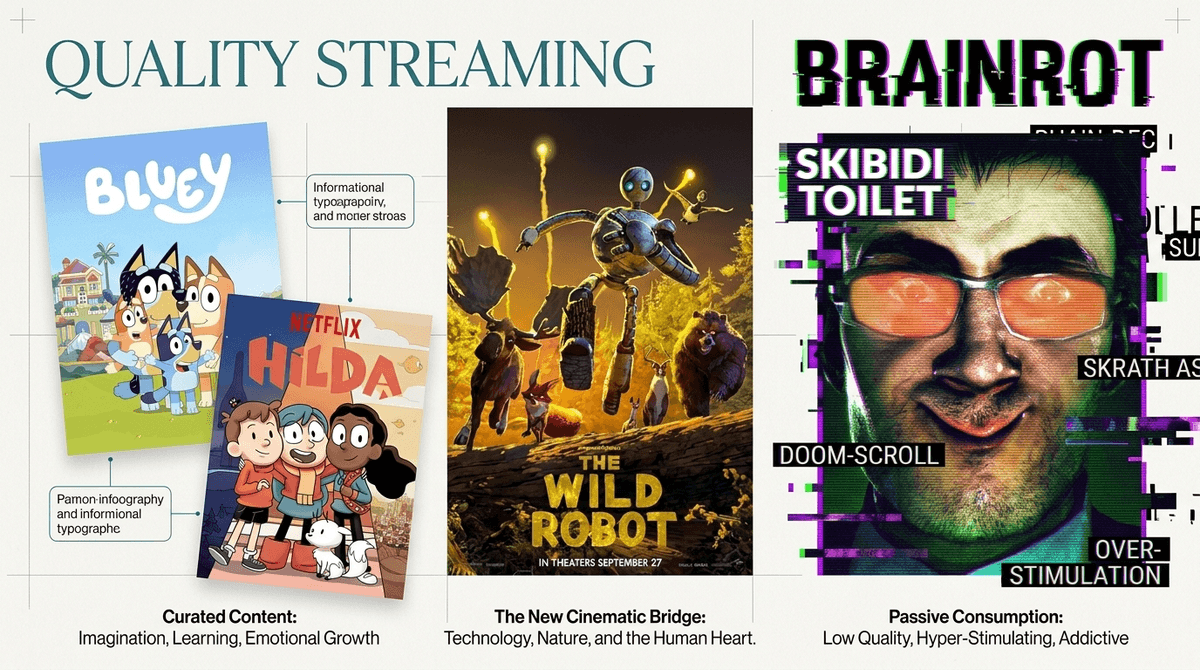
TL;DR: The Quick List If you’re standing in the kitchen and just need to know what to put on right now so you can finish making dinner without a side of algorithmic chaos, here are the gold standards for 2026:
- Ages 2-5: Bluey (Disney+), Trash Truck (Netflix), Puffin Rock (Netflix/Cartoon Saloon).
- Ages 6-9: Hilda (Netflix), The Wild Robot (Peacock/Digital), Storyline Online (Web).
- Ages 10-12: Avatar: The Last Airbender (Netflix/Paramount+), Percy Jackson and the Olympians (Disney+), The Dragon Prince (Netflix).
- The "Avoid" List: Anything that looks like a neon-colored fever dream on YouTube, specifically Skibidi Toilet or those weird "Elsagate" style knockoffs that still slip through the cracks.
Ask our chatbot for a custom playlist based on your kid's specific interests
We’ve all heard the term. It’s the catch-all phrase kids use for the weird, hyper-stimulating, often nonsensical content that populates the depths of the YouTube and TikTok algorithms. In 2026, "brainrot" isn't just a meme; it’s a genre. It's characterized by rapid-fire editing, loud noises, and bizarre recurring characters (yes, like the singing heads in toilets).
The problem isn't necessarily that it's "evil"—it’s that it’s designed by an AI to keep a human brain glued to a screen for as long as possible. It’s the digital equivalent of feeding your kid high-fructose corn syrup for every meal. They’ll eat it, they’ll want more, and they’ll have a massive crash (and a mood swing) when you take it away.
Intentional streaming is about moving away from the "auto-play" trap and back toward storytelling that actually has a soul.
The algorithm is a slot machine for the toddler and tween brain. It knows exactly when to show a bright explosion, a "level up" sound, or a familiar face to keep the dopamine flowing. Kids love it because it’s easy. They don't have to follow a complex plot or understand character development.
But as parents, we know that the "easy" stuff is usually what leads to the "hard" bedtime. When we choose shows like Bluey or Hilda, we’re giving them content that encourages empathy, curiosity, and—most importantly—a normal heart rate.
Netflix is a mixed bag. They have some of the best high-quality animated series in the world, but they also have a massive amount of "filler" content—low-budget, flashy garbage designed to be background noise.
- The Win: Their parental controls are actually decent. You can lock profiles with a PIN and, more importantly, you can remove specific titles from the library so they never even show up.
- The Warning: The "Preview" feature is annoying and can expose kids to mature trailers if they linger too long on the home screen.
Learn how to set up Netflix parental controls like a pro
Still the safest bet for most families, but with the integration of Hulu content, you really need to check your "Content Rating" settings. You don't want your 7-year-old accidentally clicking on a R-rated horror movie because you forgot to toggle the profile to PG.
- The Win: The library is deep. From National Geographic Kids to the entire Pixar catalog, there’s enough "good" stuff to last years.
I’m going to be honest: YouTube Kids is still a bit of a mess. Even in 2026, weird stuff gets through. If you use it, use the "Approved Content Only" setting. This turns off the search function and only lets your kid watch channels you have manually white-listed.
- The Warning: Regular YouTube is the primary source of brainrot. If your kid is saying things are "Ohio" or "Skibidi," they’re getting it here.
Ages 2-7 Look, if you aren't watching Bluey, are you even parenting in the 2020s? It’s the gold standard because it models healthy family dynamics, emotional intelligence, and imaginative play. It’s also one of the few shows that doesn't make parents want to lobotomize themselves with a Lego.
Ages 6-10 If you want the opposite of brainrot, this is it. Hilda is a beautifully animated, quiet, adventurous show about a girl who befriends mythical creatures. It’s cozy, thoughtful, and respects the intelligence of its audience.
Ages 6+ Based on the The Wild Robot by Peter Brown, this movie is a masterclass in visual storytelling. It deals with themes of nature, technology, and motherhood in a way that is genuinely moving. It's a great "bridge" movie for kids who are starting to move past "little kid" cartoons.
Ages 8+ The animated series (not the live-action one, which is... fine, I guess, but skip it for the original) is arguably the best piece of children's television ever made. It handles war, loss, and redemption with a level of care that most adult shows miss. If your kid is ready for a "big" story, start here.
Ages 5-12 I know, I know, it’s not "streaming video," but if you're in the car or trying to reduce "visual" screen time, Brains On! is incredible. It’s science for kids that doesn’t talk down to them.
When we talk about "age-appropriate," we aren't just talking about "no swearing." We're talking about pacing.
- Under 3: High-contrast, fast-cutting shows (like Cocomelon) can actually be overstimulating to the point of causing behavioral issues later in the day. Stick to slow-paced shows like Trash Truck or Puffin Rock.
- Ages 4-7: This is the prime time for "social-emotional" learning. Shows that model how to handle being mad, sad, or sharing are huge.
- Ages 8-12: Tweens are looking for agency. They want stories about kids who have power or go on quests. This is where Percy Jackson and Minecraft (the gameplay videos, if they're from reputable creators) come in.
You don't have to be the "No Fun Parent." You can just be the "High Standards Parent."
When your kid wants to watch something that you know is just algorithmic sludge, try saying: "I noticed that when you watch that show, you seem really cranky afterward. Let's find something that has an actual story instead. Do you want to try the one about the girl who lives with giants (Hilda) or the one about the robot in the woods (The Wild Robot)?"
Acknowledge the "brainrot" memes. If they say something is "mid" or "Ohio," laugh with them, then steer the ship back to quality. You’re building their "crap detector"—an essential skill for the 21st century.
Learn more about how to talk to your kids about digital wellness
Streaming in 2026 is a minefield, but you have the map. The goal isn't to reach "zero screen time"—that’s a losing battle for most of us. The goal is to make sure that the time they do spend in front of a screen is enriching, calm, and intentional.
Move the YouTube app off the main home screen. Set up those profile PINs on Netflix. And when in doubt, just put on Bluey. It’s the closest thing we have to a parenting "easy button" that actually does some good.
- Audit the Profiles: Spend 10 minutes tonight checking the age ratings on your Disney+ and Netflix profiles.
- Whitelist YouTube: If you use YouTube Kids, switch it to "Approved Content Only."
- Take the Survey: If you haven't yet, walk through the Screenwise family tech survey to see how your family's streaming habits compare to your community. It’s the fastest way to get a personalized roadmap for your specific house.
Ask our chatbot about age-appropriate alternatives to popular but questionable shows