

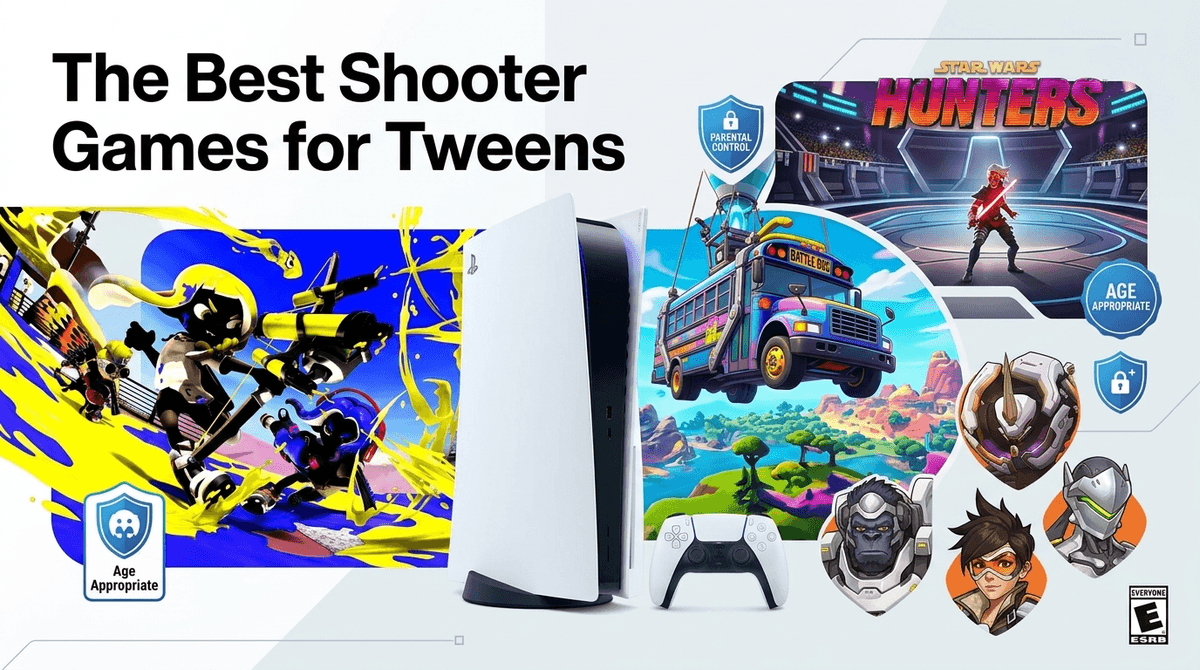
TL;DR: If your tween is begging for a shooter game but you’re not ready to hand over Call of Duty, there’s a massive middle ground. The best picks for "training wheels" shooters are Splatoon 3 (ink, not bullets), Plants vs. Zombies: Battle for Neighborville (pure cartoon chaos), and Fortnite (with the right parental controls).
It usually happens around 4th or 5th grade. One day they’re content building a dirt hut in Minecraft, and the next, they’re talking about "cranking 90s," asking for "V-Bucks," and claiming everything in their room is "so Ohio" (which apparently means weird or cringey now—don't ask).
The transition to shooter games is a major milestone in digital parenting. For kids, it’s about competition, fast-paced reflex testing, and—most importantly—socializing. For parents, it’s often a source of anxiety. We worry about the violence, the toxic chat, and whether playing Overwatch 2 is going to turn our sweet kid into a "sweat" (a player who tries way too hard) who screams at the TV.
The good news? You can let them scratch that competitive itch without exposing them to hyper-realistic military violence or the "brain rot" of unmoderated lobbies. Here is how to navigate the world of tween-appropriate shooters.
It’s rarely about the "killing." In fact, most tween-focused shooters don’t even use that word—they use "eliminations" or "splats." For this age group, shooters are the digital equivalent of a high-stakes game of Tag or Capture the Flag.
They love the mastery (getting better at aiming), the autonomy (making split-second tactical decisions), and the social currency (being able to talk about the latest "skins" at the lunch table). If you ban shooters entirely, you’re often banning the primary way their peer group interacts. The goal is to find games that offer the thrill without the trauma.
This is the gold standard for parent-approved shooters. Instead of bullets, you shoot neon-colored ink. Instead of "killing" enemies, you’re trying to cover the most territory in your team's color. It’s frantic, stylish, and incredibly fun.
- The Vibe: Post-apocalyptic chic but with squids.
- Why it’s safe: No voice chat with strangers (unless you use the separate Nintendo app, which you shouldn't), and the "violence" is essentially a messy art project.
If your kid likes the Plants vs. Zombies mobile games, this is the 3D shooter version. It’s slapstick humor at its finest.
- The Vibe: Saturday morning cartoon.
- Why it’s safe: You’re a sunflower shooting sunbeams at a disco-dancing zombie. It’s impossible to take seriously.
A newer entry that’s great for Star Wars fans. It’s a "hero shooter" (like Overwatch 2) but set in the Star Wars universe.
- The Vibe: An arena battle on a distant planet.
- Why it’s safe: It’s T-rated but feels very "Disney." The violence is all blasters and lightsabers—classic Star Wars stuff.
We have to talk about the llama in the room. Fortnite is more than a game; it’s a social platform. It’s where they watch concerts, play LEGO Fortnite, and, yes, engage in 100-player Battle Royales.
- The Vibe: A chaotic pop-culture mashup where Peter Griffin can have a shootout with a giant banana.
- The Reality: The violence is bloodless (players just pixelate away), but the social pressure and microtransactions are the real "boss fights" for parents.
- Learn more about managing Fortnite spending

This is a "Hero Shooter" where teamwork is everything. Each character has a specific job (Tank, Damage, or Support).
- The Vibe: High-end Pixar movie meets a comic book.
- Why it’s a step up: It requires more strategy and coordination than Fortnite. However, the community can be "salty" (rude), so keeping voice chat off or restricted to friends is a must.
Knockout City (Note: Check server status)
Technically a "dodgeball" shooter. You’re still aiming and timing your shots, but you’re throwing balls instead of firing guns. It’s a great way to build the skills needed for shooters without any "weaponry."
Many tweens start their shooter journey on Roblox. While games like Arsenal are very popular, Roblox is the "Wild West" of digital safety. The moderation is hit-or-miss, and the chat can get weird fast. If they’re playing shooters on Roblox, make sure you’ve locked down their privacy settings.
When you’re deciding if a game is right for your tween, look past the ESRB rating (which is often "T for Teen") and look at these three things:
- Visual Realism: There is a huge psychological difference between shooting a "Skibidi" looking character in Roblox and the gritty, military realism of Modern Warfare. If it looks like a movie, it’s probably too much. If it looks like a cartoon, it’s usually fine.
- Communication Style: Does the game require open mic voice chat? This is where 90% of the "harm" happens in gaming. It’s not the game; it’s the 19-year-old in the lobby using every curse word in the book.
- Monetization: Is the game "Free to Play"? If so, the game is designed to make your kid want to buy "skins" (costumes) and "emotes" (dances). This can lead to significant digital peer pressure.
Instead of being the "Anti-Fun Police," try to be the "Coach."
- Ask for a "Tour": "Hey, can you show me how a match works in Splatoon 3? What’s the goal?"
- Discuss Sportsmanship: Shooter games are notorious for "trash talking." Use this as a moment to talk about what it means to be a good teammate and how to handle losing without throwing a controller (or a tantrum).
- Set the "Chat Rule": A great middle-ground rule for tweens is: "You can play the game, but voice chat stays OFF unless you are in a private party with kids you know in real life."
Shooter games aren't the enemy—isolation and unmoderated content are. By steering your tween toward games like Splatoon 3 or Fortnite (with boundaries), you’re letting them join the cultural conversation while keeping their digital world age-appropriate.
They get the adrenaline and the social connection; you get the peace of mind knowing they aren't seeing anything that belongs in an R-rated movie. And if they tell you your choice is "low aura," just remind them that at least you aren't making them play Solitaire.
- Check the WISE scores: Look up Splatoon 3 and Fortnite on Screenwise to see how they rank for safety and educational value.
- Set up the console: Before the game starts, go into the console settings (Xbox, PlayStation, or Switch) and set daily time limits.
- Play a round: Seriously. Grab a controller. You will probably be terrible at it, which your tween will find hilarious, and it’s the best way to see exactly what they’re experiencing.
Check out our full guide on setting up Nintendo Switch parental controls