Our reviews and ratings are 100% unbiased. Screenwise is a Bookshop.org affiliate and an Amazon Associate, so if you buy a book through one of our links, we may earn a commission. Bookshop.org purchases also support independent bookstores.
Screenwise Verdict
If you have a kid who draws on the walls, builds weird stuff in the backyard, or asks questions that make you pause, get this book. It is the ultimate manifesto for creative confidence.
It avoids the usual 'follow your dreams' clichés by acknowledging that having a new idea is actually kind of scary and awkward. The art is stunning, and the payoff is one of those rare moments in children's literature that feels earned rather than forced.
Age Fit
Best for ages 4 to 99. While it's a picture book, the 'don't let the world crush your spirit' message is basically a commencement speech that hits just as hard for adults as it does for preschoolers.
WISE Breakdown
Wholesome
95
It is a purely positive, emotionally resonant story about nurturing creativity and self-confidence without any snark or mean-spiritedness.
Imaginative
98
The book turns the abstract concept of a 'thought' into a physical, walking companion, using visual metaphors to explain how creativity works.
Safe
100
There is zero problematic content. No violence, no language, and no scary themes beyond the mild anxiety of being judged by others.
Enriching
92
It builds resilience and encourages kids to value their own unique perspectives even when others don't understand them.
Parent Info
✓
Why It Might Be Great
Validates the weirdness of having a new thought that doesn't fit in yet, which is huge for kids who feel like outliers.
Visual storytelling that masterfully shifts from muted grayscale to vibrant color as the idea grows and gains confidence.
Encourages persistence and grit, showing that the best things in life usually start out looking a bit strange to everyone else.
⚠
What to Watch For
The book is highly abstract. If your kid is very literal, they might spend more time asking where the egg-creature came from than focusing on the metaphor.
It's a quiet, contemplative read. If you're looking for a plot-heavy adventure with a clear villain, this isn't that.
Conversation Starters
"Why do you think the boy was worried about what other people would think of his idea?"
"If your biggest idea was a creature, what would it look like and what would it eat?"
"What does it mean to 'feed' an idea in real life?"
Deep Dive
The Power of the Pivot
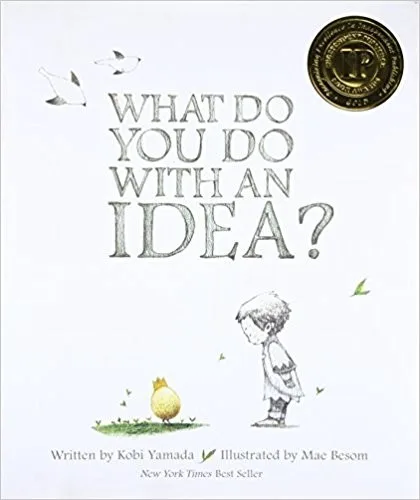
Kobi Yamada and illustrator Mae Besom hit on something special here. Most 'creativity' books for kids focus on the act of making—painting a picture, building a robot. What Do You Do With an Idea? focuses on the internal life of a creator. It captures that specific social anxiety of having something you love and being terrified that someone will laugh at it.
Visual Growth
The most effective part of the book is the color theory. It starts in a world of sketchy pencil grays. As the boy begins to care for his idea—represented as a crowned, golden egg on legs—color starts to bleed into the pages. By the end, the world is fully saturated. It’s a sophisticated way to show a kid that their internal world actually dictates how they see the external world.
Not Just for the Little Ones
While the text is simple enough for a four-year-old, the 'Idea' series (which includes What Do You Do With a Problem? and What Do You Do With a Chance?) has become a staple for older kids and even graduation gifts. It’s a great 'reset' book for a kid who is struggling with school-induced perfectionism or who has stopped taking creative risks because they're afraid of being wrong.