

The Resilience Reading List: Why Your Kid Needs After the Fall and Knight Owl
How these modern picture books help children build the grit and emotional intelligence to tackle big challenges and find their inner hero.
If you're looking for picture books that actually do something — that stick with kids after the last page and give them real emotional tools — After the Fall by Dan Santat, Knight Owl by Christopher Denise, and Super Manny Stands Up by Kelly DiPucchio belong on your shelf immediately. These aren't just cute. They're genuinely excellent books about fear, courage, and becoming who you're meant to be.
After the Fall by Dan Santat, Knight Owl by Christopher Denise, and Super Manny Stands Up by Kelly DiPucchio are among the best resilience-building picture books available right now for kids ages 4–8. Each one tackles a different dimension of grit — recovering from failure, proving yourself against the odds, and standing up for others — with stunning art and stories that don't talk down to kids. These are the books you read once at bedtime and then find your kid "reading" to their stuffed animals for the next two weeks.
Here's what's interesting about the current moment in kids' media: there's a lot of content designed to entertain and very little designed to build something. Most of what kids are consuming — and look, screen time in the Screenwise community averages about 4.2 hours a day, with weekends pushing closer to 5 — is passive, reactive, or loop-driven. That's not automatically bad. But it does mean the books we choose carry more weight than they used to.
The books on this list work differently than most. They're not morality tales with a tidy lesson stapled on at the end. They're emotionally honest stories about genuinely hard things — falling down, being underestimated, watching someone get hurt and not knowing what to do. And they trust kids to handle that.
That trust is the whole point.
Ages 4–8 | Picture Book
This is the one. If you only buy one book from this entire list, make it this one.
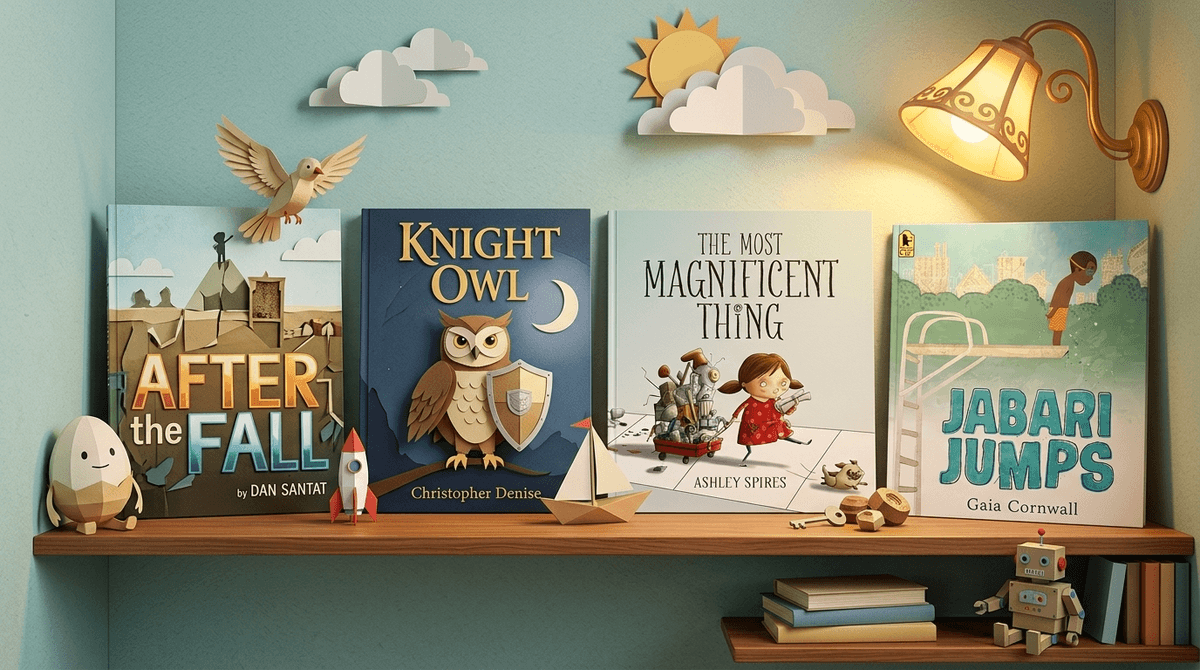
After the Fall is a sequel to Humpty Dumpty — except it's not really about Humpty Dumpty at all. It's about what happens after a traumatic fall. Humpty is terrified of heights now. He used to love watching birds from the wall, but he can't even look at a ladder without his palms sweating. The whole book is about him slowly, painfully working up the courage to climb again.
Dan Santat won the Caldecott Medal for Beekle: The Unimaginary Friend, and the art in After the Fall is equally stunning — there's a two-page spread near the end that genuinely earns the word "breathtaking." But the real magic is the emotional accuracy. The fear Humpty feels isn't cartoonish. It's the real, specific, embarrassing kind of fear that kids (and adults) actually experience. And the resolution isn't "he just decided to be brave." It's messier and more honest than that.
This book is incredible for kids who've had a setback — a bad sports season, a friendship falling apart, a scary medical thing — but honestly it works for any kid, any time. See how to use After the Fall to talk to kids about anxiety .
.
Ages 4–7 | Picture Book
Knight Owl is about a small owl who wants to be a knight more than anything — and everyone around him thinks that's ridiculous. He's an owl. Owls aren't knights. He's also tiny. The knight training is hard. None of it makes sense on paper.
And then it does.
Christopher Denise's illustrations are rich and dark and gorgeous in a way that feels almost medieval — this isn't bright primary colors and simple shapes. It feels like a real storybook from another era. The story itself is deceptively simple: small creature, big dream, lots of doubt (from others and from himself), eventual triumph. But it's executed so well that it doesn't feel like a formula.
What makes Knight Owl special is the specificity of the doubt. It's not just "everyone said he couldn't do it." The obstacles are real and the owl's uncertainty is real. Kids who feel like they're the smallest or youngest or least-likely-to-succeed in any room will see themselves here immediately.
There's a companion book, Owl's First Day of School, that's also worth grabbing if you've got a kindergarten or first-grade transition coming up.
Ages 4–8 | Picture Book
Super Manny is a little different from the other two — it's less about personal fear and more about moral courage. Manny is a kid who loves superheroes and imagines himself as one. But when he actually witnesses someone being bullied, the superhero fantasy collides with the much scarier reality of actually doing something.
Kelly DiPucchio (Grace for President, Gaston) is really good at writing kids who feel genuine conflict, and this book doesn't let Manny off easy. He freezes. He second-guesses. And then he acts — not perfectly, not heroically in a movie way, but in the real, imperfect, brave way that actual kids can actually do.
This is a great book to read before a new school year, before a situation where you know your kid might witness something hard, or just as a regular conversation-starter about what bravery actually looks like in everyday life. Find more books about standing up to bullying.
Ages 4–7
A girl tries to build the most magnificent thing and completely loses it when it doesn't work. The frustration in this book is so real — kids recognize that meltdown energy immediately. But the path back from frustration to persistence is handled with real care. Great for kids who struggle with perfectionism or giving up when things get hard.
Ages 3–6
Shorter and more interactive than the others, but worth including because it does something specific: it physically demonstrates that mistakes can become something new. Torn pages become beaks. Spills become ponds. It's tactile and playful and surprisingly effective at reframing how kids think about mess-ups. Learn more about growth mindset books for kids.
Ages 4–7
Jabari has passed his swimming test and is ready to jump off the diving board. Except he's not ready at all, and the book is honest about that gap between "I should be able to do this" and "I'm terrified." The father-son dynamic here is warm without being saccharine, and the ending is genuinely earned. One of the best books about fear of a specific thing rather than fear in the abstract.
Ages 5–9
Part of a trilogy (along with What Do You Do With an Idea? and What Do You Do With a Chance?), this one is specifically about avoidance — the way problems grow when you ignore them, and shrink when you face them. The art is abstract and striking. The message is direct without being preachy. Good for kids who tend to avoid hard things rather than confront them.
These books are genuinely good on their own, but they're great as conversation launchers. A few questions worth asking after reading:
- After After the Fall: "Is there something you used to love doing that you stopped because it felt scary? What would it take to try again?"
- After Knight Owl: "Has anyone ever told you that you couldn't do something? Did that make you want to try harder or give up?"
- After Super Manny: "What's the difference between a superhero in a movie and a real-life hero? What does real bravery actually look like?"
You don't need to turn storytime into a therapy session. Even just asking one of these and then listening — really listening, not steering — does a lot. Get more conversation starters for resilience and emotional intelligence.
About 70% of families in the Screenwise community report that screen time isn't managed around bedtime — meaning the last thing kids are consuming before sleep is often a screen, not a book. And about 70% also report that kids have significant independence in choosing their own content. Neither of those things is automatically a crisis, but it does mean intentional choices about what gets read (when reading does happen) matter more.
Books like these aren't a replacement for screen time conversations — they're a complement to them. A kid who has internalized what Humpty Dumpty learned about fear, or what Manny learned about bravery, has better tools for navigating everything: the playground, the group chat, the moment when something online feels wrong. Explore how books and screen time can work together.
Q: What age is After the Fall by Dan Santat appropriate for?
After the Fall is ideal for ages 4–8, but honestly reads well at any age — the emotional content is sophisticated enough that parents often get something out of it too. It's particularly resonant for kids who've experienced a setback or developed a specific fear.
Q: Is Knight Owl good for kids who are starting school or feeling like the underdog?
Yes, absolutely. Knight Owl is one of the best picture books available for kids who feel small, underestimated, or like they're trying to do something people think they can't. It's a great back-to-school read or anytime a kid needs a confidence boost grounded in actual effort, not just cheerleading.
Q: Are these books good for boys specifically?
All three books — After the Fall, Knight Owl, and Super Manny — feature male protagonists, which makes them particularly useful for boys who sometimes get fewer emotionally honest stories aimed at them. But they work for all kids. Emotional resilience isn't gendered.
Q: What are the best picture books about resilience for kids ages 5–7?
The strongest options right now are After the Fall by Dan Santat, Knight Owl by Christopher Denise, Jabari Jumps by Gaia Cornwall, and The Most Magnificent Thing by Ashley Spires. Each tackles a slightly different aspect of resilience — fear of heights, being underestimated, perfectionism, and fear of a specific challenge — so together they cover a lot of ground. See our full guide to resilience books for kids.
Q: How do I use these books to talk to my kid about anxiety without making it weird?
Read the book first without an agenda — just enjoy it together. Then, if your kid brings something up or you notice a reaction, follow their lead. You don't need to announce "this is about your anxiety." The books do the work. If you want more structured guidance, See how to use picture books to address childhood anxiety.
After the Fall, Knight Owl, and Super Manny Stands Up aren't just good books — they're the kind of books that give kids actual emotional vocabulary for actual hard situations. In a media landscape full of content that's designed to keep eyeballs locked on screens, a book that makes a kid sit quietly for five minutes after the last page and think is genuinely countercultural.
That's worth something. Explore more books that build emotional intelligence in kids.