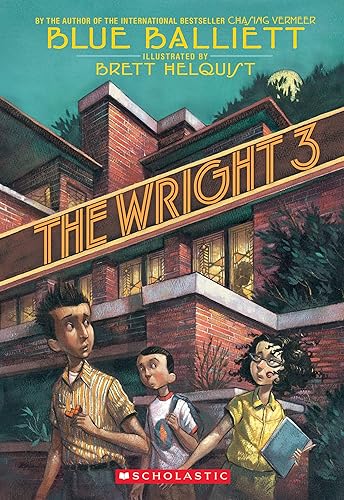
The Wright 3

The Wright 3

book

2007, Children's Books, Literature & Fiction

WISE
84%

WISE Score

4.7

Amazon

Frank Lloyd Wright meets kid detectives with pentomino puzzles and coded messages—smart mystery that makes architecture genuinely cool.

Amazon4.7
Common Sense Media

Where to Read

Our reviews and ratings are 100% unbiased, but as an Amazon Associate, Screenwise earns an affiliate fee if you buy a book or game by clicking one of our links. We don't get any credit if you just Google it instead :)

Screenwise Verdict

This is the smart kid mystery that doesn't talk down to its audience. Blue Balliett weaves Frank Lloyd Wright's actual Robie House into a puzzle-filled adventure that makes architecture feel urgent and cool—no small feat.

The pentomino puzzles scattered throughout are a clever touch that invites hands-on engagement (some kids will want to buy their own set). The friend dynamics are realistic: when Tommy returns, the established Petra-Calder duo gets complicated in ways that feel true to middle school.

It's dense enough that reluctant readers might bounce off, but for kids who like their mysteries with layers—coded messages, literary references, historical details—this delivers. The 4.7 Amazon rating and consistent 10+ age recommendations across sources suggest it's found its audience. Not a must-read for every kid, but a strong pick for the right one.
Age Fit

Best for ages 9-13, especially strong readers who like puzzles and mysteries. The architecture and art history context works better for kids who can appreciate that layer, but the mystery plot carries even if they skip the deeper references. Upper elementary through middle school sweet spot.

WISE Breakdown
Wholesome
82

Mystery adventure featuring three friends working together to solve puzzles and save architecture. Models cooperation, intellectual curiosity, and persistence. Some tension from the friend triangle (Petra, Calder, and returning Tommy) adds realistic social dynamics without being mean-spirited. Age-appropriate emotional complexity for the 9-12 range.

Imaginative
88

Blends art history, architecture, coded messages, 3D pentominoes puzzles, literary references (H.G. Wells), and mystery-solving in genuinely creative ways. Frank Lloyd Wright's Robie House becomes a character itself. The pentomino puzzles invite hands-on engagement, and the layered mystery rewards pattern recognition and critical thinking. This is the kind of book that sends kids Googling architecture and trying to decode messages.

Safe
90

Classic middle-grade mystery with 'death, deception, and surprise' mentioned in synopsis but handled age-appropriately. No graphic content, inappropriate themes, or unexpected triggers. The 'dangerous web' is puzzle-solving danger, not violence. Ghostly happenings are atmospheric rather than scary. Very safe for the target age range of 9-13.

Enriching
85

Introduces Frank Lloyd Wright's architecture, art history, mathematical pentominoes, and problem-solving in an engaging context. Builds critical thinking, pattern recognition, and appreciation for historic preservation. The mystery format keeps kids reading while sneaking in genuine learning about architecture and coded messages. Strong Amazon rating (4.7/5) suggests kids actually enjoy it, which matters for enrichment.

Parent Info

Why It Might Be Great

  • Makes architecture, art history, and math puzzles feel like an adventure rather than homework
  • Strong friendship dynamics with realistic tension when a third friend joins the duo
  • Pentomino puzzles woven throughout invite hands-on problem-solving alongside reading
  • Part of the Chasing Vermeer series but works as standalone—good for kids who loved the first or want to jump in fresh
  • Actually respects kids' intelligence with layered clues and sophisticated references

What to Watch For

  • Friend triangle (Petra-Calder-Tommy) creates some social awkwardness that mirrors real middle school dynamics
  • Mystery involves some atmospheric 'ghostly happenings' and accidents—not scary but slightly spooky
  • Kids who struggle with reading may find the coded message elements challenging (though that's part of the fun for strong readers)

Conversation Starters

  • "If you could leave a coded message in a building, what would it say and where would you hide it?"
  • "Have you ever felt like the 'third wheel' when a friend returns to the group? How did you handle it?"
  • "What buildings in our neighborhood do you think are worth saving? Why?"
  • "The book mixes real architecture (Robie House) with fiction—want to look up pictures of the actual building?"

Ask Anything

Get a personalized guide on any topic