

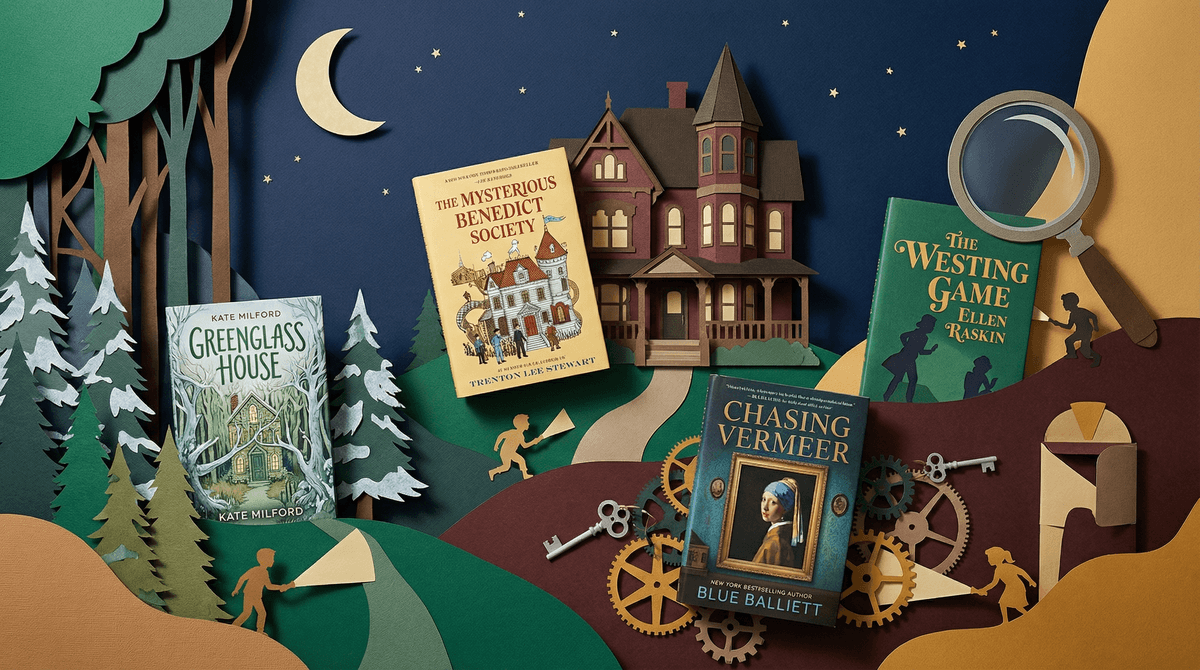
You know that feeling when your kid finishes The Mysterious Benedict Society and immediately asks "what's next?" — and you realize they've just experienced something special? A book that treated them like the smart, capable person they are, with real kids solving problems through observation, logic, and teamwork rather than waving a wand or discovering they're the Chosen One?
These books are genuinely hard to find. Most middle-grade fiction either leans heavily into fantasy/magic or talks down to kids with overly simplistic plots and obvious lessons. But there's a sweet spot of intelligent adventure fiction that respects young readers — books where the protagonists use their brains, the writing doesn't pull punches, and the stakes feel real even without supernatural elements.
Let's find your kid's next favorite series.
The Mysterious Benedict Society works because it trusts kids. The puzzles are actually challenging. The villains have complex motivations. The friendships feel earned, not manufactured. And critically — the kids succeed because they're observant, clever, and work together, not because they have special powers.
This kind of reading does something important: it shows kids that intelligence, creativity, and collaboration are legitimate superpowers. In a media landscape dominated by Marvel movies and fantasy epics, these grounded adventure stories remind readers that regular humans can do extraordinary things.
Plus, let's be honest — parents appreciate these books too. You can actually discuss the plot twists and moral dilemmas without feeling like you're losing brain cells.
The Westing Game by Ellen Raskin
Ages 9-13
This is THE book. A brilliantly constructed mystery where 16 heirs must solve a puzzle to inherit a fortune. Every character has secrets, every clue matters, and the solution is genuinely clever — you can solve it alongside the characters if you're paying attention. The writing is sharp, funny, and treats readers like intellectual equals.
Why it works: Multiple smart kids (and adults) working through an elaborate puzzle. Zero magic. Maximum brain engagement.
From the Mixed-Up Files of Mrs. Basil E. Frankweiler by E.L. Konigsburg
Ages 8-12
Two siblings run away to live in the Metropolitan Museum of Art and get caught up in an art mystery. The protagonist Claudia is particular, organized, and determined to run away with style and dignity — she's a planner who uses her brain to survive in the museum and solve the mystery.
Why it works: Practical problem-solving (how DO you bathe in a museum fountain?), real-world adventure, and a mystery that requires research and deduction.
Chasing Vermeer by Blue Balliett
Ages 9-13
When a priceless Vermeer painting is stolen, two sixth-graders use pentominoes (geometric puzzles) and pattern recognition to solve the mystery. The book itself contains visual puzzles, and the mystery requires actual logical thinking.
Why it works: Art history, mathematics, and detective work. The kids are genuinely smart and the adults don't have all the answers. (There are two sequels: The Wright 3 and The Calder Game.)
Hatchet by Gary Paulsen
Ages 10-14
Survival adventure where 13-year-old Brian must survive alone in the Canadian wilderness after a plane crash. No magic, no convenient rescues — just a kid learning to make fire, find food, and keep himself alive through observation and trial-and-error.
Why it works: Pure problem-solving under pressure. Every small victory (making fire, catching fish) feels earned. The writing is lean and respectful of both the character and reader.
The Phantom Tollbooth by Norton Juster
Ages 9-12
Okay, this one has a magical tollbooth that transports Milo to another world — but hear me out. Once he's there, he solves problems through wordplay, logic, and mathematical thinking. The entire book is a love letter to language, learning, and intellectual curiosity.
Why it works: The "magic" is just the transportation device. Everything else is clever thinking, puns, and conceptual problem-solving. Incredibly smart writing that never dumbs down.
The London Eye Mystery by Siobhan Dowd
Ages 9-13
When Ted's cousin disappears from a sealed pod on the London Eye, Ted (who has an unspecified neurological condition that makes him think differently) uses his unique perspective to solve the mystery. This is detective work, observation, and logical deduction.
Why it works: A neurodivergent protagonist whose different way of thinking is his strength, not something to overcome. Real mystery, real London, real problem-solving.
The Lemonade War by Jacqueline Davies
Ages 8-12
Sibling rivalry becomes a business competition as Evan and Jessie each try to make more money selling lemonade. It's about math, marketing, ethics, and family dynamics — all grounded in reality.
Why it works: Real-world skills (entrepreneurship, math, negotiation) in a story about smart kids competing and ultimately learning about each other. There's a whole series, each tackling different concepts (The Lemonade Crime, The Bell Bandit, etc.).
Holes by Louis Sachar
Ages 10-14
Stanley Yelnats is sent to a juvenile detention camp where boys dig holes in the desert. The mystery of why they're digging unfolds alongside a parallel historical storyline, and everything connects in deeply satisfying ways.
Why it works: Multiple timelines that readers must piece together. Real consequences. Smart plotting that rewards attention. And Stanley survives through persistence and problem-solving, not special abilities.
The Mysterious Benedict Society series by Trenton Lee Stewart
Ages 8-13
Obviously the whole series deserves mention — if they loved the first book, there are three more main books plus a prequel. The quality stays consistent: clever kids, real problem-solving, genuine danger, and writing that respects readers.
Greenglass House by Kate Milford
Ages 9-13
When mysterious guests arrive at Milo's family's inn during winter break, he and a new friend investigate their secrets. It's part mystery, part puzzle-box, with role-playing game elements woven in. There's a tiny bit of magical realism at the edges, but the mystery-solving is all observation and deduction.
Why it works: Atmospheric, complex plotting, and smart kids figuring things out. The role-playing game framework gives Milo confidence to investigate, but the actual detective work is grounded.
These aren't just "books without magic" — they share specific qualities:
Complex plotting: Multiple threads, real mysteries, satisfying solutions that readers can potentially solve themselves
Intelligent protagonists: Kids who observe, deduce, plan, and collaborate. Their smarts are their superpower.
Respect for readers: No talking down, no over-explaining, no dumbing down of vocabulary or concepts
Real stakes: Consequences matter. Problems can't be solved with magic — they require thought, effort, and sometimes failure first.
Strong writing: These are well-crafted books that adults can appreciate too. The prose doesn't condescend.
Most of these land in the 8-13 range, but that's a huge span developmentally. Some guidelines:
Ages 8-10: Start with From the Mixed-Up Files, The Lemonade War, or the first Mysterious Benedict Society book. These have the most accessible prose and clearest plotting.
Ages 10-12: All of these work, but Chasing Vermeer, The London Eye Mystery, and Greenglass House hit especially well for this age.
Ages 12-14: Holes, Hatchet, and The Westing Game have more mature themes and complex plotting that older middle-graders appreciate. These also work well for reluctant readers in early high school.
If your kid loves this style of problem-solving adventure, consider:
- Escape room experiences
 — real-world puzzle-solving with friends
 - Minute Mysteries — short puzzle stories perfect for car rides
- Encyclopedia Brown series — classic short mysteries for younger readers
- The 39 Clues series — more action-oriented but still puzzle-based (though quality varies across the many books)
The Mysterious Benedict Society is special because it proves that middle-grade fiction can be genuinely intelligent without being preachy, adventurous without relying on magic, and engaging without talking down to readers. These recommendations share that DNA.
Your kid doesn't need a lightning bolt scar or a magic ring to have an adventure. Sometimes the best superpower is a curious mind, a good friend, and the determination to figure things out.
Next time you're at the library or bookstore, grab The Westing Game and one other from this list. See which one clicks. And when your kid finishes at midnight with a flashlight under the covers because they had to know how it ended? That's the magic we're really looking for.
Explore more smart middle-grade books or find books for reluctant readers if you need a different angle.