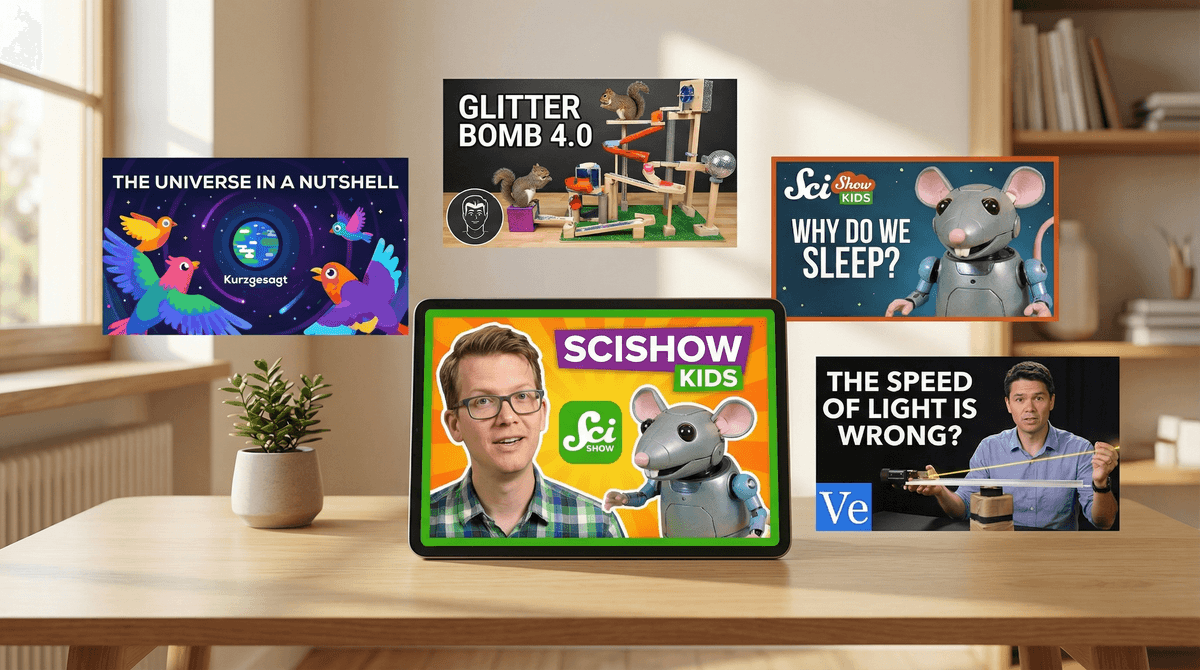
Steve Mould – WISE Score & Parent Review | Screenwise
Steve Mould
YouTube2006Science, Mathematics
85%
WISE Score
3.5M
Subscribers
Oxford physicist turns everyday phenomena into mind-bending visual lessons that make science actually cool.
Steve Mould
YouTube
2006, Science, Mathematics
85%
WISE Score
3.5M
Subscribers
Oxford physicist turns everyday phenomena into mind-bending visual lessons that make science actually cool.
Jump to
Also rated on
3.5M
Screenwise Verdict
Steve Mould is one of the genuinely good corners of YouTube—a trained physicist who makes science accessible without sacrificing accuracy or depth. His videos spark curiosity, model clear thinking, and provide real STEM enrichment in bite-sized chunks.
The production is polished, the tone is warm, and the content is designed for family viewing. Mould's background in children's BBC programming shows: he knows how to engage young viewers without resorting to hyperactive editing or manufactured drama.
The only real caveat is that it's YouTube, which means one click can take your kid from learning about the Turntable Paradox to watching someone eat increasingly spicy wings. But as YouTube channels go, this is top-tier educational content that's actually worth your kid's screen time.
Age Fit
Best for ages 8-99. Younger elementary kids will enjoy the visual experiments even if some explanations go over their heads, while teens and adults will appreciate the depth. This is true all-ages educational content that doesn't talk down to anyone.
WISE Breakdown
Wholesome
92
Warm, enthusiastic science presenter with a background in children's BBC programming (Blue Peter, The One Show). Videos are family-friendly with clear narration, no harsh language, and a gentle sense of humor. Mould's tone is inviting and encouraging rather than condescending or chaotic—perfect for curious kids and whole-family viewing.
Imaginative
88
Focuses on visual phenomena, optical illusions, mechanical paradoxes, and physics demos that spark genuine curiosity. Videos like 'Turntable Paradox' and 'How Does an Ames Room Actually Work?' invite viewers to think differently about everyday physics. The content encourages experimentation and wonder, though it's more about demonstrating existing science than open-ended creative play.
Safe
90
No mature themes, explicit language, violence, or inappropriate content. Mould's pedigree in family BBC programming signals careful content curation. Comments are enabled but the audience skews educational and respectful. The channel promotes books and Patreon but without aggressive monetization tactics. Only minor concern: YouTube's broader ecosystem means kids could easily click away to less-appropriate content.
Enriching
94
Exceptional STEM enrichment. Mould holds an MA in Physics from Oxford and translates complex concepts into 5-10 minute digestible lessons with real-world experiments. Videos build scientific literacy, critical thinking, and genuine understanding of physics and mathematics. The production quality and visual clarity make abstract concepts concrete. This is exactly the kind of educational content that actually teaches rather than just entertains.
Parent Info
✓
Why It Might Be Great
Genuine science education from a credentialed physicist who knows how to explain complex ideas to kids without dumbing them down
Videos are short (5-10 min), visually compelling, and designed to spark 'wait, what?!' moments that lead to deeper curiosity
BBC pedigree means production values are high and content is vetted for family viewing—no clickbait, no manufactured drama
Covers optical illusions, mechanical paradoxes, and physics demos that kids can actually understand and discuss
Perfect for STEM-curious kids who want more substance than typical YouTube science content
⚠
What to Watch For
It's still YouTube—autoplay and recommended videos can quickly lead to less educational (or less appropriate) content
Some concepts may fly over younger kids' heads, though the visuals keep them engaged even when the math gets dense
Comments are enabled, so there's potential for kids to wander into comment sections (though this audience tends to be respectful)
Conversation Starters
"What experiment from Steve's video could we try at home with stuff we already have?"
"Why do you think that optical illusion tricks your brain? What's your brain expecting to see?"
"If you could ask Steve one science question, what would it be?"
"Which of his experiments surprised you the most, and why do you think it works that way?"