

Science vs. the Sigma: Best YouTube Channels for Learning Without Brainrot
Your kid wants YouTube science content that doesn't feel like a slot machine designed by caffeinated squirrels? Here are the channels that deliver actual learning without the sensory assault:
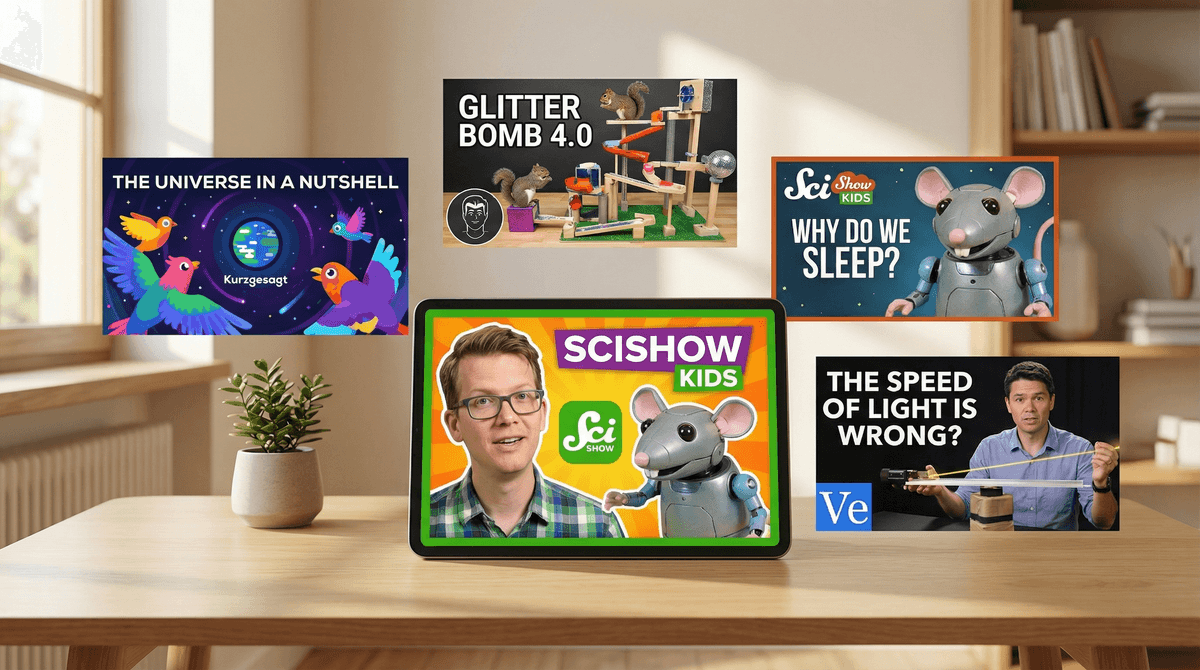
Elementary (Ages 6-10): SciShow Kids, Crash Course Kids, The Brain Scoop
Middle School (Ages 11-14): Kurzgesagt, Mark Rober, Veritasium
High School+ (Ages 14+): NileRed, Physics Girl, Steve Mould
Let's be real: about 42% of kids are watching YouTube solo according to Screenwise data, and that means they're making their own content choices. The algorithm doesn't care if your kid learns about mitochondria or watches someone scream about toilet-themed memes for three hours straight.
The good news? There's a whole universe of science content that's genuinely engaging, well-produced, and doesn't rely on jump cuts every 0.3 seconds to hold attention. These creators prove that real discovery can be more compelling than manufactured chaos.
Before we dive in, let's define terms. Brainrot content typically features:
- Rapid-fire editing that never lets your brain rest
- Clickbait thumbnails with shocked faces and arrows
- Content stretched to hit the 8-minute monetization mark
- Zero educational payoff despite science-adjacent titles
- Comments sections that make you question humanity
Quality science content, on the other hand:
- Respects your intelligence and attention span
- Uses production quality to enhance understanding, not just stimulate
- Actually teaches something you didn't know
- Cites sources and admits uncertainty when appropriate
- Leaves you curious, not just overstimulated
Ages 6-10
Jessi Knudsen Castañeda hosts this gem that treats kids like actual humans capable of understanding complex ideas. Episodes run 3-5 minutes, cover everything from "Why do we have earwax?" to "How do bridges stay up?", and feature Squeaks the robot rat sidekick without being annoying about it.
The pacing is deliberately slower than typical YouTube content, which is exactly the point. Your kid's brain gets to actually process information instead of just receiving dopamine hits. Over 2 million subscribers proves you don't need chaos to keep kids watching.
Ages 8-12
From the same team behind the legendary Crash Course series, this elementary version covers physical science, life science, and earth science with actual curriculum alignment. Host Sabrina Cruz brings genuine enthusiasm without the performative YouTube energy that makes adults want to throw their devices out windows.
Each episode is around 5 minutes and designed to complement what kids learn in school. It's not trying to replace education—it's enhancing it. Revolutionary concept, I know.
Ages 9-12
Emily Graslie, Chief Curiosity Correspondent at the Field Museum in Chicago, takes kids behind the scenes of natural history museums. This is where you see scientists doing actual science—cataloging specimens, preparing exhibits, discussing the ethics of collection.
It's slower-paced, sometimes nerdy in the best way, and shows that science is a process done by real people, not just a series of explosive demonstrations. Some episodes involve preserved specimens and taxidermy, so preview if your kid is squeamish.
Ages 11+
These gorgeously animated explainers tackle big questions: What happens if we detonate all nuclear weapons at once? What is consciousness? Could we terraform Mars? The German team behind Kurzgesagt (it means "in a nutshell") produces about one video per month, and you can tell—the research is meticulous, the animation is stunning, and the pacing actually allows for comprehension.
Fair warning: some topics get existential or discuss death/extinction scenarios. But they handle heavy subjects with appropriate gravity and always include sources in the description. Over 20 million subscribers, and the comments section is shockingly civil and thoughtful.
Ages 10+
Former NASA engineer turned YouTube creator, Rober makes elaborate contraptions to answer questions like "Can you make a dartboard that guarantees a bullseye?" or "How do package thieves operate?" His videos are highly produced and entertaining, but they're also teaching engineering principles, physics, and scientific method.
The production values are high (sometimes TOO high—these aren't videos you'll replicate at home), but the educational content is solid. He also does annual charity fundraisers and occasionally features other science creators, making him a gateway to deeper content.
Ages 12+
Derek Muller has a PhD in physics education research, and it shows. His videos often start with a counterintuitive question or demonstration, then methodically work through the science. "Why is this string hanging like that?" becomes a 20-minute exploration of catenary curves, tension, and calculus.
Some videos get quite technical, making this better for kids who are already interested in STEM. But Muller's presentation style is conversational enough that motivated middle schoolers can follow along. He also regularly updates old videos when new research emerges, modeling scientific integrity.
Ages 14+
Chemistry demonstrations that are genuinely fascinating rather than just "watch this explode!" NileRed synthesizes compounds, extracts substances from unexpected sources (making grape soda from gloves, anyone?), and explains the chemistry throughout.
Videos can run 30+ minutes, and they don't hold your hand. This is real chemistry with real explanations. The comment section is full of chemistry students and professionals discussing techniques. Some experiments involve dangerous chemicals or processes—this is strictly watch-and-learn content, not try-at-home.
Ages 12+
Dianna Cowern makes physics accessible and genuinely cool. She covers everything from acoustic levitation to the physics of figure skating, often collaborating with other science communicators and researchers. Her enthusiasm is infectious without being performative.
The channel has been less active recently due to Cowern's health challenges, but the existing library of 200+ videos is gold. It's also worth noting how the science communication community rallied around her—a good conversation starter about how science is collaborative.
Ages 13+
British science communicator who specializes in making the weird and wonderful aspects of physics and chemistry understandable. His videos on topics like non-Newtonian fluids, strange materials, and optical illusions are both entertaining and genuinely educational.
Mould has a talent for finding everyday phenomena that reveal deeper scientific principles. His presentation style is calm and methodical—the anti-brainrot. Perfect for kids who want to understand why things work, not just see cool demonstrations.
Here's the thing: only 20% of families in the Screenwise community use YouTube Kids, and there's a reason. The curated content is heavily skewed toward very young children, and the algorithm still prioritizes watch time over educational value.
For science content specifically, your middle schooler will find YouTube Kids limiting and frustrating. The channels listed above are all appropriate for their age ranges but aren't available on YouTube Kids because they're on the main platform.
Better approach: supervised access to regular YouTube with specific channel subscriptions. About 38% of families use this model, and it makes sense for science content. Set up a separate account, subscribe to quality channels, and teach your kid to actively choose content rather than follow the algorithm.
Screenwise data shows families average 4.2 hours of screen time daily across all devices. If YouTube is part of that time, you might as well make some of it worthwhile.
But here's the nuance: even quality educational content can become passive consumption if that's all it is. The best science YouTube channels inspire kids to try things, ask questions, or dig deeper—not just rack up watch time.
Don't just let them autoplay. The algorithm will eventually drift toward higher-engagement (read: more stimulating) content. Create playlists of specific channels or have your kid actively choose videos.
Watch together sometimes. Not in a hovering way, but genuine co-viewing. "Oh, you're watching Kurzgesagt? I love their animation style" opens doors for conversation about the content.
Connect to real life. Mark Rober video about squirrels? Build a bird feeder together. NileRed extracting compounds? Visit a science museum. The channels are better when they're springboards, not destinations.
Respect the learning curve. Some of these channels are genuinely challenging. If your 10-year-old doesn't fully grasp Veritasium's video on quantum mechanics, that's fine. Exposure to complex ideas builds comfort with not knowing everything immediately.
Use the sources. Many of these creators link to research papers and additional resources. For high schoolers especially, this models how to learn beyond a single video.
Even with good channels, be aware of:
Collaboration creep: Quality science creators sometimes collab with more entertainment-focused YouTubers. Check the guest appearances.
Algorithm drift: YouTube will suggest "related" content that's often less educational. Teach your kid to recognize when they've wandered into reaction videos or commentary channels.
Comment section rabbit holes: Even good channels have comments that range from insightful to unhinged. Discuss internet literacy around evaluating sources and claims.
Sponsorship content: Most YouTubers have sponsors. Channels like these are typically transparent about it, but it's worth discussing how sponsorships work and why creators need them.
YouTube isn't the only game in town. If you want to diversify:
- Podcasts: Brains On! and Wow in the World offer science content without screens
- Streaming services: Cosmos and Our Planet provide higher production values
- Interactive websites: [Crash Course](https://screenwiseapp.com/media/crash-course-youtube has full curriculum, Khan Academy offers structured learning
Explore more alternatives to standard YouTube content if you want to reduce overall platform time while maintaining educational access.
The difference between brainrot and quality science content isn't about entertainment value—it's about whether the content respects your kid's intelligence and attention. These channels prove you can be engaging without being exploitative, educational without being boring, and popular without pandering.
Your kid is probably going to watch YouTube. The question is whether they're passively consuming whatever the algorithm serves up or actively choosing content that feeds curiosity. These channels make that choice easier.
Start with one or two that match your kid's age and interests. Subscribe. Turn off autoplay. See what happens.
And maybe, just maybe, you'll learn something too. (Kurzgesagt's video on the immune system is genuinely mind-blowing, just saying.)
- Audit current YouTube habits: See how to track what your kid watches on YouTube

- Set up supervised access: Learn about YouTube parental controls
- Create a quality channel list: Subscribe to 3-5 channels from this guide appropriate for your kid's age
- Have the conversation: Talk about what makes content worth watching vs. just stimulating
- Check in regularly: Every few weeks, watch a video together and discuss what they're learning
The algorithm wants engagement. You want education. These channels deliver both. That's not brainrot—that's actually using YouTube the way it was supposed to work.