Four questions, not a list of dangers
Most books about teens and screens are organized around risks: cyberbullying, sexting, porn, the latest app. Walsh organizes hers around the developmental questions every teenager is working on, and fits the risks inside them. Chasing headlines, in the book's own description, only fuels overwhelm and "worry-whack-a-mole." The four parts:
- What am I capable of? The teenage brain is built for discovery, primed for rewards and sensitive to stress.
- Who am I? Separation and connection, independence, online self-expression, love, relationships and sexual identity.
- Where do I belong? Friendship and self-worth.
- How can I contribute? Purpose and voice.
 The table of contents: one part for each question a teenager is working through. Image from the Amazon listing.
Walsh also widens the frame. Neurologically, she notes, adolescence runs from about 10 to 25, which is some comfort to parents who see it arriving early and a reminder that a college kid is still developing.
Limits are a tool, not the whole toolkit
Walsh does not argue against limits. Her point is that a toolkit built only on turning things off, banning and lecturing clashes with what teens are wired to do: experiment, discover and build skills. "Limits are a tool," she told MPR News, "but they can't be the only tool in a tool kit for parenting teens in the digital age." She borrows Lisa Damour's pairing of warmth and structure: boundaries, ideally made together with the teen, plus adults who step toward them with chances to build skills and reflect.
Plant seeds side by side
Her advice on conversations is the most usable part. Do not book an hour of your teen's time. Ask curious questions where they are most likely to talk: in the car, on the bus, late at night when they wake up and you are tired. Ask what advice they would give a sixth grader, which can be easier than talking about themselves. And when the curious question gets stony silence or two words, do not read that as a signal to stop. Warm, open communication with a caring adult is one of the strongest protective factors there is. Keep trying.
 Erin Walsh, co-founder of Spark & Stitch Institute. Photo from sparkandstitchinstitute.com.
A translator, by her own description
Walsh is clear about her role. "I am not a clinician or primary researcher," she writes. She is a writer who spends her working life combing through the research on adolescent development and digital media and putting it in plain language for parents, teachers and teens. She came to it through her father, David Walsh, who founded one of the first nonprofits on media and child development; they wrote the tenth anniversary edition of his bestseller Why Do They Act That Way? together. The book was a 2026 Minnesota Book Awards finalist in general nonfiction.
Emily Weinstein of Harvard's Center for Digital Thriving, co-author of Behind Their Screens, blurbed it:
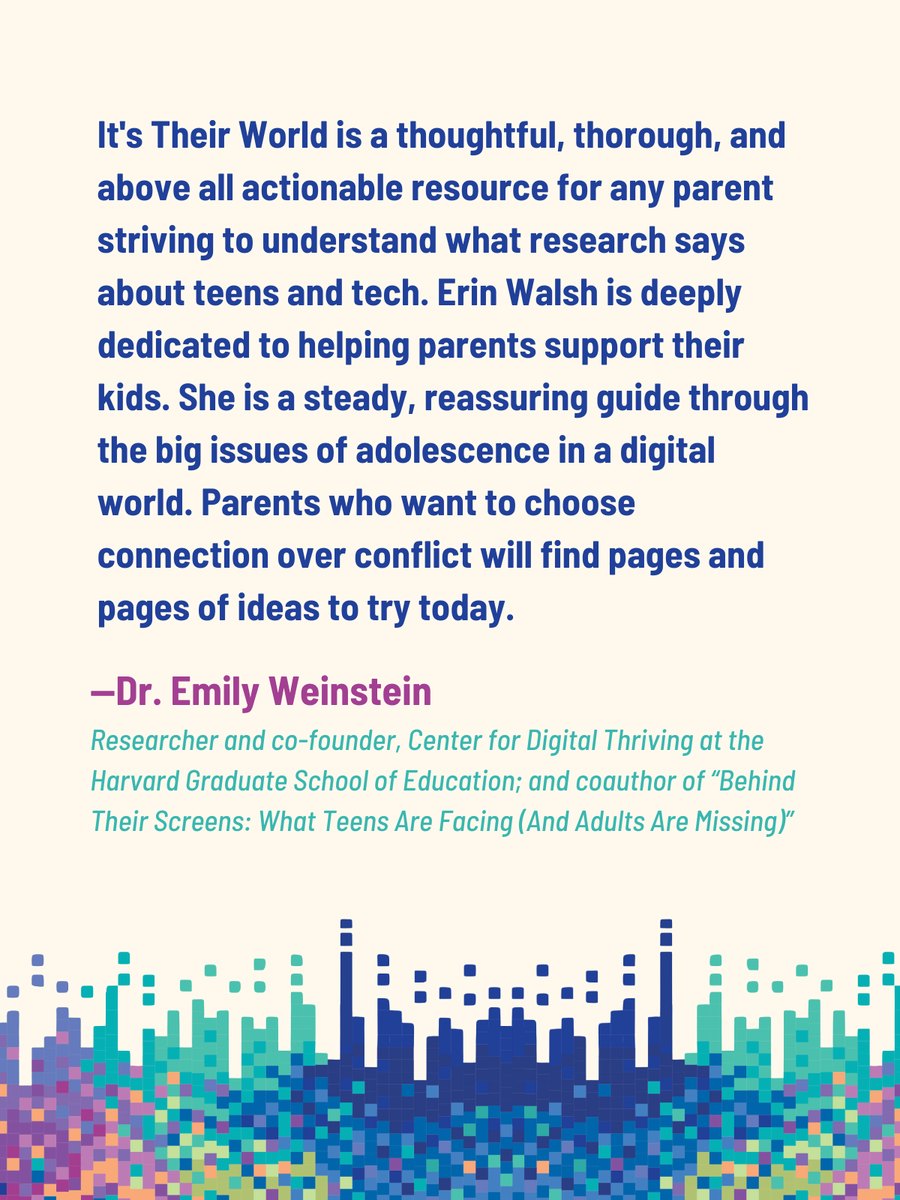 Praise from Emily Weinstein. Image from sparkandstitchinstitute.com.
What it is not
It is not a rulebook. Parents who want firm lines for phones and social media will get more from 10 Rules for Raising Kids in a High-Tech World; this book is better at helping you understand why your teen does what they do online, and how to stay close while they do it.
Watch her explain it
Walsh on why she wrote the book:
Her longer conversation on teens, screens and the science of adolescence for This Is So Awkward:


